
Here’s what you’ll learn when you read this story:
- American currency as we know it today has been in circulation since 1792.
- Founding Fathers, past presidents, and a selection of other notable historical figures appear on the country’s paper bills and coins.
- There are ongoing efforts to add women like Harriet Tubman and Eleanor Roosevelt to U.S. money.
The history of U.S. currency and the many distinguished individuals featured on American paper bills and coins is a long, winding road.
Upon its founding in 1776, the United States had what was known as Continental currency in circulation for many years. Nearly two decades later, in April 1792, the U.S. dollar was created as the official American currency. The fictional Lady Liberty was the main symbol on U.S. coins at the time, but in 1909, Abraham Lincoln became the first U.S. president to appear on American money. Founding Fathers and other deceased presidents, including Thomas Jefferson and Benjamin Franklin, have since joined him.
In recent years, the general public has taken an interest diversifying the people depicted on their money. New designs are being considered for cash and coins to represent a wider breadth of historical symbols and figures who have helped define America.
While Harriet Tubman’s portrait is set to be the new face of the $20 bill (a rollout that’s still several years away), images of Martin Luther King Jr.’s “I Have a Dream” speech, Marian Anderson’s 1939 opera concert at the Lincoln Memorial, and a portrait of Eleanor Roosevelt are planned for the reverse side of the new $5 bill. The Treasury has also announced suffragists Lucretia Mott, Sojourner Truth, Susan B. Anthony, Elizabeth Cady Stanton, and Alice Paul are expected to be featured on the reverse side of the $10 bill. Of all the redesigns, the $10 bill is expected to be the first, but it won’t be ready until 2026 and will take until 2028 to be in circulation.
Beyond these major redesigns, the U.S. Mint regularly releases special edition coins that often promote notable Americans. For example, the January 2025 release of the American Innovation $1 Coin, a series honoring innovation and inventors in each state, features naval engineer Raye Montague. Another series, American Women Quarters, celebrates the achievements of women, including journalist and suffragist Ida B. Wells, Girl Scouts founder Juliette Gordon Low, and tennis player Althea Gibson.
To help you keep track of which famous faces regularly appear on U.S. money, we’ve assembled a rundown of the people and unique features on standard currency, from the penny (it’s not going anywhere just yet) to the $100 bill, as of this year.
Abraham Lincoln on the Penny

To mark the centennial of President Abraham Lincoln’s birth, the Lincoln penny was produced and issued in 1909. Designed by Victor David Brenner, it was the first U.S. coin that featured a portrait and the first to include the motto “In God We Trust.” Two wheat stalks flanked the denomination’s reverse side for decades (leading to this version’s nickname, the wheat penny), along with the words “United States of America” and the Latin phrase E Pluribus Unum, which translates as “Out of many, one.”
Since 2010, the tails side has featured the Union shield. This marks the most recent of the Lincoln penny’s three major redesigns, with earlier overhauls in 1959 and 2009. This May, the U.S. Mint announced plans to stop producing new pennies, though the 1-cent coin will still be in circulation.
Thomas Jefferson on the Nickel

In 1938, artist Felix Schlag won a U.S. Mint competition to redesign the five-cent coin. His entry for the Jefferson Nickel replaced the Buffalo Nickel that same year. From its initial production to today, the nickel continues to be one of the most popular coins in circulation among collectors. The obverse side, or heads side, shows President Thomas Jefferson’s portrait with the inscriptions “In God We Trust” and “Liberty.” The reverse is a portrait of his Monticello plantation, along with the inscriptions E Pluribus Unum and “United States of America.”
Franklin D. Roosevelt on the Dime

In honor of Franklin D. Roosevelt’s death in 1945, the Roosevelt dime was quickly secured and minted the following year. It replaced the Mercury dime, the version of the 10-cent coin that had been in circulation since 1916. Despite the fact that President Roosevelt led the nation through the Great Depression and most of World War II, the Roosevelt dime was actually issued in honor of his personal and philanthropic fight against polio, which led to the founding of the March of Dimes.
Designed by Chief Engraver John R. Sinnock, the Roosevelt dime features the president’s portrait with the word “Liberty” on the left and “In God We Trust” sitting below. The reverse side features a freedom torch surrounded by olive and oak branches, the symbols for peace and victory. As with other U.S. coins, the phrases “United States of America” and E Pluribus Unum appear.
George Washington on the Quarter

The Washington quarter was first minted in 1932 in celebration of President George Washington’s 200th birthday. The bicentennial committee originally wanted a temporary Washington half-dollar issued to honor the first president, but when Congress got involved, half-dollar plans were scrapped. Instead, the Washington quarter permanently replaced the Standing Liberty quarter. Although the committee vied for sculptor Laura Gardin Fraser’s design of Washington’s portrait, then–Treasury Secretary Andrew W. Mellon ultimately got his wish and chose the design of sculptor John Flanagan. Starting in 2022, Fraser’s portrait made it on the quarter at last. The design notably features Washington facing to the right instead of the left as in Flanagan’s version.
For decades, an eagle and an olive branch graced the quarter’s back side, but since 1999, there have been a slew of reverse side designs. This has included images to honor all 50 states as well as various national parks, historic sites, and American territories. Prominent women in history—such as actor Anna May Wong, aviator Bessie Coleman, and singer Celia Cruz—have also appeared. For one year only, in 2021, the quarter’s reverse side depicted a scene of Washington crossing the Delaware.
John F. Kennedy on the Half Dollar

John F. Kennedy became the face of the half dollar in 1964, a year after his assassination. The obverse side of the 50-cent coin features a portrait of Kennedy designed for his presidential medal, while the reverse shows the Presidential Seal. Before JFK, the coin previously portrayed Benjamin Franklin and, from 1916 to 1947, “Walking Liberty.” Although the Kennedy half dollar was mainly produced for annual coin sets starting in the early 21st century, the U.S. Mint began ordering them for circulation again in 2021.
Sacagawea on the $1 Dollar Coin

Designed by Glenna Goodacre, the Sacagawea Golden Dollar shows the Lemhi Shoshone woman carrying her infant son, Jean Baptiste. Thomas D. Rogers Sr. designed the reverse side of the coin, which features a soaring American bald eagle. Although the coin, issued from 2000 to 2008, was minted as a “Golden Dollar,” it doesn’t actually contain any of the precious metal.
Other historical figures have appeared on additional versions of the dollar coin. This includes Susan B. Anthony as well as the first 41 presidents, with the exception Jimmy Carter, as part of the Presidential $1 Coin Program. Dollar coins are no longer in production, but you might still spot them (and use them!) in circulation.
George Washington on the $1 Dollar Bill

It wasn’t until the Federal Reserve Act of 1913 that currency became standardized for the country’s economic stability. By then, much of the design components of the $1 bill were already set in place—its color, borders, and phraseology—as they had long been in use. As one of the oldest U.S. currency designs still in use today, the $1 bill features an image of George Washington (based on Gilbert Stuart’s Athenaeum Portrait) on the obverse, while the reverse shows the Great Seal of the United States. The design dates back to 1963, though Washington first graced the dollar in 1869.
Abraham Lincoln on the $5 Bill

Before Abraham Lincoln’s portrait first debuted on the $5 bill in 1914, seven other men secured a transitory spot on the denomination, including Founding Father Alexander Hamilton, Oncpapa Chief Running Antelope, and President James Garfield. The bill’s current image of Lincoln is based on Anthony Berger’s 1864 portrait of the president. In 1928, the reverse side was redesigned to feature the Lincoln Memorial after previously depicting a vignette of Christopher Columbus sighting land.
In 2008, the $5 bill debuted a high-tech redesign to deter counterfeits. Its front includes the color purple, an imprint of The Great Seal of the United States to the right of Lincoln’s face, and a band of stars. On the back, the bold purple “5” watermark at the bottom right stands most conspicuously, along with a sprinkle of yellow 5s to the top right, among its security features.
Alexander Hamilton on the $10 Bill
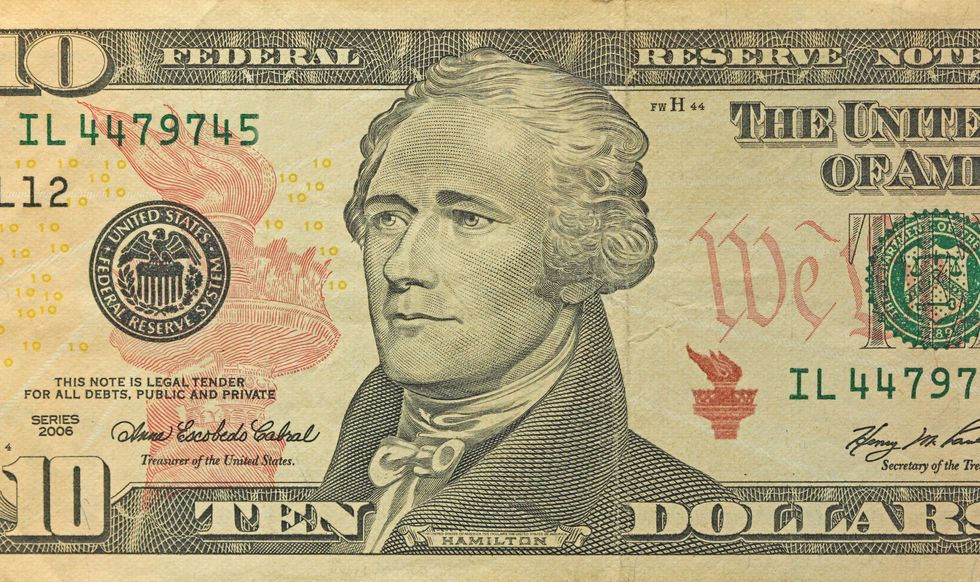
Prior to Alexander Hamilton, a variety of notable figures appeared on the $10 bill, including politician Daniel Webster, explorers Meriwether Lewis and William Clark, and President Andrew Jackson. But starting in 1929, Hamilton became the statesman of choice, and the imprinted portrait you see of him today is based on a 1805 painting by John Trumbull. As the nation’s first Treasury secretary, Hamilton is one of two non-presidents to be featured on U.S. paper currency (the other is Benjamin Franklin).
While Hamilton’s portrait is seen on the front, the reverse shows the U.S. Treasury Building. Although a great deal of new technology, such as watermarks and color-shifting ink, has been added to the $10 bill, the biggest change for this denomination is still to come. In 2015, the Treasury announced a woman would replace Hamilton as the new face of the denomination in 2020. However, due to security concerns, the redesign has been delayed until 2026.
Andrew Jackson on the $20 Bill

As a man who wanted to abolish paper money, President Andrew Jackson would’ve found it quite ironic that his face sits on the $20 bill. While he is seen on the denomination’s front side, adorned with watermarks and green and peach hues, the White House is imprinted on the backside.
In 2016, it was announced that abolitionist Harriet Tubman would replace Jackson as the new face of the $20 bill starting in 2020, but two years later, then–Treasury Secretary Steve Mnuchin announced the decision would be halted until 2028 for security reasons. President Joe Biden’s administration said it was “exploring ways to speed up” the release of the Tubman $20 in January 2021, but the change isn’t scheduled to take effect until 2030.
Ulysses S. Grant on the $50 Bill

Since 1913, Civil War hero and the 18th U.S. President Ulysses S. Grant has been the face of the $50. While many people wonder why Grant was chosen to be on this particular bill, no one really knows the answer. The reverse side of Grant’s portrait features the U.S. Capitol, though the earliest iterations included images of Panama, a merchant, and a battleship. Blue and red colors were added on both sides of the bill beginning in 2004, and micro-printed words such as “Fifty” and “USA” surround Grant’s face, along with a watermark of the American flag to his right.
Benjamin Franklin on the $100 Bill

Benjamin Franklin had many titles—Founding Father, inventor, diplomat—but U.S. president wasn’t one of them. Still, Franklin began gracing one of the most desirable of denominations, the $100 bill, starting in 1914. A massive redesign in 2013 features Franklin slightly to the left of a quill pen, inkwell, and the Declaration of Independence, along with holographic watermarks and black light technology. The reverse side presents an image of Independence Hall in Philadelphia, the first building outside of Washington D.C. to be seen on any American money.
Catherine Caruso joined the Biography.com staff in August 2024, having previously worked as a freelance journalist for several years. She is a graduate of Syracuse University, where she studied English literature. When she’s not working on a new story, you can find her reading, hitting the gym, or watching too much TV.


