(1950-)
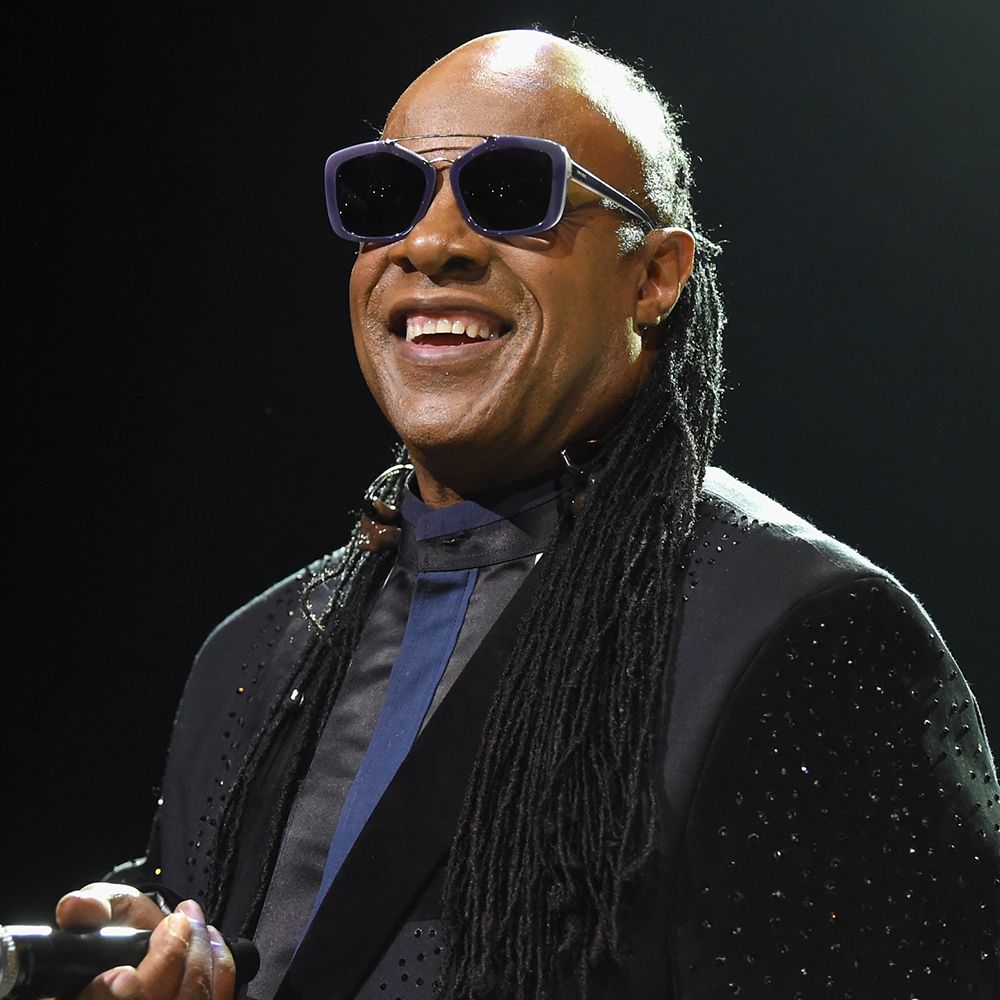
Who Is Stevie Wonder?
Stevie Wonder made his recording debut at age 11, becoming a 1960s force to be reckoned with via chart hits like "Fingertips, Pt. 2," "I Was Made to Love Her" and "My Cherie Amour." Over the next decade, Wonder had an array of No. 1 songs on the pop and R&B charts, including "Superstition," "You Are the Sunshine of My Life" and "Higher Ground." He continued to churn out hits into the 1980s, including "I Just Called to Say I Love You" and "Part-Time Lover."
Early Life
Wonder was born Stevland Hardaway Judkins on May 13, 1950, in Saginaw, Michigan. He was born six weeks early with retinopathy of prematurity, an eye disorder which was exacerbated when he received too much oxygen in an incubator, leading to blindness.
Wonder showed an early gift for music, first with a church choir in Detroit, Michigan, where he and his family had moved to when he was four years old, and later with a range of instruments, including the harmonica, piano and drums, all of which he taught himself before age 10.
READ MORE: How Stevie Wonder Lost His Sight
Motown Discovery
Wonder was just 11 years old when he was discovered by Ronnie White of the Motown band The Miracles. An audition followed with Motown founder Berry Gordy Jr., who didn't hesitate to sign the young musician to a record deal.
In 1962, the newly renamed Little Stevie Wonder, working with Motown songwriter Clarence Paul, among others, released his debut The Jazz Soul of Little Stevie Wonder, an instrumental album that showed off the youngster's remarkable musicianship.
The same year he also released Tribute to Uncle Ray, where Wonder covered the songs of soul icon Ray Charles. Wonder then developed a major audience with Little Stevie Wonder the 12 Year Old Genius, an album recorded live.
The set's edited single "Fingertips, Pt. 2" became Wonder's first No. 1 song, reaching the top of both the R&B and pop charts.
Songs and Albums
"Uptight (Everything's Alright)"
Rather than rest on his laurels, the hard-working Wonder, who would go on to study classical piano, pushed to improve his musicianship and songwriting capabilities.
After dropping "Little" from his stage name in the mid-1960s, he churned out the top 5 pop single "Uptight (Everything's Alright)," which reached No. 1 on the R&B charts.
'For Once In My Life
Wonder scored two more No. 1 R&B hits with a cover of Bob Dylan's "Blowin' in the Wind" and the jubilant "I Was Made to Love Her," with the latter reaching No. 2 on the pop charts.
The 1968 album For Once in My Life offered even more successful singles with the title track, "Shoo-Be-Doo-Be-Doo-Da-Day" and "You Met Your Match," with Wonder serving as co-writer on all three songs.
'Signed Sealed Delivered'
The following year saw the release of My Cherie Amour, with the romantic top 5 pop/R&B title ballad as well as the top 5 R&B "Yester-Me, Yester-You, Yesterday." Wonder would remain a consistent hitmaker over the next two decades, with the artist co-producing 1970's Signed, Sealed, Delivered; the album featured the No. 1 R&B title track and a top 5 R&B cover of the Beatles' "We Can Work It Out."
The '70s: An Acclaimed Decade
Due in part to innate talent, but also because of his deep commitment to his craft, Wonder faced the difficulty of staying relevant as a musician as he grew from boy to man, and his voice matured into a shining tenor.
In 1971, Wonder negotiated a new contract with Motown that gave him almost total control over his records and greatly increased his royalty rate. It was an unprecedented concession by Gordy, but, artistically, just what Wonder needed.
As the 1970s unfolded, the musician went through an unrivaled period of production. 1971's Where I'm Coming From, with its groovy top 10 single "If You Really Love Me," marked the first time Wonder had writing or co-writing credits for every song on an album.
1972's Music of My Mind offered the top 20 R&B/top 40 pop single "Superwoman (Where Were You When I Needed You)," an emotionally rich jazz-soul opus that highlighted Wonder's pioneering work in synthesized/electronic sounds.
"Superstition" and "You Are the Sunshine of My Life"
His 1972 album Talking Book offered two No. 1 hits, the jaunty funk jam "Superstition" and "You Are the Sunshine of My Life," a smile-inducing ode to love that exemplified Wonder's abilities as a romanticist.
'Innervisions'
Next up was Innervisions, a meditative concept album that was simultaneously introspective, political, critical and full of wit. The record featured two socially conscious No. 1 R&B hits, "Higher Ground" and "Living for the City," as well as the humorous "Don't You Worry 'Bout a Thing," which reached No. 2 on the R&B chart. All three singles fared well on the pop charts as well.
'Fulfillingness' First Finale'
Fulfillingness' First Finale, released after Wonder had survived a serious car accident that left him in a coma, displayed his trademark odes to romance and beauty while also looking squarely at spirituality and death. Wonder created a song that railed against President Richard Nixon—"You Haven't Done Nothin'," which reached No. 1 on both the pop and R&B charts and featured The Jackson 5.
The sexy "Boogie on Reggae Woman" went to No. 1 on the pop chart as well, while the album tracks "Creepin'" and "They Won't Go When I Go" were eventually covered by Luther Vandross and George Michael, respectively.
'Songs in the Key of Life'
Even with this array of accomplishments, it was the double album with EP set Songs in the Key of Life that many have hailed as Wonder's most legendary project and one of the greatest records of all time. Offering a rich span of songs with genre fusions aplenty, Songs covered everything from ethnic diversity in the U.S. and fantastic utopian communities to vengeful relationships and transcendent love.
Songs had two pop/R&B No. 1 singles, both uptempo: the Duke Ellington tribute "Sir Duke" and the back-in-the-day paean "I Wish." Wonder had additional top 40 hits with "Another Star" and "As," while the harmonica-laden "Isn't She Lovely," though not a charting single, nonetheless became a radio mainstay as it heralded the cherished birth of a daughter.
During this era, Wonder was working with other artists as well, including Minnie Riperton (the mother of Maya Rudolph) and the band Rufus, with Chaka Khan's vocals heard on the Wonder-penned top 5 track "Tell Me Something Good."
Over the years, other artists struck gold with Wonder remakes, as seen with Aretha Franklin's No. 1 R&B cover of "Until You Come Back to Me (That's What I'm Gonna Do)." Among an array of honors, Wonder captured 15 Grammy Awards during the decade, with Innervisions, Fulfillingness' First Finale and Songs in the Key of Life each recognized as album of the year.
'Journey Through the Secret Life of Plants'
By those incredible lofty standards, the 1980s weren't nearly as successful for Wonder. Still, he continued to be a huge musical force. He ended the '70s with the double album Journey Through the Secret Life of Plants, an avant-garde set for an unreleased botanical documentary, featuring the top 5 pop/R&B ballad "Send One Your Love."
'Hotter Than July'
1980's Hotter Than July was a more succinct, commercial affair with the disco track "All I Do" as well as the No. 1 R&B hit "Master Blaster (Jammin')," a reggae-influenced tribute to Bob Marley, and the top 5 R&B, country-influenced number "I Ain't Gonna Stand for It."
"Ebony and Ivory"
In 1982, Wonder teamed up with ex-Beatle Paul McCartney for the No. 1 U.S./U.K. single "Ebony and Ivory," a song promoting racial harmony that was featured on the McCartney album Tug of War.
'Original Musiquarium I'
That same year, Wonder also released his greatest hits compilation Original Musiquarium I, which featured the No. 1 R&B/top 5 pop single "That Girl," as well as additional hits "Ribbon in the Sky" and "Do I Do," featuring Dizzy Gillespie.
"I Just Called to Say I Love You
In 1984, Wonder released the soundtrack for the Gene Wilder film The Woman in Red, which featured contributions from Dionne Warwick as well as the top 5 R&B hit "Love Light in Flight" and the massive No. 1 pop single "I Just Called to Say I Love You." Like so much of Wonder's work, the song appealed to a wide audience, paving the way for it to become Motown's biggest international hit of all time. The single also won Wonder an Academy Award for best original song.
"Part-Time Lover"
Wonder released his next album, In Square Circle, in 1985, which featured the historic track "Part-Time Lover," the first song to ever reach No. 1 on the pop, R&B, adult contemporary and dance charts.
'Characters'
The album Characters was released two years later, featuring two No. 1 R&B hits—"Skeletons" and "You Will Know." In 1989, Wonder was inducted into the Rock and Roll Hall of Fame.
'Jungle Fever'
Wonder continued his soundtrack contributions with his work for the 1991 Spike Lee film Jungle Fever, starring Wesley Snipes and Annabella Sciorra. For the Jungle Fever album, Wonder composed three more top 10 R&B singles: "Gotta Have You," "Fun Day" and "These Three Words."
'Conversation Peace'
A few years later, Wonder released Conversation Peace; its first single, the easygoing "For Your Love," reached the top 20 R&B and earned two Grammys in 1996, the same year he received the Grammy Lifetime Achievement Award.
Advocacy Work
In addition to his acclaimed artistry, Wonder has routinely tackled social issues through his music and appearances.
He successfully spearhead a movement to create a national holiday recognizing the birthday of Dr. Martin Luther King Jr., a celebration he sang about in the track "Happy Birthday" from Hotter Than July. ("Happy Birthday" became a major U.K. hit as well, reaching No. 2.)
Wonder had dedicated his Oscar win to anti-apartheid activist/future president Nelson Mandela and had performed on the No. 1 charity singles "We Are the World," to raise money for famine relief in Africa, and "That's What Friends Are For," with Warwick, Elton John and Gladys Knight, benefiting the American Foundation for AIDS Research (amfAR).
Wonder has also been a longtime advocate for improving services for the blind and those with disabilities. In connection with the International Day of Persons With Disabilities, he was named a United Nations Messenger of Peace in 2009.
In June 2013, Wonder continued his advocacy work when he announced he would make good on a promise to perform a concert in Marrakech for negotiators from the World Intellectual Property Organization when they agreed on an international treaty providing blind and visually impaired individuals around the world with more access to books.
Honors
Following a 10-year hiatus, Wonder released the well-received A Time to Love in 2005, with guest appearances from India.Arie, Doug E. Fresh, McCartney, Bonnie Raitt and Prince, among others. Wonder also put out the concert DVD Live At Last: A Wonder's Summer Night in 2009.
In 2014, Wonder received the Presidential Medal of Freedom from President Barack Obama. The following year, the singer/songwriter/musician was paid tribute by a pantheon of performers on the telecast Stevie Wonder: Songs in the Key of Life—An All-Star Grammy Salute, recognizing his classic 1976 album.
Later Music
Wonder occasionally surfaced with new music as he progressed through his late 60s, recording the Golden Globe-nominated single "Faith" with Ariana Grande in 2016, as well as the song "Future Sunny Days," specifically written for the 2018 finale of the hit series Scandal.
Personal Life
Wonder married fellow Motown singer/songwriter Syreeta Wright in 1970, divorcing two years later. A skilled lyricist, she worked with Wonder on hits like "Signed, Sealed, Delivered I'm Yours" and "If You Really Love Me," while he worked with Wright on her albums Syreeta (1972) and Stevie Wonder Presents Syreeta (1974). Wright died of cancer in 2004.
Wonder had his first child, Aisha, with Yolanda Simmons in 1975. His daughter was the inspiration for "Isn't She Lovely." The couple had a son, Keita, who was born in 1977. In 1983, he had a son, Mumtaz, with Melody McCulley. Wonder had a daughter, Sophia, and son, Kwame, with a woman whose name has not been publicized.
Wonder married Karen Millard Morris in 2001. The couple had two sons, Kailand and Mandla, before their divorce was finalized in 2015. Meanwhile, Wonder began a relationship with Tomeeka Robyn Bracy; the couple had two children, before tying the knot in 2017.
Quick Facts
FULL NAME: Stevland Hardaway Morris
BIRTHPLACE: May 13, 1950
BORN: Saginaw, MI
ASTROLOGICAL SIGN: Taurus
Fact Check
We strive for accuracy and fairness. If you see something that doesn't look right, contact us!
QUOTES
- Just because a man lacks the use of his eyes doesn't mean he lacks vision.
- Time is long but life is short.
- I never thought of being blind as a disadvantage, and I never thought of being Black as a disadvantage. I am what I am. I love me!
- I want to live so I can carry out the essence of what my mother has shown me: kindness and goodness.
- I always just want to do better. I have to love and share like there's no tomorrow.
- I'm a work in progress, but if I know in my heart that I'm doing my best, that my heart's in the right place, that I have unconditional love, I feel okay.
- We've had all sorts of time to talk about war, but when will there be a time to love? It's now.
- I've flown a plane before. A Cessna or something, from Chicago to New York. Scared the hell out of everybody.
- When people ask me what is my most favorite song, I quote Duke Ellington and say I haven't written it yet.
- One thing we have a great need to have time for is a time for love.
- Music, at its essence, is what gives us memories. And the longer a song has existed in our lives, the more memories we have of it.
- Minds ripen at very different ages.
- Clearly, love is love, between a man and a woman, a woman and a man, a woman and a woman and a man and a man.
- Ya gots to work with what you gots to work with.
- What I'm not confused about is the world needing much more love, no hate, no prejudice, no bigotry and more unity, peace and understanding. Period.
The Biography.com staff is a team of people-obsessed and news-hungry editors with decades of collective experience. We have worked as daily newspaper reporters, major national magazine editors, and as editors-in-chief of regional media publications. Among our ranks are book authors and award-winning journalists. Our staff also works with freelance writers, researchers, and other contributors to produce the smart, compelling profiles and articles you see on our site. To meet the team, visit our About Us page: https://www.biography.com/about/a43602329/about-us