11 Famous Black Inventors Who Changed Your Life
From Madam C.J. Walker’s hair care products to Mark Dean’s computer innovations, these Black inventors' creations continue to impact everyday life.

There’s a rich history of Black inventors in the United States that likely begins before our current historical record—but there’s plenty of noteworthy individuals we know of who changed the world with their creations, dating back to the nineteenth century.
In 1821, Thomas L. Jennings became the first Black inventor to be granted a U.S. patent for his revolutionary method of cleaning clothes, which pioneered the modern dry cleaning industry. His success opened the door for many other African American inventors to similarly make their marks on the world.
Since then, innovators like Madam C.J. Walker, Frederick McKinley Jones, and Patricia Bath have transformed nearly every industry with their ingenious products, machinery, and technology.
Read on to learn about how these famous Black inventors significantly improved everyday life with their invaluable contributions.
Thomas L. Jennings

1791–1859
The first African American U.S. patent recipient, Thomas L. Jennings was working as a tailor and businessman in New York City when he invented a process for dry-cleaning delicate clothing known as “dry-scouring.” Jennings applied for a patent in 1820 and received his history-making approval the following year. With the money he earned from his invention, the formerly enslaved inventor donated to abolitionist causes and even reportedly freed his still-enslaved family members.
Elijah McCoy

1844-1929
Of the 57 patents Elijah McCoy—reportedly the namesake for the complimentary phrase “the real McCoy”—received over his lifetime, the portable ironing board might be one of the most timeless. As the story goes, having to iron on uneven surfaces frustrated his wife, Mary Eleanor Delaney, and so he created the ironing board to make her life a little easier. McCoy received the patent for this particular creation in May 1874. He is also the man behind another major invention beloved by homeowners: the lawn sprinkler.
Sarah Boone

1832-1904
Dressmaker Sarah Boone made a substantial design improvement to McCoy’s ironing board, adding a padded surface and smaller rounded end. Boone wrote in her patent application that the purpose of her invention was “to produce a cheap, simple, convenient, and highly effective device, particularly adapted to be used in ironing the sleeves and bodies of ladies’ garments.” In 1892, she became one of the first African American women to be awarded a patent.
Alexander Miles

1838-1918
Anyone who’s ridden modern elevators has Alexander Miles to thank for the stair alternative’s automatic doors. Prior to his design’s 1867 patent, riders had to manually open and close two sets of doors when entering and exiting elevator cars. If a passenger happened to forget to close one of the doors, subsequent elevator riders risked a potentially fatal fall down the elevator shaft. Because, as the adage goes, necessity is the mother of invention, Miles created a mechanism that forced both elevator doors to close simultaneously, thus preventing dangerous accidents.
Madam C.J. Walker

1867-1919
Philanthropist and entrepreneur Madam C.J. Walker was born to formerly enslaved sharecroppers and orphaned at just 7 years old. After later suffering hair loss from a scalp condition, Walker invented an innovative line of Black hair care products in 1905 that led to her distinction as one of America’s first self-made millionaires. Her highly successful cosmetics brand is still around today.
Read More about Madam C.J. Walker
Related: How Madam C.J. Walker Invented Her Hair Care Products
Garrett Morgan

1877-1963
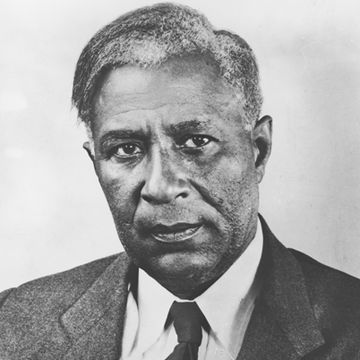
Garrett Morgan was a prolific Black inventor whose early patent for an improved sewing machine design provided financial security for him and his family. But the Kentucky native was also concerned about the welfare of others. His “safety hood,” patented in 1914, was a breathing device that filtered out harmful elements and became the prototype for the World War I–era gas mask. He also created a more sophisticated traffic signal by adding a warning light, similar to what we use on streets today.
Frederick McKinley Jones

1893-1961
Before Frederick McKinley Jones developed the automatic refrigeration equipment used in long-haul trucks that transport perishables in the late 1940s, the only way to keep food cold en route to delivery destinations was by using ice. Thanks to his invention, grocery stores were able to buy and sell products—many of which you probably purchase regularly—from far distances without the risk of them spoiling during transport. Jones’ technology was also used to transport blood during World War II.
Alice H. Parker

1895-1920
The central heating furnace design that Alice H. Parker patented in December 1919 made use of natural gas for the first time to keep homes warm and toasty. Inspiring her innovation: the limited efficiency of fireplaces, along with the smoke and ash they produce, during the cold winters at her house in Morristown, New Jersey. Most modern homes still employ a similar forced air heating system for which her idea was a precursor.
Marie van Brittan Brown

1922-1999
New York City native Marie Van Brittan Brown created an early version of the modern home security system. Feeling unsafe due to her neighborhood’s high crime rate, the full-time nurse rigged a motorized camera to record her home entryway and project images onto a TV monitor. Also included in her setup was a two-way microphone in order to communicate with visitors without opening the door, as well as a panic button to notify police of any potential emergency in progress. After filing to patent the closed circuit TV security system in 1966, Brown received her approval in December 1969.
Patricia Bath

1942-2019
A true visionary, Patricia Bath became the first Black female doctor to receive a medical patent when she invented a laser cataract treatment device called a Laserphaco Probe in 1986. It was one of several firsts the ophthalmologist achieved. The co-founder of the American Institute for the Prevention of Blindness patented her invention in 1988. Now used around the world, Bath’s device has improved sight for millions of people.
Related: These Black Doctors and Nurses Broke New Ground in Health Care
Mark Dean

1957-present
We have Mark Dean to thank for several computer innovations that we might take for granted today. The color PC monitor, which you might be using right now, is just one of them. With more than 20 patents to his name, Dean also led the IBM team that created the first gigahertz chip—a groundbreaking innovation that can handle a billion calculations per second—and co-created a system to allow peripheral devices like monitors and printers to plug directly into computers.
Adrienne directs the daily news operation and content production for Biography.com. She joined the staff in October 2022 and most recently worked as an editor for Popular Mechanics, Runner’s World, and Bicycling. Adrienne has served as editor-in-chief of two regional print magazines, and her work has won several awards, including the Best Explanatory Journalism award from the Alliance of Area Business Publishers. Her current working theory is that people are the point of life, and she’s fascinated by everyone who (and every system that) creates our societal norms. When she’s not behind the news desk, find her hiking, working on her latest cocktail project, or eating mint chocolate chip ice cream.
Catherine Caruso joined the Biography.com staff in August 2024, having previously worked as a freelance journalist for several years. She is a graduate of Syracuse University, where she studied English literature. When she’s not working on a new story, you can find her reading, hitting the gym, or watching too much TV.

How Madam C.J. Walker Invented Her Hair Products
George Washington Carver
Garrett Morgan

Madam C.J. Walker