c. 6-4 BCE–30 CE
Who Was Jesus Christ?
Jesus, or Jesus Christ, was a 1st century preacher and religious leader who is revered in Christianity. According to Christians, Jesus is considered the incarnation of God, and his teachings are followed as an example for living a more spiritual life. Christians believe he died for the sins of all people and rose from the dead. Little is known about his early years, but his life and ministry are recorded in the New Testament of the Bible. Beyond this theological document, ancient texts from Jewish and Roman scholars also make mention of the preacher. Various events in Jesus’ life are commemorated in Christian holidays. Christmas celebrates his birthday, Good Friday marks his crucifixion, and Easter honors his resurrection.
Quick Facts
FULL NAME: Jesus
BORN: circa 6-4 BCE
DIED: 30 CE
BIRTHPLACE: Bethlehem (modern-day Palestine)
Where and When Was Jesus Born?
Scholars believe Jesus was born between 6 and 4 BCE in the town of Bethlehem, located in the modern-day West Bank. The Middle Eastern territory is located in what is now Palestine, though Israel has occupied the area since 1967. His exact birth date is unknown, but Christians celebrate Jesus’ birthday on December 25, the Christmas holiday. (Orthodox Christmas is observed on January 7 due to a 13-day difference in the ancient Julian calendar Eastern Orthodox churches follow and the more widely accepted Gregorian calendar.)
According to the Bible, Jesus’ mother, Mary, was a virgin who was betrothed to a carpenter named Joseph. Christians believe Jesus was conceived by the power of the Holy Spirit, the unbodied spirit of God. The Christian doctrine of the Trinity explains that there is one God divided into three parts: the Father, Son, and Holy Spirit. Jesus is considered the son and physical embodiment of God.
The Gospel of Matthew claims that Jesus was born during the reign of Herod the Great, who upon hearing of his birth felt threatened and tried to kill Jesus by ordering the execution of all of Bethlehem’s male children under age 2. An angel warned Joseph, according to Scripture, and he took Mary and the child to Egypt until Herod’s death. Joseph then brought the family back, and they settled in the town of Nazareth, in Galilee, located in northern Israel. Jesus’ relation to the historic town is why he is also referred to as Jesus of Nazareth. He is also known by other names, including his Hebrew name, Yeshua.
Early Life
Most of Jesus’ life is told through the four Gospels of the Bible’s New Testament, known as the Canonical Gospels, written by Matthew, Mark, Luke, and John. These are not biographies in the modern sense but accounts with allegorical intent. They are written to engender faith in Jesus as the Messiah and the incarnation of God who came to teach, suffer, and die for people’s sins.
There is very little written about Jesus’ early life. The Gospel of Luke (2:41-52) recounts that a 12-year-old Jesus had accompanied his parents on a pilgrimage to Jerusalem, a city in between the Dead Sea and the Mediterranean, and became separated. He was found several days later discussing affairs with some of Jerusalem’s elders in a temple.
Throughout the New Testament, there are trace references of Jesus working as a carpenter as a young adult. It is believed that he began his ministry as a Jewish preacher at age 30 when he was baptized by John the Baptist, who upon seeing Jesus declared him the Son of God.
After his baptism, Jesus went into the Judean Desert to fast and meditate for 40 days and nights. This period encompassed the Temptation of Christ, as chronicled in the Gospels of Matthew, Mark, and Luke (known as the Synoptic Gospels). The Devil appeared and tempted Jesus three times: once to turn stone to bread, once to cast himself off a mountain where angels would save him, and once to offer him all the kingdoms of the world. All three times, Jesus rejected the Devil’s temptation and sent him off.
Jesus’ Ministry
Jesus returned to Galilee and made trips to neighboring villages. During this time, several people became his disciples. One of these was Mary Magdalene, who is first mentioned the Gospel of Luke (8:1–3) and later in all four Gospels at the crucifixion. Although she isn’t mentioned in the context of the 12 apostles, she is considered to have been involved in Jesus’ ministry from the beginning to his death and after.
When Jesus was beginning his ministry, as told in the Gospel of John (2:1-11), he and his disciples traveled with his mother, Mary, to a wedding at Cana in Galilee. The wedding host had run out of wine and Mary came to him for help. At first, Jesus refused to intervene, but then he relented and asked a servant to bring him large jars filled with water. He turned the water into a wine of higher quality than any served during the wedding. The event is depicted as the first sign of Jesus’ glory and his disciples’ belief in him.
After the wedding, Jesus, Mary, and his disciples traveled to Jerusalem for the Jewish holiday of Passover. At the temple, they saw money changers and merchants selling goods. In a rare display of anger, Jesus overturned the tables and, with a whip made of cords, drove them out, declaring that his Father’s house isn’t a house for merchants.
The Synoptic Gospels chronicle Jesus as he traveled through Judea and Galilee. Along the way, he used parables and miracles to explain how the prophecies were being fulfilled and that the kingdom of God was near. As word spread of Jesus’ teaching and healing the sick and diseased, more people began to follow him. At one point, Jesus came to a level area and was joined by a great number of people. There, at the Sermon on the Mount, he presented several discourses, known as the Beatitudes, which encapsulate many of the spiritual teachings of love, humility, and compassion.
As Jesus continued preaching about the kingdom of God, the crowds grew larger, and they began to proclaim him as the Messiah, or savior, and Son of David. The latter is a Messianic title that refers to Jesus as the anointed one: a descendant of King David prophesied to free the Israelites. Experts on Jewish law and tradition, who were known as the Pharisees, heard of this and publicly challenged Jesus, accusing him of having the power of Satan. He defended his actions with a parable, then questioned their logic and told them such thinking denied the power of God, which only further hardened their resolve to work against him.
Near the ancient city of Caesarea Philippi, now known as Banias, Jesus talked with his disciples. According to the Gospel of Matthew (16:13), he asked, “Who do you say that I am?” The question confused them, and only Peter responded, saying, “You are the Christ, the Son of the living God.” Jesus blessed Peter, accepting the titles of the “Son of God” and “Christ,” which means Messiah, and declared the proclamation a divine revelation from God. Jesus then proclaimed Peter to be the leader of the church. Jesus also warned his disciples of the Pharisees’ conspiracy against him and of his fate to suffer and be killed only to rise from the dead on the third day.
Less than a week later, Jesus took three of his disciples to a high mountain where they could pray alone. According to the Synoptic Gospels, Jesus’ face began shining like the sun and his entire body glowed with a white light. Then, the prophets Elijah and Moses appeared, and Jesus talked to them. A bright cloud emerged around them, and a voice said, “This is my beloved Son, with whom I am well pleased; listen to him.” This event, known as the Transfiguration, is a pivotal moment in Christian theology. It supports the identity of Jesus as the Christ, the Son of the living God.
Jesus arrived in Jerusalem, the week before Passover, riding on a donkey. Great numbers of people took palm branches and greeted him at the city’s entry. They praised him as the Son of David and as the Son of God. The priests and Pharisees, fearful of the growing public adulation, felt he must be stopped.
All four Gospels describe Jesus’ final week in Jerusalem. During this time, Jesus raised Lazarus from the dead, confronted money changers and merchants in the temple, and debated with the high priests who questioned his authority. He told his disciples about the coming days and that Jerusalem’s temple would be destroyed. Meanwhile, the chief priests and elders met with high priest Caiaphas and set plans in motion to arrest Jesus. One of the disciples, Judas, met with the chief priests and told them how he would deliver Jesus to them. They agreed to pay him 30 pieces of silver.
The Last Supper
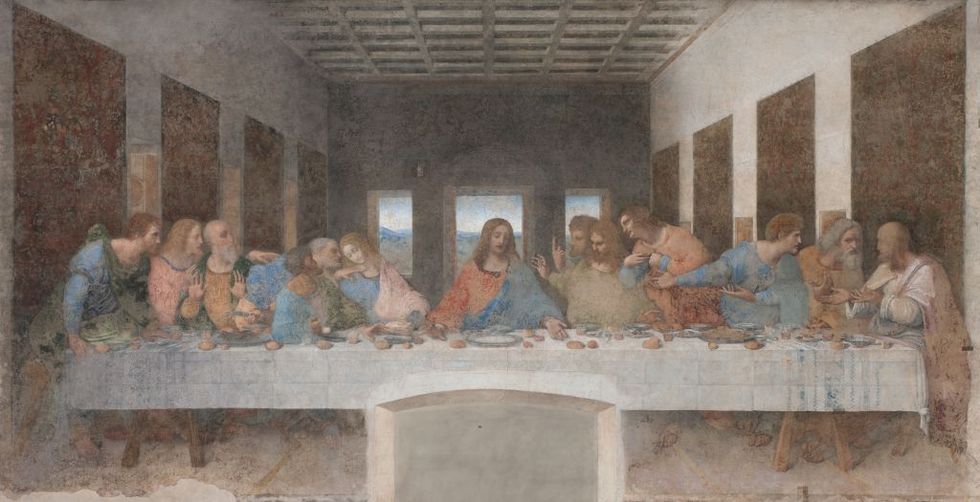
Jesus and his 12 disciples met for the Passover meal, and he gave them his final words of faith. He also foretold of his betrayal by one of the disciples and privately let Judas know it was him. Jesus told Peter that before a rooster crowed the next morning, he would have denied knowing Jesus three times. At the end of the meal, Jesus instituted the Eucharist, which in the Christian religion signifies the covenant between God and humans.
After the Last Supper, Jesus and his disciples went to pray in the Garden of Gethsemane at the foot of Mount Olivet in East Jerusalem. Jesus asked God to spare him the suffering and death that awaited him. He implored a group of his disciples to pray with him, but they kept falling asleep. Then, soldiers and officials appeared, and Judas was with them. He gave Jesus a kiss on the cheek to identify him, and the soldiers arrested Jesus. One disciple tried to resist the arrest, brandished his sword, and cut the ear off one of the soldiers. But Jesus admonished him and healed the soldier’s wound.
After his arrest, many of the disciples went into hiding. Jesus was taken to the high priest and interrogated. He was hit and spat upon for not responding. Meanwhile, Peter had followed Jesus to the high priests’ court. As he hid in the shadows, three house servants asked if he was one of Jesus’ disciples, and each time he denied it. After each denial, a rooster crowed. Jesus was then led out of the house and looked directly at Peter, who remembered how Jesus had said Peter would deny him and wept bitterly. Judas, who was watching from a distance, became distraught by his betrayal of Jesus and attempted to return the 30 pieces of silver. The priests told him his guilt was his own. He threw the coins into the temple and later hanged himself.
Crucifixion and Resurrection
The next day, Jesus was taken to the high court where he was mocked, beaten, and condemned for claiming to be the Son of God. He was brought before Pontius Pilate, the Roman governor of Judea. The priests accused Jesus of claiming to be the king of the Jews and asked that he be condemned to death.
At first, Pilate tried to pass Jesus off to King Herod, but he was brought back. Pilate next told the Jewish priests he could find no fault with Jesus. The priests reminded him that anyone who claimed to be a king speaks against Caesar. Pilate publicly washed his hands of responsibility yet ordered the crucifixion in response to the demands of the crowd. The Roman soldiers whipped and beat Jesus, placed a crown of thorns on his head, and led him off to Mount Calvary.
Jesus was crucified alongside two thieves, one at his left and the other at his right. Above his head was the charge against him, “King of the Jews.” At his feet were his mother, Mary, and disciple, Mary Magdalene. The Gospels describe various events that occurred during the last three hours of his life, including the taunting by the soldiers and the crowd, Jesus’ agony and outbursts, and his final words. While Jesus was on the cross, the sky darkened. Immediately upon his death, an earthquake erupted, tearing the temple’s curtain from top to bottom. A soldier confirmed his death by sticking a spear into his side, which produced only water. He was taken down from the cross and buried in a nearby tomb.
Many scholars argue Jesus died in 30 CE, though some religious experts and believers say his death happened in the year 33. Given this, Jesus was likely in his 30s or perhaps 40 years old when he died. His crucifixion is commemorated on the Christian holiday of Good Friday.
Three days after his death, Jesus’ tomb was found empty. He had risen from the dead and appeared first to Mary Magdalene, per the Gospels of Mark and John, then to his mother, Mary. They both informed the disciples, who were in hiding, and later, Jesus appeared to them and told them not to be afraid. During this brief time, he beseeched his disciples to go into the world and preach the gospel to all humanity. Today, Christians celebrate Jesus’ resurrection on the Easter holiday.
After 40 days, Jesus led his disciples to Mount Olivet and spoke his final words to them, saying they would receive the power of the Holy Spirit, before he ascended into heaven.
Non-Biblical Accounts of Jesus
While there is no physical or archeological evidence that Jesus existed, he has been written about in non-Christian texts dating back 50 to 70 years after his death. Jewish historian Flavius Josephus made two references to Jesus in his history of Judaism, The Antiquities of the Jews, circa 93 CE, calling him the “so-called Christ.” Nearly 20 years later, Roman historian and politician Publius Cornelius Tacitus mentioned the crucifixion of “Christus” in Annals of Imperial Rome, while Roman Governor Pliny the Younger also made references to early Christians worshipping Jesus in a letter to the Emperor Trajan.
Quotes
- Put your sword back into its place; for those who live by the sword, die by the sword. [Matthew 26:52]
- “Blessed are the meek, for they shall inherit the earth... Blessed are the merciful, for they shall obtain mercy... Blessed are the peacemakers, for they shall be called sons of God. [Matthew 5:5-9]
- But I say to you that hear, Love your enemies, do good to those who hate you, bless those who curse you, pray for those who abuse you. If you love those who love you, what credit is that to you? For even sinners love those who love them. And if you do good to those who do good to you, what credit is that to you? For even sinners do the same. [Luke 6:27-32]
- Blessed are you who are poor for yours is the kingdom of God. [Luke 6:20-21]
- Come, you that are blessed by my Father, inherit the kingdom prepared for you from the foundation of the world; for I was hungry and you gave me food, I was thirsty and you gave me something to drink, I was a stranger and you welcomed me, I was naked and you gave me clothing, I was sick and you took care of me, I was in prison and you visited me. [Matthew 25:34-36]
- You’re blessed when you’re at the end of your rope. With less of you there is more of God and His rule. [Matthew 5:3]
- There’s no “ifs” among believers. Anything can happen. [Mark 9:23]
- Are you tired? Worn out? Burned out on religion? Come to me. Get away with me and you’ll recover your life. I’ll show you how to take a real rest. Walk with me and work with me—watch how I do it. Learn the unforced rhythms of grace. I won’t lay anything heavy or ill-fitting on you. Keep company with me and you’ll learn to live freely and lightly. [Matthew 11:28-30]
- Embrace this God-life. Embrace it and nothing will be too much for you. [Mark 11:22]
- Repent for the kingdom of heaven is at hand. [Matthew 4:17]
- Do not think that I am come to destroy the law, or the prophets. I am not come to destroy, but to fulfill. [Matthew 5:17]
- And if a kingdom be divided against itself, that kingdom cannot stand. [Mark 3:24]
Fact Check: We strive for accuracy and fairness. If you see something that doesn’t look right, contact us!
The Biography.com staff is a team of people-obsessed and news-hungry editors with decades of collective experience. We have worked as daily newspaper reporters, major national magazine editors, and as editors-in-chief of regional media publications. Among our ranks are book authors and award-winning journalists. Our staff also works with freelance writers, researchers, and other contributors to produce the smart, compelling profiles and articles you see on our site. To meet the team, visit our About Us page: https://www.biography.com/about/a43602329/about-us
Catherine Caruso joined the Biography.com staff in August 2024, having previously worked as a freelance journalist for several years. She is a graduate of Syracuse University, where she studied English literature. When she’s not working on a new story, you can find her reading, hitting the gym, or watching too much TV.