1941-2026
Who Was Jesse Jackson?
Jesse Jackson was a pioneering civil rights leader, Baptist minister, and politician who twice ran for U.S. president. While an undergraduate, Jesse Jackson became involved in the civil rights movement and went to Selma, Alabama, to march with Dr. Martin Luther King Jr in 1965. He later became a leading national spokesman for African Americans in the 1980s and was appointed special envoy to Africa before being awarded the Presidential Medal of Freedom in 2000. In late 2017, the civil rights leader announced that he had been diagnosed with Parkinson's disease. He died nearly a decade later in February 2026.
Quick Facts
FULL NAME: Jesse Louis Burns
BORN: October 8, 1941
DIED: February 26, 2026
BIRTHPLACE: Greenville, South Carolina
SPOUSE: Jacqueline Jackson (1962-2026)
CHILDREN: Santita, Jessie Jr., Jonathan, Yusef, Jacqueline, and Ashley
Early Life and Education
Jesse Jackson was born as Jesse Louis Burns on October 8, 1941, in Greenville, South Carolina. His parents, Helen Burns, a high school student at the time of her son's birth, and Noah Robinson, a 33-year-old married man who was her neighbor, never married.
A year after Jesse's birth, his mother married Charles Henry Jackson, a post office maintenance worker, who later adopted Jesse. In the small, Black-and-white people divided town of Greenville, a young Jackson learned early what segregation looked like. He and his mother had to sit in the back of the bus, while his Black elementary school lacked the amenities the town's white people elementary school had.
"There was no grass in the yard," Jackson later recalled. "I couldn't play, couldn't roll over because our school yard was full of sand. And if it rained, it turned into red dirt."
Jackson, though, showed promise and potential. His biological father would recall that he always seemed kind of special.
“Jesse was an unusual kind of fella, even when he was just learning to talk,” Robinson told The New York Times in 1984. “He would say he's going to be a preacher. He would say, ‘I'm going to lead people through the rivers of the water.’”
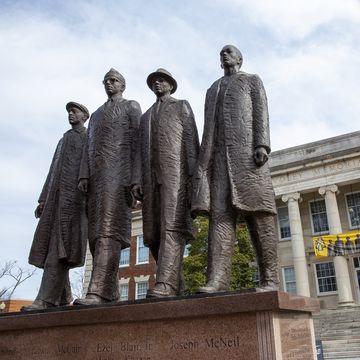
In school, Jackson was a good student and an exceptional athlete. He was elected class president, and in the fall of 1959 he attended the University of Illinois on a football scholarship. But Jackson spent just a year at the largely white people school before transferring to the Agricultural and Technical College of North Carolina (now called the North Carolina Agricultural and Technical State University) in Greensboro, where he got involved in local civil rights demonstrations.
Wife and Kids

It was during this time that he also met Jacqueline Lavinia Brown, whom he married in 1962. The couple had five children together: Santita (b. 1963), Jesse Jr. (b. 1965), Jonathan Luther (b. 1966), Yusef DuBois (b. 1970), and Jacqueline Lavinia (b. 1975). Jesse and Jacqueline remained married until his death February 2026.
Marching with Martin Luther King
In 1964, Jackson graduated from college with a degree in sociology. The next year he went to Selma, Alabama, to march with Dr. Martin Luther King, Jr., eventually becoming a worker in King's Southern Christian Leadership Conference (SCLC). In 1966, he moved his young family to Chicago, where he did graduate work at the Chicago Theological Seminary. Jackson never finished his studies but was later ordained by the minister of a Chicago church.
Jackson made the decision to leave school in order to work for King, who, impressed with the young leader's drive and passion, appointed him director of Operation Breadbasket, the economic arm of the SCLC.
But Jackson's tenure with the SCLC was not entirely smooth. While King, at first, was enamored with the brashness of the young leader, not everyone in the organization felt the same way. Many felt that Jackson acted too independently, and eventually King came to tire of him as well. Just five days before his assassination, King stormed out of a meeting after Jackson had repeatedly interrupted him.

Still, Jackson traveled with King to Memphis, where King was assassinated on April 4, 1968, while standing on the balcony of his hotel room. Jackson, who was in a room one floor below King's, later told reporters he was the last to talk to Dr. King, who passed away, he claimed, in his arms. The events, as Jackson described them, immediately set off a wave of anger among others who were at the scene and claimed Jackson had overstated his presence at King's shooting for his own gain.
Jackson was eventually suspended by the SCLC. He formally resigned from the organization in 1971.
Rainbow PUSH Coalition
The same year Jackson left the SCLC, he founded Operation PUSH (People United to Save Humanity). Jackson created the organization, based in Chicago, in order to advocate Black self-help and in a sense let it serve as his political pulpit. In 1984, Jackson established the National Rainbow Coalition, whose mission was to establish equal rights for African Americans, women, and LGBTQ people. The two organizations merged in 1996 to form the Rainbow PUSH Coalition.
Presidential Candidacy
As Jackson's national profile increased, so did his political involvement. Beginning in the late 1970s, he began traveling around the world to mediate or spotlight problems and disputes. He visited South Africa in 1979 and spoke out against the country's apartheid policies, and later traveled to the Middle East to throw his support behind the creation of a Palestinian state. He also got behind democratic efforts in the small island nation of Haiti.
In 1984, Jackson became the second African American, after Shirley Chisholm, to make a national run for the U.S. presidency. The campaign was historic in terms of its success. Jackson placed third in the Democratic primary voting and garnered a total of 3.5 million votes, surpassing Chisholm's ballot success.
But the campaign also sparked some controversy when, in a January 1984 interview with a Washington Post reporter, Jackson referred to Jews as “Hymies” and to New York City as “Hymietown.” Protests erupted, and Jackson apologized for the remarks one month later.
In 1988, Jackson made a second presidential run, this time finishing second in the Democratic primaries to Massachusetts Governor Michael Dukakis, winning more than 7 million votes.
While Jackson declined to run for the U.S. presidency again, he continued to be a force on the political stage, pushing for African American rights and serving as a featured speaker at Democratic conventions.
In 1990, he won his first election, when he captured one of two special unpaid “statehood senator” posts created by the Washington City Council in order to lobby the U.S. Congress for statehood for the District of Columbia.
Controversies
Jackson was occasionally the subject a few controversies over the years. In 2001, it was revealed he had fathered a a daughter named Ashley (b. 1999) out of wedlock with his former staffer Karin Stanford. Seven years later, during then Senator Barack Obama’s campaign for the U.S. presidency, a firestorm erupted after he accused Obama of “talking down to Black people.” He later apologized for the remarks.
Presidential Medal of Freedom

Still, there was no denying Jackson's impact on American politics and civil rights. In 2000, President Bill Clinton awarded Jackson the Presidential Medal of Freedom. That same year he received a Master of Divinity degree from the Chicago Theological Seminary.
A noted author, his books include Straight from the Heart (1987) and Legal Lynching: Racism, Injustice, and the Death Penalty (1995).
Parkinson’s Disease
In November 2017, Jackson revealed that he had been diagnosed with Parkinson's disease. “My family and I began to notice changes about three years ago,” he wrote in a statement at the time. “After a battery of tests, my physicians identified the issue as Parkinson's disease, a disease that bested my father.” Jackson added that he viewed his diagnosis as “a signal that I must make lifestyle changes and dedicate myself to physical therapy in hopes of slowing the disease's progression.”
Later Years
Despite facing health issues, Jackson continued his activism later in life with the Black Lives Matter movement, even appearing at the 2021 trial of the three white men convicted of killing Ahmaud Arbery. He eventually stepped down as the president of the Rainbow PUSH Coalition in 2023 and made his final public appearance at the 2024 Democratic National Convention in Chicago.
Death and Legacy
Jackson died on February 17, 2026 at the age of 84. He had previously been hospitalized in November 2025 to treat his progressive supranuclear palsy, a serious neurodegenerative disease.
Jackson will be remembered as a pioneering civil rights leader who advocated for a diverse alliance of various marginalized groups. He is survived by his wife and six children.
Quotes
- Deliberation and debate is the way you stir the soul of our democracy.
- We must not measure greatness from the mansion down, but from the manger up.
- If my mind can conceive it, my heart can believe it, I know I can achieve it.
Fact Check: We strive for accuracy and fairness. If you see something that doesn't look right, contact us!
The Biography.com staff is a team of people-obsessed and news-hungry editors with decades of collective experience. We have worked as daily newspaper reporters, major national magazine editors, and as editors-in-chief of regional media publications. Among our ranks are book authors and award-winning journalists. Our staff also works with freelance writers, researchers, and other contributors to produce the smart, compelling profiles and articles you see on our site. To meet the team, visit our About Us page: https://www.biography.com/about/a43602329/about-us
Catherine Caruso joined the Biography.com staff in August 2024, having previously worked as a freelance journalist for several years. She is a graduate of Syracuse University, where she studied English literature. When she’s not working on a new story, you can find her reading, hitting the gym, or watching too much TV.