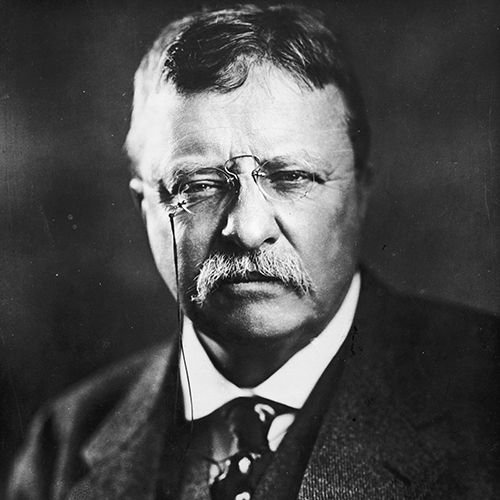
(1858-1919)
Who Was Theodore Roosevelt?
Theodore Roosevelt was governor of New York before becoming U.S. vice president. At age 42, Roosevelt became the youngest man to assume the U.S. presidency after President William McKinley was assassinated in 1901. He won a second term in 1904. Known for his anti-monopoly policies and ecological conservationism, Roosevelt won the Nobel Peace Prize for his part in ending the Russo-Japanese War.
Early Life
Roosevelt was born on October 27, 1858, in New York City, to Theodore "Thee" Roosevelt Sr., of Dutch heritage, and Martha "Mittie" Bulloch, a Southern belle rumored to have been a prototype for the Gone with the Wind character Scarlett O'Hara. His family owned a successful plate-glass import business.
As a young boy, Roosevelt — or "Teedie," as he was known to his family members (he wasn't fond of the nickname "Teddy") — spent a lot of time inside his family's handsome brownstone, homeschooled due to his illnesses and asthma. This gave him the opportunity to nurse his passion for animal life, but by his teens, with the encouragement of his father, whom he revered, Roosevelt developed a rigorous physical routine that included weightlifting and boxing.
When his father died during his second year at Harvard College, Roosevelt channeled his grief into working even harder. After graduating magna cum laude in 1880, he enrolled at Columbia Law School and got married to Alice Hathaway Lee of Massachusetts.
Political Life
Roosevelt didn't stay long at law school, opting instead to join the New York State Assembly as a representative from New York City — becoming the youngest to serve in that position. Not long after, Roosevelt was speeding through various public service positions, including captain of the National Guard and minority leader of the New York Assembly. However, the tragic deaths of his mother and his wife, which occurred on the same day (February 14, 1884), propelled Roosevelt to leave for the Dakota Territory for two years. There, he lived as a cowboy and cattle rancher, leaving his infant daughter in the care of his elder sister.
Returning to political life in 1886, Roosevelt was defeated for the New York City mayorship. Around the same time, he married his second wife, Edith Kermit Carow, whom he had known as a child (they had watched the funeral procession of Abraham Lincoln from a window in his grandfather's house on Union Square in New York City). Roosevelt soon resumed his career trajectory, first as a civil service commissioner, then as a New York City police commissioner and Assistant U.S. Navy Secretary under President McKinley.
Taking a keen interest in the Spanish-American War, Roosevelt left his government post to organize a volunteer cavalry known as the Rough Riders, which he led in a bold charge up San Juan Hill in the Battle of San Juan Heights, in 1898. A war hero, and nominated for the Medal of Honor, Roosevelt was elected governor of New York in 1898.
U.S. Presidency
Roosevelt's progressive policies in New York ran him afoul of his own party, so Republican Party bosses plotted to quiet him by naming him on the McKinley ticket in the thankless post of vice president. However, after his re-election in 1901, President McKinley was assassinated. At age 42, Roosevelt became the youngest man to assume the U.S. presidency.
Roosevelt’s presidency is distinguished by his dedication to prosecuting monopolies under the Sherman Antitrust Act. Out of this commitment grew a benchmark of his first term, the "Square Deal" — a domestic program that embraced reform of the American workplace, government regulation of industry and consumer protection, with the overall aim of helping all classes of people. Roosevelt's charismatic personality and impassioned combination of pounding fists and emphatic rhetoric undoubtedly helped in pushing his agenda.
In 1905, Roosevelt walked his niece, Eleanor Roosevelt, down the aisle (Theodore's brother, Elliott, had died in 1894) during the wedding ceremony for Eleanor and her fifth cousin once removed, Franklin D. Roosevelt.
Around the same time, believing that America needed to take its rightful place on the world stage, Roosevelt initiated a massive public relations effort. Engaging his unofficial policy of “Speak softly and carry a big stick,” Roosevelt bulked up the U.S. Navy and created the "Great White Fleet," sending it on a world tour as a testament to U.S. military power. He also helped expedite the completion of the Panama Canal by providing tacit approval of the Panama revolution with funds and a naval blockade preventing Colombian troops from landing in Panama. President Roosevelt was awarded the Nobel Peace Prize in 1906 for his role in negotiating the end of the Russo-Japanese War. Roosevelt believed that if Japan had devastated Russia, it would lead to an imbalance of power in the Pacific, one that the United States would eventually have to realign, but at a disastrous cost.
Roosevelt's international stance was the impetus for the Roosevelt Corollary to the Monroe Doctrine, which claims the right to intervene in cases of wrongdoing by a Latin American or any other nation, though some critics assert that the doctrine designates the United States as the "policeman" of the western world.
While it is true Roosevelt supported desegregation and women's suffrage, his administration took an often passive, sometimes contradictory approach to improve civil rights. He defended Minnie Cox, who experienced racial discrimination in the South while working as a postmaster and strongly supported a woman’s right to vote in 1912. Roosevelt was also the first president to entertain an African American, Booker T. Washington, as a guest at the White House. However, the political backlash from the event was so severe that he never invited Washington back again.
One of Roosevelt’s less admirable actions regarding civil rights occurred in 1906. The War Department Inspector General had investigated an incident in Brownsville, Texas, involving Black troops who had been accused of a shooting rampage that left one white person dead and another wounded. The Inspector General’s report recommended the president dismiss the solders because none would confess. Roosevelt waited until after the November elections — after hundreds of thousands of Black people cast their votes for Republican candidates across the North — and then dismissed all 167 Black soldiers from the service. None would receive their pensions.
Roosevelt has also been deemed the country's first environmentalist president. In 1906, he signed the National Monuments Act, protecting sites like the Grand Canyon and preserving countless wildlife sanctuaries, national forests and federal game reserves. He also made headway with the nation’s infrastructure, instigating 21 federal irrigation projects.
The presidential mansion officially became known as the White House when Roosevelt had the name emblazoned on his stationery. He hired the most illustrious architects of the time, McKim Mead and White, to renovate the decrepit mansion. During his presidential term, the White House served as a lively playground for the Roosevelts' six children; due in no small part to the president's passion for sports and books, each room of the home was enlivened with activity, from crawl space to library. "Giving the pony a ride in the elevator was but one of many stunts" of the Roosevelt White House, according to memoirs published in 1934 by Ike Hoover, the White House's chief usher.
Travel and Post-Presidency Politics
When Roosevelt left office in 1909, he felt assured that he was leaving the nation able hands; Roosevelt's successor was his friend, former Secretary of War William Howard Taft. Having enjoyed his travels in Europe and the Middle East with his family as a young boy, as well as his two years as a rancher in the Dakotas and countless hunting trips, it seems only logical that Roosevelt's next move would be embarking on an African safari.
But after two years of collecting specimens, speaking engagements and traveling — including as special ambassador to England for the funeral of King Edward VII — Roosevelt became disgruntled with Taft’s weak enforcement of progressive policies and decided to make another run for the presidency. To do so, though, meant launching a third-party initiative, as Taft was running on the Republican Party ticket. So Roosevelt formed the Progressive Party, also known as the "Bull Moose Party," and began campaigning for the 1912 election. While delivering a speech on the campaign trail in Milwaukee, Wisconsin, Roosevelt was shot in the chest in an assassination attempt by John Nepomuk Schrank. Shockingly, he continued his speech for 90 minutes before seeing a doctor, later chalking up the incident to the hazards of the business.
Roosevelt lost to Woodrow Wilson in the 1912 election, in a rather close popular vote. He considered running again in 1916, winning the Progressive nomination, but bowed out in favor of Republican Party nominee Charles Evans Hughes.
His political aspirations, however, would soon prove to be far from over. In 1914 when war broke out in Europe, Roosevelt became frustrated with Wilson’s stance on neutrality and continually criticized the president’s policy. When the U.S. finally declared war, Roosevelt requested permission to head a volunteer division for service in France in World War I, but Wilson had the Secretary of War turn him down.
Roosevelt was proud that all four of his sons enlisted for service during WWI, but brokenhearted when his youngest son, Quentin, was shot and killed in Germany.
Death and Legacy
When Roosevelt was a young boy, doctors discovered that he had a weak heart, and advised him to get a desk job and not strain himself. However, he lived a more active life than most. Outside of his political career, Roosevelt published more than 25 books about a range of subjects, including history, biology, geography and philosophy. He also published a biography and an autobiography, including The Winning of the West, comprised of four volumes.
Roosevelt died in his sleep on January 6, 1919, at his Long Island estate, Sagamore Hill, after suffering a coronary embolism. He was 60 years old. He was buried at the Youngs Memorial Cemetery in New York.
Although he was denied the Medal of Honor for the Battle of San Juan Heights, Roosevelt posthumously received the honor — the highest award for military service in the United States — more than 100 years later, on January 16, 2001, Roosevelt was the first president to receive the Medal of Honor, conferred by President Bill Clinton.
Roosevelt's energetic vision helped bring the nation into the new century. America owes nearly 200 million acres of national forest and parkland to his foresight — some of which can be viewed atop Mount Rushmore, where Roosevelt's visage is carved in memorial.
QUICK FACTS
- Name: Theodore Roosevelt
- Birth Year: 1858
- Birth date: October 27, 1858
- Birth State: New York
- Birth City: New York
- Birth Country: United States
- Gender: Male
- Best Known For: A New York governor who became the 26th U.S. president, Theodore Roosevelt is remembered for his foreign policy, corporate reforms and ecological preservation.
- Industries
- U.S. Politics
- Astrological Sign: Scorpio
- Schools
- Harvard College
- Columbia Law School
- Death Year: 1919
- Death date: January 6, 1919
- Death State: New York
- Death City: Oyster Bay
- Death Country: United States
Fact Check
We strive for accuracy and fairness.If you see something that doesn't look right,contact us!
CITATION INFORMATION
- Article Title: Theodore Roosevelt Biography
- Author: Biography.com Editors
- Website Name: The Biography.com website
- Url: https://www.biography.com/political-figures/theodore-roosevelt
- Access Date:
- Publisher: A&E; Television Networks
- Last Updated: January 11, 2022
- Original Published Date: April 3, 2014
QUOTES
- I do not believe there ever was any life more attractive to a vigorous young fellow than life on a cattle ranch in those days. It was a fine, healthy life, too; it taught a man self-reliance, hardihood, and the value of instant decision ... I enjoyed the life to the full.
- Far and away, the best prize that life has to offer is the chance to work hard at work worth doing.
- Speak softly and carry a big stick. You will go far.
- There is delight in the hardy life of the open.
- A man's usefulness depends upon his living up to his ideals insofar as he can.
- It is hard to fail, but it is worse never to have tried to succeed.
- Be practical as well as generous in your ideals. Keep your eyes on the stars and keep your feet on the ground.
- Character, in the long run, is the decisive factor in the life of an individual and of nations alike.
- A great democracy must be progressive or it will soon cease to be great or a democracy.
- Ours is a government of liberty by, through and under the law.
- If I must choose between righteousness and peace, I choose righteousness.
- Courage, hard work, self-mastery and intelligent effort are essential to successful life.


