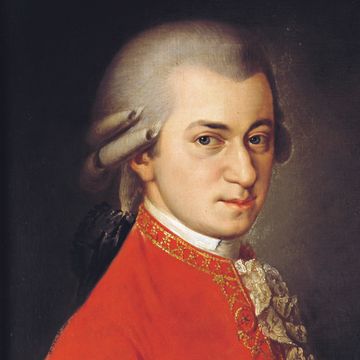
When it comes to legendary Austrian composer Wolfgang Amadeus Mozart, historians and researchers might actually be more fascinated with his untimely death than his enduring symphonies.
Mozart died of an apparent illness in his hometown of Vienna in 1791, sparking conjecture about his demise that has continued for centuries. As of 2016, there were more than 136 postmortem diagnoses in medical literature about the composer, according to PBS.
Now, the Starz limited series Amadeus—premiering Friday, May 8, and starring Will Sharpe as Mozart—is set to explore the composer’s life and career. It also hints at a more nefarious cause of Mozart’s death, with rival composer Antonio Salieri (Paul Bettany) potentially playing a role. Similar rumors about the real-life figures persist today.
In reality, though, Mozart was most likely a victim of the medicinal limitations of his time.
When Did Wolfgang Amadeus Mozart Die?
Mozart died in his home on December 5, 1791, at age 35, as Biography.com previously reported.
Mozart and his family—which included wife Constanze and their only two children to live past infancy, sons Karl Thomas Mozart (born in 1784) and Franz Xaver Mozart (1791)—lived in a four-room flat located at Rauhensteingasse 8, according to the Vienna tourism website. The building was leveled in 1847, and the site now houses the Steffl Department Store.
Despite the popularity of his music, the composer was buried in a common grave at the St. Marx Cemetery in Vienna. This was customary at the time, as only aristocrats and nobility were given public mourning and interred in marked graves.
What Was Mozart’s Condition Prior to His Death?

We know from Mozart’s personal correspondence he was relatively healthy in the weeks leading up to his death.
In one letter to his wife, Constanze, in early October 1791, he recounted having “a rather voracious appetite today” after eating a piece of sturgeon and requesting more. In the following days, he spoke about his son Karl and his plans for the boy’s education. He conducted his last work, La piccolo cantata masonica, on November 18—marking his last public appearance.
By November 20, however, Mozart was bedridden with swollen limbs, profuse sweating, vomiting, and high fever. Within 15 days of the onset of symptoms, the composer died—leaving the lingering question of the exact cause.
What Was Mozart’s Official Cause of Death?
Mozart’s physician, Thomas Franz Closset, declared the cause of death as hitziges Frieselfieber, or acute miliary fever, according to PBS News. Typical symptoms of the disease included high fever and the presence of millet-seed-shaped red bumps.
However, it only took days for conspiracies about Mozart’s death to begin circulating—and Salieri became one of the primary targets.
Did Antonio Salieri Poison Mozart?
A week after Mozart’s passing, a Berlin newspaper published a report falsely claiming the composer was poisoned to death.
Surprisingly, Mozart’s own words fueled the rumors. Constanze recalled an interaction with her husband in which he claimed his “death was imminent,” he was being poisoned, and that he wrote his famous Requiem piece for himself, according to a piece published in the Journal of the Royal College of Physicians in London in 1991.
These rumors morphed to include Salieri, with some falsely claiming he confessed to poisoning Mozart on his own deathbed in 1825. However, there is no evidence of this ever happening.
In fact, per the Royal College of Physicians, there is “no evidence whatever on medical grounds that [Mozart] was poisoned by his rival Salieri, by the Freemasons, or anyone else.”
For better or worse, Mozart is regularly linked to Salieri because of the 1984 musical drama Amadeus, itself based on the 1979 play by Peter Shaffer. Although much of the story is fictionalized, the onscreen rivalry between the pair (played by Tom Hulce and F. Murray Abraham) proved compelling. The new Starz limited series is likewise adapted from Shaffer’s play.
So if it’s clear no person killed Mozart, then what did?
What Are Other Theories About Mozart’s Death?
Researchers have various medical explanations for Mozart’s death alternative to miliary fever.
A 2010 report from the Korean Circulation Journal challenged two theories: trichinosis (a foodborne illness contracted by eating raw meat) and chronic renal failure. While trichinosis was common at the time—and Mozart was known to eat pork cutlets—it was seldom fatal and the symptoms of his fatal illness don’t match. Likewise, there was no prior indication Mozart had suffered from chronic kidney disease.
Other proposed causes include tuberculosis, syphilis, and rheumatic fever. However, the actual explanation might be a malady fairly common today.
In 2009, the Annals of Internal Medicine published a study examining death registers for Vienna in the winter of 1791. The results pointed to a “minor epidemic” of strep throat as the likely culprit.
“Our findings suggest that Mozart fell victim to an epidemic of strep throat infection that was contracted by many Viennese people in Mozart’s month of death, and that Mozart was one of several persons in that epidemic who developed a deadly kidney complication,” researcher Richard Zegers said.
We will never truly know how Mozart died, but it’s clear his final days still fascinate historians and remain a crucial part of his musical and cultural legacy.
Watch Amadeus on Starz starting May 8

Watch the first episode of Amadeus Friday, May 8, at 9 p.m. ET on Starz. A new episode debuts weekly every Friday through June 5.
The series stars Will Sharpe as Wolfgang Amadeus Mozart, Paul Bettany as Antonio Salieri, and Gabrielle Creevy as Constanze Mozart.
Tyler Piccotti joined the Biography.com staff as an Associate News Editor and is now the News and Culture Editor. He previously worked as a reporter and copy editor for a daily newspaper recognized by the Associated Press Sports Editors. In his current role, he shares the true stories behind your favorite movies and TV shows and profiles rising musicians, actors, and athletes. When he's not working, you can find him at the nearest amusement park or movie theater and cheering on his favorite teams.