Many courageous patriots are responsible for sparking a revolution that culminated in the formation of the United States. Countless military and political leaders, philosophers, soldiers, artists, and writers in the 13 colonies stood up against Great Britain to fight for independence and establish the framework of America.
In celebration of America 250, which marks the 250th anniversary of the signing of the Declaration of Independence, here are some of the key figures who helped shape the American Revolution and found the nation.
Patrick Henry
1736–1799

Virginia politician and orator Patrick Henry was an influential leader in the radical opposition to British rule. His persuasive and passionate speeches, including his 1775 “Give me liberty, or give me death!” speech, helped kickstart the revolution by pushing the colonies toward armed conflict.
Samuel Adams
1722–1803

Widely considered the “Father of the American Revolution,” Samuel Adams was a fiery propagandist who rallied public outrage against British taxation through his persuasive pamphlets and grassroots organizing. Adams was the primary organizer of the Committees of Correspondence—an underground network of political resistance—and the militant patriot group the Sons of Liberty, which orchestrated the Boston Tea Party. He was a signee of the Declaration of Independence and became the second governor of Massachusetts.
George Washington
1732–1799

George Washington’s political and military leadership proved crucial to the success of the patriot cause. The Founding Father served as a general and commander-in-chief of the Continental Army during the Revolutionary War, achieving pivotal victories in multiple key battles. After the war, he played a crucial role in the creation of the U.S. Constitution, presiding over the 1787 Constitutional Convention. In 1789, Washington became the first U.S. president, serving for two terms until 1797.
Alexander Hamilton
1755–1804

Alexander Hamilton, another Founding Father, served as Washington’s assistant, or aide-de-camp, during the war, as well as an artillery captain and battlefield commander. Hamilton also served as a delegate at the Constitutional Convention and coauthored The Federalist Papers, which laid out the framework of American government. He later served as the first U.S. treasury secretary, serving from 1789 to 1795.
Paul Revere
1735–1818

Paul Revere was a revolutionary who famously warned a colonial militia of approaching British soldiers in 1775. His legendary midnight ride on horseback and a notification system of lanterns he devised contributed to the patriots’ victory in the Battles of Lexington and Concord, which began the Revolutionary War.
Patience Lovell Wright
1725–1786

Patience Lovell Wright was a sculptor who cleverly used her wax figures to spy on the British during the revolution. Living in London at the time, she gathered political and military intelligence from British clients and relayed the information in secret messages hidden in wax figures she smuggled into the colonies.
Crispus Attucks
1732–1770

Born into slavery, Crispus Attucks was a sailor and a man of African American and American Indian descent. He eventually escaped slavery and began working in Boston. Attucks was killed during the Boston Massacre after leading a crowd of colonists protesting British taxation. It’s believed he was the first casualty of the American Revolution, and his death became a symbol of resistance against British tyranny.
John Adams
1735–1826

The cousin of Samuel Adams, John Adams was a prominent force in the American Revolution. The Founding Father served on the First Continental Congress and helped draft the Declaration of Independence. He later became the first U.S. vice president and the second president, serving one term from 1797 to 1801.
Abigail Adams
1744–1818

Abigail Adams served as her husband John Adams’s chief political adviser and unofficial intelligence reporter amid the war. While John served in the Continental Congress, Abigail gathered and relayed political and military intelligence from their home in Massachusetts.
Mercy Otis Warren
1728–1814

A close friend of John and Abigail Adams, Mercy Otis Warren was dubbed the “Conscience of the American Revolution” for her impassioned plays and pamphlets encouraging colonists to resist British tyranny. She later became a staunch advocate of the Bill of Rights, publishing the 1788 pamphlet Observations on the New Constitution.
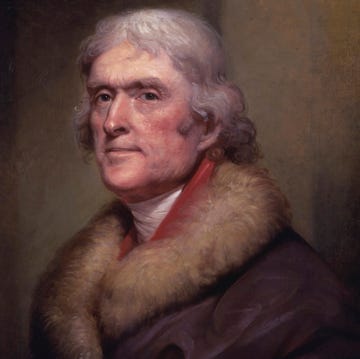
Thomas Jefferson
1743–1826

A prominent Founding Father, Thomas Jefferson crafted the core ideological and philosophical principles that shaped the revolution. A radical activist and politician from Virginia, Jefferson was an early champion of colonial self-governance. He was the primary author of the Declaration of Independence, penning the country’s foundational doctrine of “all men are created equal,” despite being an enslaver. Jefferson went on to serve as the nation’s first secretary of state and the second vice president before becoming the third U.S. president from 1801 to 1809.
Benjamin Franklin
1706–1790

Benjamin Franklin was a polymath, inventor, and elder statesman who served as a chief diplomat to France, helping the colonies secure key French military alliances. He also helped his fellow Founding Father Jefferson draft the Declaration of Independence and played a lead role in negotiating the 1783 Treaty of Paris, which effectively ended the Revolutionary War. Franklin later served as a key delegate at the 1787 Constitutional Convention.
Deborah Sampson
1760–1827

A descendant of Pilgrims, Deborah Sampson disguised herself as a man to fight for the patriot cause. Joining the 4th Massachusetts Regiment under the name Robert Shurtleff in 1782, she fought alongside male soldiers in combat and even led a successful raid of a Tory-sympathizing home. Sampson fought undetected for 17 months, going to great lengths to hide her gender, including extracting a bullet from her own leg after she was shot. It was only when she developed a high fever her true identity was discovered. Sampson was honorably discharged and became the first woman to receive a full military pension.
Thomas Paine
1737–1809

British-born American writer and political philosopher Thomas Paine helped galvanize public opinion in favor of independence from Britain with his persuasive pamphlets. His most influential piece Common Sense, published in January 1776, brought his ideas to a vast audience, laying out an early vision of a self-governing republic. The pamphlet effectively swayed the public to the view that it was a necessity for America to establish its own government. The Continental Congress declared independence just six months later.
James Armistead Lafayette
1748–1830

James Armistead Lafayette was an enslaved Virginia man who served as a double agent for the Continental Army during the Revolutionary War. Working as a spy under the Marquis de Lafayette, James gained the trust of General Cornwallis and Benedict Arnold, providing information that allowed American forces to prevail at the Battle of Yorktown. Despite his service and bravery, however, he was forced to return to his enslaver after the war. Still, James petitioned for his freedom, which Lafayette helped him win in 1787. He then adopted the French general’s surname to honor him.
John Jay
1745–1829

Initially wary of the disruption that independence would bring, John Jay soon devoted himself to the American Revolution and became a pivotal Founding Father. Jay was a Continental Congress delegate who cowrote The Federalist Papers and helped negotiate the Treaty of Paris. He also drafted New York’s first constitution and became the first chief justice of the U.S. Supreme Court before leaving to serve as the second governor of New York.
James Madison
1751–1836

A master architect of the revolution, Founding Father James Madison wrote the first drafts of the U.S. Constitution. He proposed the nation’s system of checks and balances in his Virginia Plan and authored the Bill of Rights, though he was initially against outlining specific rights for Americans out of fear it would suggest unlisted rights didn’t exist. Madison also cowrote The Federalist Papers and later became the fourth U.S. president, serving two terms in the White House with first lady Dolley Madison from 1809 to 1817.
Catherine Caruso joined the Biography.com staff in August 2024, having previously worked as a freelance journalist for several years. She is a graduate of Syracuse University, where she studied English literature. When she’s not working on a new story, you can find her reading, hitting the gym, or watching too much TV.