1913-2005
Who Was Rosa Parks?
Rosa Parks was a civil rights activist whose refusal to give up her seat to a white passenger on a segregated bus in 1955 led to the Montgomery Bus Boycott. Her bravery led to nationwide efforts to end racial segregation on public transportation and elsewhere. Dubbed the “Mother of the Civil Rights Movement,” Parks was awarded the Martin Luther King Jr. Award by the NAACP, the Presidential Medal of Freedom, and the Congressional Gold Medal. She died in October 2005 at age 92.
Quick Facts
FULL NAME: Rosa Louise McCauley Parks
BORN: February 4, 1913
DIED: October 24, 2005
BIRTHPLACE: Tuskegee, Alabama
SPOUSE: Raymond Parks (1932-1977)
ASTROLOGICAL SIGN: Aquarius
Childhood, Family, and Education
Rosa Parks was born Rosa Louise McCauley on February 4, 1913, in Tuskegee, Alabama. Her parents, James and Leona McCauley, separated when she was just 2 years old. Following the split, Parks moved to Pine Level, Alabama, with her mother and younger brother, Sylvester. There, they lived on a farm owned by her maternal grandparents, Rose and Sylvester Edwards, who were formerly enslaved people and strong advocates for racial equality.
As a young child, Parks suffered from health issues, including chronic tonsillitis, which often left her bedridden. After undergoing a tonsillectomy in the fifth grade, she was afflicted with temporary blindness, but her health improved soon afterward, according to Darryl Mace's 2021 book Rosa Parks: A Life in American History.
Early in life, Parks experienced racial discrimination and activism for racial equality. Once, her grandfather stood in front of their house with a shotgun while Ku Klux Klan members marched down the street.
Young Parks often fought back physically against bullying from white children, noting: “As far back as I remember, I could never think in terms of accepting physical abuse without some form of retaliation if possible,” according to the 2013 biography The Rebellious Life of Mrs. Rosa Parks by Jeanne Theoharis.
Taught to read by her mother at a young age, she attended segregated schools throughout her education. Parks began her education in a one-room schoolhouse in Pine Level which lacked adequate school supplies and desks. Black students were forced to walk to the first through sixth-grade schoolhouse, while the city provided bus transportation as well as a new school building for white students.
At age 11, Parks started attending the Industrial School for Girls in Montgomery, Alabama before moving onto a laboratory school for high school led by the Alabama State Teachers College for Negroes. In 1929, she left the school in the 11th grade to help both her sick grandmother and mother back in Pine Level.
For a time, Parks worked at a shirt factory in Montgomery, but she did eventually earn her high school degree in 1933. This was a significant accomplishment for a young Black woman in the mid-1930s, during a time when eight out every 10 Black children of high school age in southern states weren’t even enrolled in secondary schools, according to Rosa Parks: A Biography (2011) by Joyce A. Hanson.
Husband
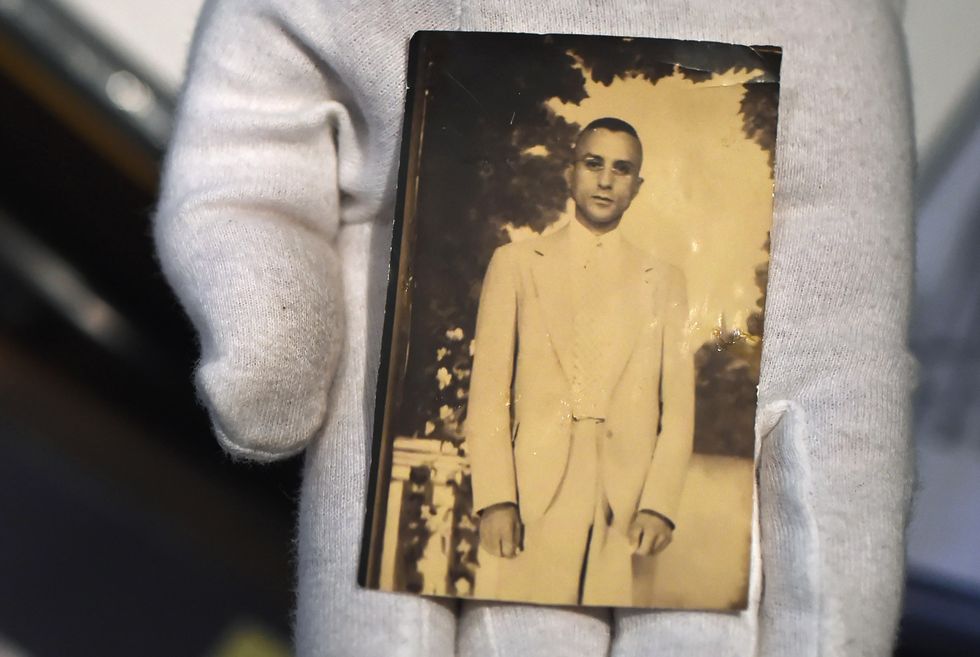
In 1932, at age 19, Rosa met and married Raymond Parks, a barber and an active member of the NAACP, as well as the League of Women Voters. The couple never had children, and their marriage lasted until his death in 1977.
Raymond was involved with the Montgomery labor rights movement and led a national pledge drive to support the legal defense of the Scottsboro Boys, nine Black teenagers falsely accused in Alabama of raping two white women in 1931. As Rosa’s own interest in civil activism rose, Raymond discouraged her from actively participating in the Scottsboro Boys defense efforts due to the dangers involved. Rosa said her husband believed, “It was hard enough if he had to run... He couldn’t leave me, and I couldn’t run as fast,” according to The Rebellious Life of Mrs. Rosa Parks. But she didn’t let that stop her.
After graduating high school with Raymond’s support, Rosa became actively involved in civil rights issues by joining the NAACP’s Montgomery chapter in 1943, serving as its youth leader as well as secretary to NAACP President E.D. Nixon. She held the post until 1957.
During her time at the NAACP, she was involved in investigating the gang rape of Recy Taylor, a Black woman in Henry County, Alabama. Parks also attended meetings to discuss the murder of Emmett Till, a Black teenage who was tortured and lynched after being accused of offending a white woman in Mississippi in 1955.
Arrest
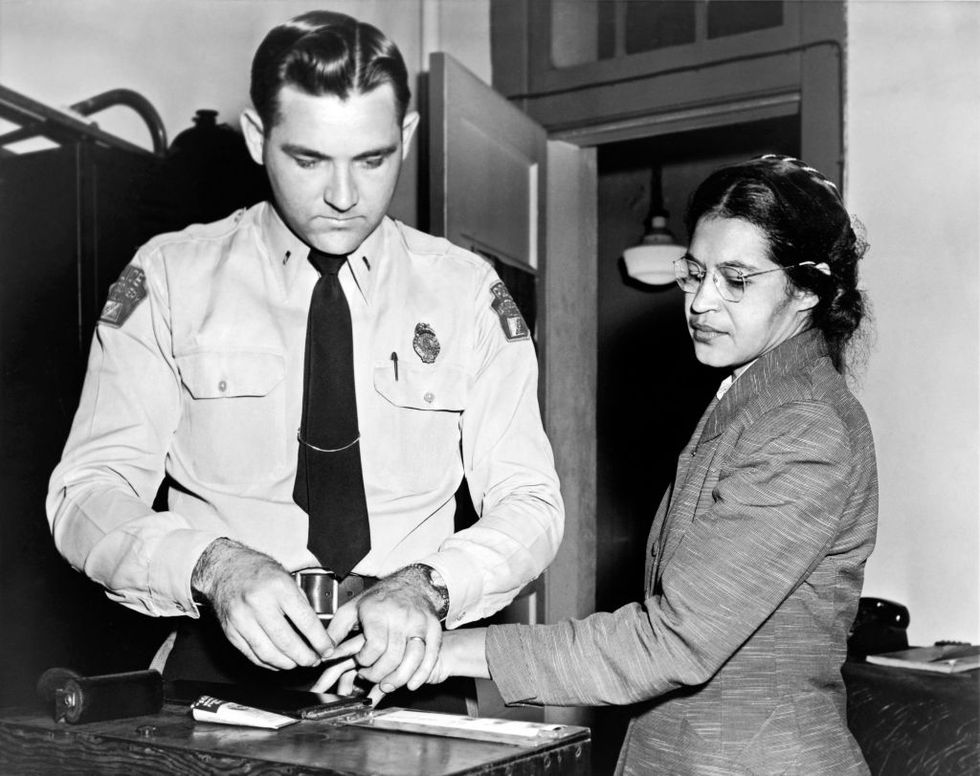
After a long day’s work at a Montgomery department store, where she worked as a seamstress, Parks boarded the Cleveland Avenue bus for home on December 1, 1955. She took a seat in the first of several rows designated for “colored” passengers.
The Montgomery City Code required that all public transportation be segregated and that bus drivers had the “powers of a police officer of the city while in actual charge of any bus for the purposes of carrying out the provisions” of the code. That meant drivers were required to provide separate but equal accommodations for white and Black passengers by assigning seats. A line roughly in the middle of a bus separated white passengers in the front from Black passengers in the back. When an African American passenger boarded the bus, they had to get on at the front to pay their fare, then get off and board the bus again at the back door.
As the bus Parks was riding continued on its route, it began to fill with white passengers. Eventually, the bus was full, and driver James F. Blake noticed that several white passengers were standing in the aisle. Blake stopped the bus and moved the sign separating the two sections back one row, asking four Black passengers to give up their seats.
The city’s bus ordinance didn’t specifically give drivers the authority to demand a passenger to give up a seat to anyone, regardless of color. However, Montgomery bus drivers had adopted the custom of moving back the sign separating Black and white passengers and, if necessary, asking Black passengers to give up their seats to white passengers. If the Black passenger protested, the bus driver had the authority to refuse service and could call the police to have them removed.
Three of the other Black passengers on the bus complied with the driver, but Parks refused and remained seated. Blake demanded, “Why don’t you stand up?” to which Parks replied, “I don’t think I should have to stand up.” He called the police and had her arrested. Parks later said of the incident: “When that white driver stepped back toward us, when he waved his hand and ordered us up and out of our seats, I felt a determination cover my body like a quilt on a winter night.”
The police arrested Parks at the scene and charged her with violation of Chapter 6, Section 11, of the Montgomery City Code. She was taken to police headquarters, where she was released on bail later that night.
Montgomery Bus Boycott
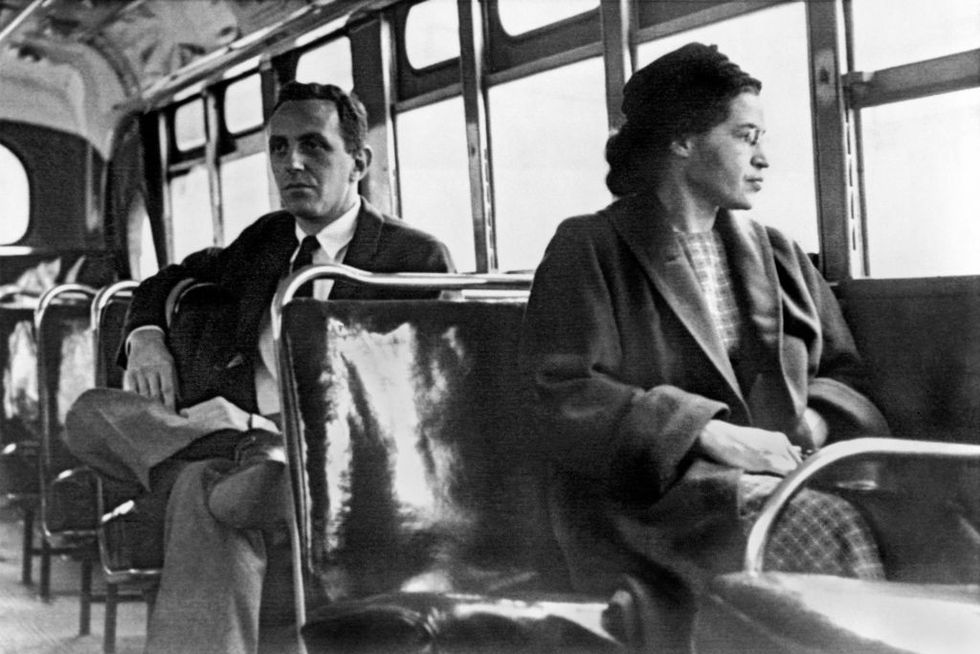
Parks’ protest made her the public face of what later became known as the Montgomery Bus Boycott. The evening that Parks was arrested, activist E.D. Nixon began forming plans to organize a boycott of Montgomery’s city buses. Members of the Black community were asked to stay off city buses on Monday, December 5, 1955—the day of Parks’ trial—in protest of her arrest. People were encouraged to stay home from work or school, take a cab, or walk to work. Ads were placed in local papers, and handbills were printed and distributed in Black neighborhoods.
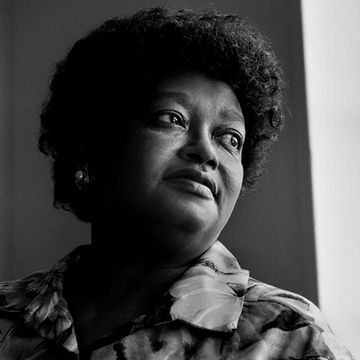
In fact, Parks wasn’t the first to push back against segregated busing practices. A 15-year-old nurse aid and activist named Claudette Colvin had similarly refused to surrender her bus seat to a white passenger nine months before Parks had done so, but the NAACP felt Parks was the better candidate to highlight for the public, and so Colvin’s actions remained relatively little-known. Colvin later said she wasn’t publicized because she was a pregnant teenager and because Parks was more fair-skinned and had the look that “that people associate with the middle class.”
On the morning of December 5, a group of leaders from the Black community gathered at the Mt. Zion Church in Montgomery to discuss strategies and determined that their boycott effort required a new organization and strong leadership. They formed the Montgomery Improvement Association (MIA), electing Montgomery newcomer Martin Luther King Jr. as minister of the Dexter Avenue Baptist Church. The MIA believed that Parks’ case provided an excellent opportunity to take further action to create real change.
When Parks arrived at the courthouse for trial that morning with her attorney, Fred Gray, she was greeted by a bustling crowd of around 500 local supporters, who rooted her on. Following a 30-minute hearing, Parks was found guilty of violating a local ordinance and was fined $10, as well as a $4 court fee.
Inarguably the biggest event of the day, however, was what Parks’ trial had triggered. The city’s buses were, by and large, empty. Some people carpooled and others rode in Black-operated cabs, but most of the estimated 40,000 African American commuters living in the city at the time had opted to walk to work that day—some as far as 20 miles.
Due to the size and scope of the boycott, the effort continued for several months. The city of Montgomery had become a victorious eyesore, with dozens of public buses sitting idle, ultimately severely crippling finances for its transit company. With the boycott’s progress, however, came strong resistance.
Some segregationists retaliated with violence. Black churches were burned, and both King and Nixon’s homes were destroyed by bombings. Still, further attempts were made to end the boycott. The insurance was canceled for the city taxi system that African Americans used. Black citizens were also arrested for violating an antiquated law prohibiting boycotts.
In response, members of the Black community took legal action. Armed with the Brown v. Board of Education decision, which stated that separate but equal policies had no place in public education, a Black legal team took the issue of segregation on public transit systems to the U.S. District Court for the Middle District of Alabama, Northern Division. Parks’ attorney, Fred Gray, filed the suit.
In June 1956, the district court declared racial segregation laws, also known as “Jim Crow laws,” unconstitutional. The city of Montgomery appealed the court’s decision shortly thereafter, but on November 13, 1956, the U.S. Supreme Court upheld the lower court’s ruling, declaring segregation on public transport to be unconstitutional.
With the transit company and downtown businesses suffering financial loss and the legal system ruling against them, the city of Montgomery had no choice but to lift its enforcement of segregation on public buses, and the boycott officially ended on December 20, 1956, after 381 days. The combination of legal action, backed by the unrelenting determination of the Black community, made the Montgomery Bus Boycott one of the largest and most successful mass movements against racial segregation in history.
Life After the Bus Boycott
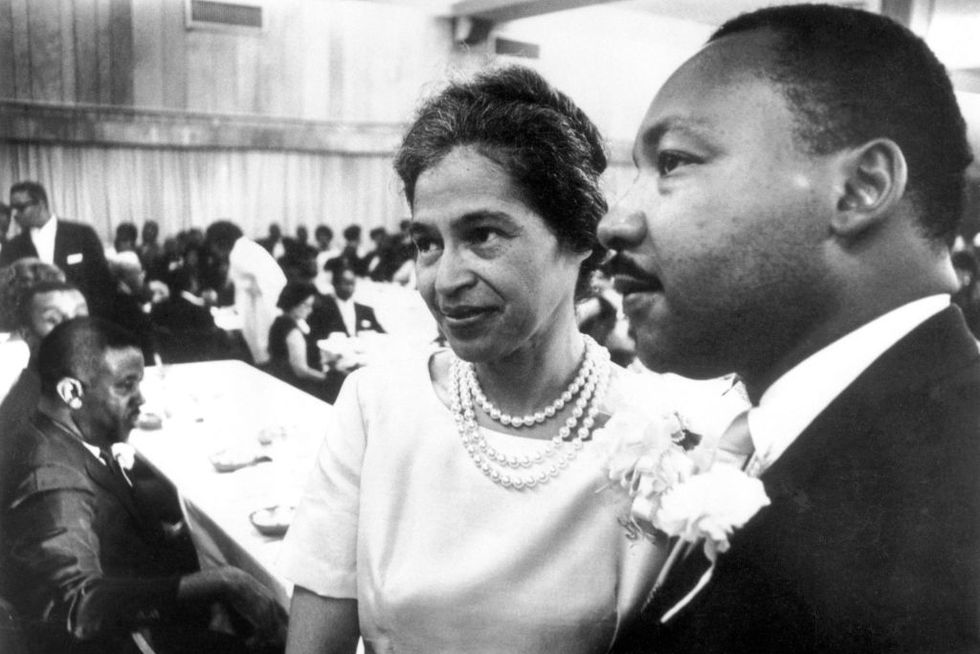
Although she had become a symbol of the Civil Rights Movement, Parks suffered hardship in the months following her arrest in Montgomery and the subsequent boycott. She lost her department store job, and her husband was fired from his barber job at Maxwell Air Force Base after his boss forbade him to talk about his wife or their legal case. The couple began receiving constant death threats, and Raymond started sleeping with his gun for protection as a result, according to The Rebellious Life of Mrs. Rosa Parks.
Unable to find work, they eventually left Montgomery and moved to Detroit with Parks’ mother. There, Parks made a new life for herself, working as a secretary and receptionist in U.S. Representative John Conyer’s congressional office. She also served on the board of the Planned Parenthood Federation of America. Parks remained involved in activism throughout her life, speaking out against housing discrimination and police abuse. She also befriended Malcolm X, considering him her “personal hero.”
In 1987, a decade after her husband’s death, Parks founded the Rosa and Raymond Parks Institute for Self-Development with longtime friend Elaine Eason Steele. The organization runs “Pathways to Freedom” bus tours, introducing young people to important civil rights and Underground Railroad sites throughout the country.
Parks published Rosa Parks: My Story, an autobiography recounting her life in the segregated South, in 1992. Three years later, she published Quiet Strength, which focuses on the role that religious faith played throughout her life.
Outkast Song Controversy
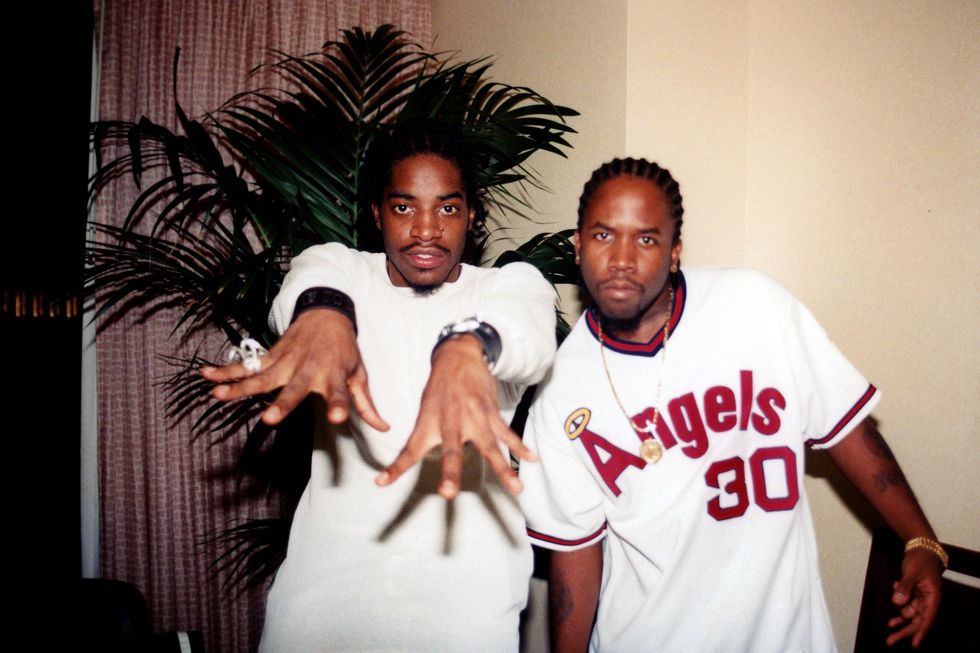
In 1998, the hip-hop group Outkast released a song, “Rosa Parks,” which peaked at No. 55 on the Billboard Hot 100 music chart the following year. The song featured the chorus: “Ah-ha, hush that fuss. Everybody move to the back of the bus.”
In response, Parks filed a lawsuit against the group and its label in 1999 alleging defamation and false advertising because Outkast used Parks’ name without her permission. Outkast said the song was protected by the First Amendment and didn’t violate Parks’ publicity rights. In 2003, a judge dismissed the defamation claims. Parks’ lawyer soon refiled based on the false advertising claims for using her name without permission, seeking over $5 billion.
In April 2005, the case was finally settled. Outkast and co-defendants SONY BMG Music Entertainment, Arista Records LLC, and LaFace Records admitted no wrongdoing but agreed to work with the Rosa and Raymond Parks Institute to develop educational programs that “enlighten today’s youth about the significant role Rosa Parks played in making America a better place for all races,” according to a statement released at the time.
When Did Rosa Parks Die?
On October 24, 2005, Parks quietly died in her apartment in Detroit at the age of 92. She had been diagnosed the previous year with progressive dementia, which she had been suffering from since at least 2002.
Parks’ death was marked by several memorial services, among them, lying in honor at the U.S. Capitol Rotunda in Washington, where an estimated 50,000 people viewed her casket.
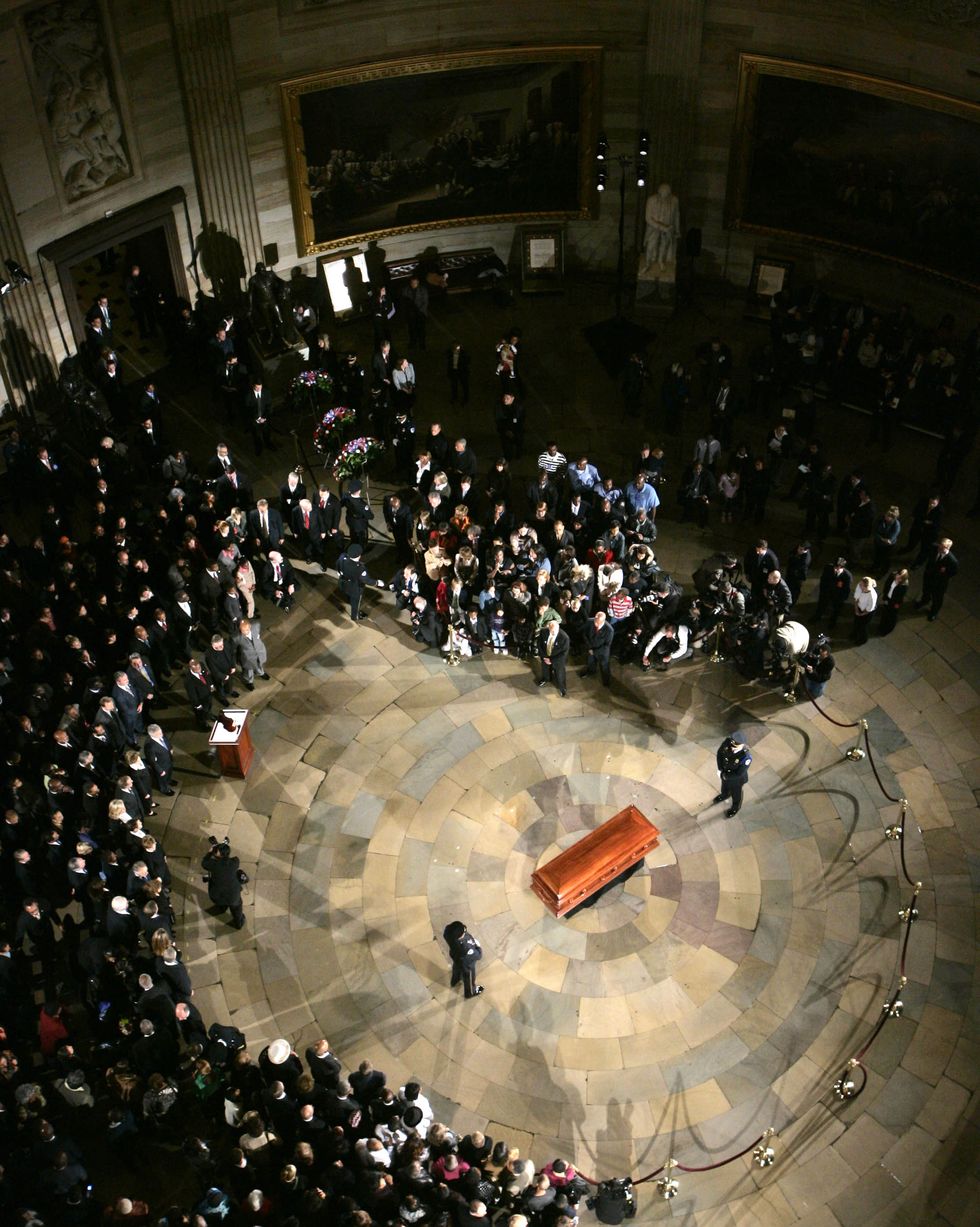
Parks was the first woman and only the second Black person—after Jacob Joseph Chestnut, a U.S. Capitol police officer killed in 1998—to lie in the Capitol, which is considered the “most suitable place for the nation to pay final tribute to its most eminent citizens.” City officials in Montgomery and Detroit reserved the front seats of their buses with black ribbons in honor of Parks.
Parks was laid to rest between her husband and mother at Detroit’s Woodlawn Cemetery, in the chapel’s mausoleum. Shortly after her death, the chapel was renamed the Rosa L. Parks Freedom Chapel. Speaking during her funeral, then–Secretary of State Condoleezza Rice said, “I can honestly say that without Mrs. Parks, I probably would not be standing here today as secretary of state.”
Awards and Tributes
Parks received many accolades during her lifetime, including the Spingarn Medal, the NAACP’s highest award, and the prestigious Martin Luther King Jr. Award. In September 1996, President Bill Clinton awarded Parks the Presidential Medal of Freedom, the highest honor given by the United States’ executive branch. The following year, she was awarded the Congressional Gold Medal, the highest award given by the U.S. legislative branch. Time magazine also named Parks on its 1999 list of “The 20 Most Influential People of the 20th Century.”
On the 45th anniversary of her arrest, Troy University created the Rosa Parks Museum, located at the site of her arrest in downtown Montgomery, Alabama in December 2000. A year later, Grand Rapids, Michigan consecrated Rosa Parks Circle, a 3.5-acre park designed by architect Maya Lin, who designed the Vietnam War Memorial in D.C.
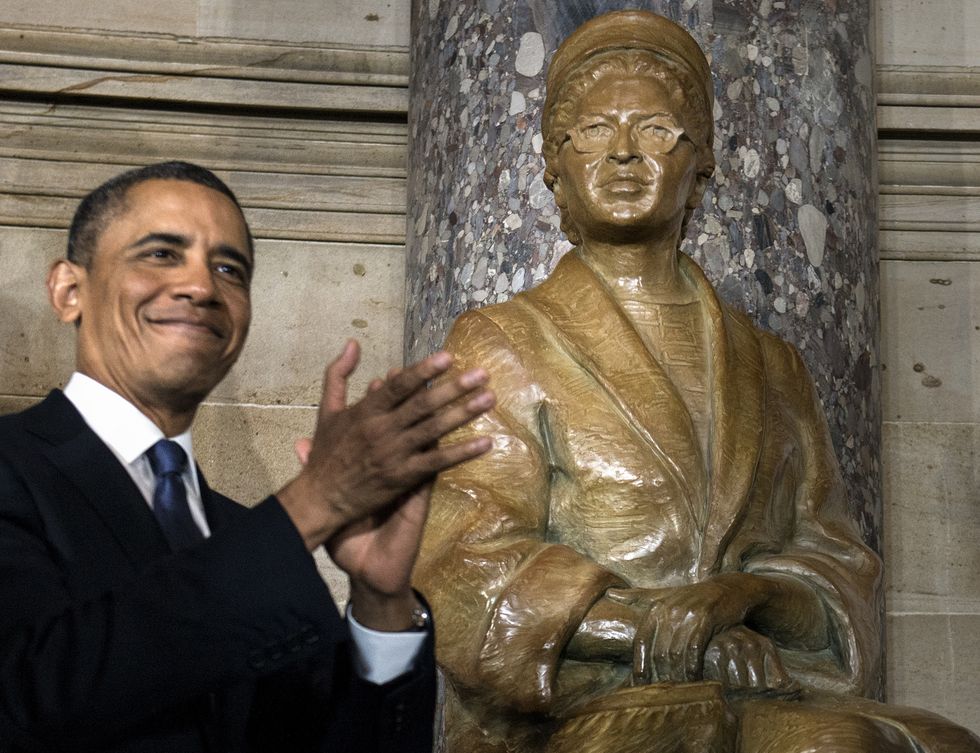
In February 2013, the U.S. Postal Service released a commemorative stamp—on what would have been Parks’ 100th birthday—called the Rosa Parks Forever stamp, featuring a rendition of the famed activist. That same month, President Barack Obama unveiled a statue, designed by Robert Firmin and sculpted by Eugene Daub, honoring Parks in the nation’s Capitol building. “In a single moment, with the simplest of gestures, she helped change America and change the world,” Obama said during the dedication ceremony. “And today, she takes her rightful place among those who shaped this nation’s course.”
Quotes
- At the time I was arrested, I had no idea it would turn into this. It was just a day like any other day. The only thing that made it significant was that the masses of the people joined in.
- I have learned over the years that when one’s mind is made up, this diminishes fear; knowing what must be done does away with fear.
- People always say that I didn’t give up my seat because I was tired... the only tired I was, was tired of giving in.
- Each person must live their life as a model for others.
- I would like to be remembered as a person who wanted to be free... so other people would be also free.
- I’d see the bus pass every day... the bus was among the first ways I realized there was a black and white world.
- When I thought about Emmett Till, I could not go to the back of the bus.
- My only concern was to get home after a hard day’s work.
- The time had just come when I had been pushed as far as I could stand to be pushed.
- I had decided that I would have to know once and for all what rights I had as a human being and a citizen, even in Montgomery, Alabama.
- My resisting being mistreated on the bus did not begin with that particular arrest. I did a lot of walking in Montgomery.
- My desires were to be free as soon as I learned that there had been slavery of human beings.
- As I look back on those days, it’s just like a dream, and the only thing that bothered me was that we waited so long to make this protest and to let it be known, wherever we go, that all of us should be free and equal and have all opportunities that others should have.
- God has always given me the strength to say what is right.
- There were times when it would have been easy to fall apart or to go in the opposite direction, but somehow, I felt that if I took one more step, someone would come along to join me.
- When I made that decision [to refuse to surrender my seat], I knew I had the strength of my ancestors behind me.
- I am always very respectful and very much in awe of the presence of Septima Clark, because her life story makes the effort that I have made very minute. I only hope that there is a possible chance that some of her great courage and dignity and wisdom has rubbed off on me.
Fact Check: We strive for accuracy and fairness. If you see something that doesn’t look right, contact us!
The Biography.com staff is a team of people-obsessed and news-hungry editors with decades of collective experience. We have worked as daily newspaper reporters, major national magazine editors, and as editors-in-chief of regional media publications. Among our ranks are book authors and award-winning journalists. Our staff also works with freelance writers, researchers, and other contributors to produce the smart, compelling profiles and articles you see on our site. To meet the team, visit our About Us page: https://www.biography.com/about/a43602329/about-us
Colin McEvoy joined the Biography.com staff in 2023, and before that had spent 16 years as a journalist, writer, and communications professional. He is the author of two true crime books: Love Me or Else and Fatal Jealousy. He is also an avid film buff, reader, and lover of great stories.
Catherine Caruso joined the Biography.com staff in August 2024, having previously worked as a freelance journalist for several years. She is a graduate of Syracuse University, where she studied English literature. When she’s not working on a new story, you can find her reading, hitting the gym, or watching too much TV.