
1854–1900
Who Was Oscar Wilde?
Oscar Wilde was an author, playwright, and poet in late Victorian England known for The Picture of Dorian Gray and The Importance of Being Earnest. Originally from Ireland, he began writing poetry while studying at Oxford University. In 1891, he published The Picture of Dorian Gray, his only novel, which was panned as immoral by Victorian critics but is now considered one of his most notable works. Many of Wilde’s plays were well received, including his satirical comedies Lady Windermere’s Fan, A Woman of No Importance, An Ideal Husband, and The Importance of Being Earnest, his most famous play. Through his works and his lectures, Wilde became a leading proponent of aestheticism, a creative movement emphasizing the pursuit of beauty for its own sake. Unconventional in his writing and life, Wilde’s affair with a young man led to his arrest for homosexuality in 1895. He was imprisoned for two years and died in poverty not long after, in 1900, at the age of 46.
Quick Facts
FULL NAME: Oscar Fingal O’Flahertie Wills Wilde
BORN: October 16, 1854
DIED: November 30, 1900
BIRTHPLACE: Dublin, Ireland
SPOUSE: Constance Lloyd (1884–1898)
CHILDREN: Cyril and Vyyan
ASTROLOGICAL SIGN: Libra
Early Life and Education
Oscar Fingal O’Flahertie Wills Wilde was born on October 16, 1854, in Dublin. His father, William Wilde, was an acclaimed doctor who was knighted for his work as a medical advisor for the Irish censuses. William later founded St. Mark’s Ophthalmic Hospital, entirely at his own expense, to treat the city’s poor. Wilde’s mother, Jane Francesca Elgee, was a poet who was closely associated with the Young Irelander Rebellion of 1848. The skilled linguist’s acclaimed English translation of the Pomeranian novel Sidonia the Sorceress by Wilhelm Meinhold had a deep influence on her son’s later writing.
Oscar was a bright and bookish child. He attended the Portora Royal School at Enniskillen where he fell in love with Greek and Roman studies. He won the school’s prize for the top classics student in each of his last two years as well as second prize in drawing during his final year. He graduated in 1871.
Oscar was then awarded the Royal School Scholarship to attend Trinity College in Dublin. At the end of his first year at Trinity, in 1872, he placed first in the school’s classics examination and received the college’s Foundation Scholarship, the highest honor given to undergraduates. Upon his graduation in 1874, Oscar received the Berkeley Gold Medal as Trinity’s best student in Greek as well as the Demyship scholarship for further study at Magdalen College at the University of Oxford.

There, Wilde continued to excel academically, receiving first class marks from his examiners in both classics and classical moderations. It was also at Oxford that Wilde made his first sustained attempts at creative writing. In 1878, the year of his graduation, his poem “Ravenna” won the Newdigate Prize for the best English verse composition by an Oxford undergraduate.
Early Career: Poetry and Aestheticism Leader
His education complete, Wilde moved to London to live with his friend Frank Miles, a popular portraitist among London’s high society. Wilde continued to focus on writing poetry, as he had at Oxford, and published his first collection, Poems, in 1881. Although the book received only modest critical praise, it nevertheless established Wilde as an up-and-coming writer.
The next year, in 1882, Wilde traveled from London to New York City to embark on an American lecture tour. He delivered a staggering 140 lectures in just nine months and still found time to meet with some of the leading American scholars and literary figures of the day. This included Henry Longfellow, Oliver Wendell Holmes, and Walt Whitman, whom Wilde especially admired. “There is no one in this wide great world of America whom I love and honor so much,” he later wrote to his idol.
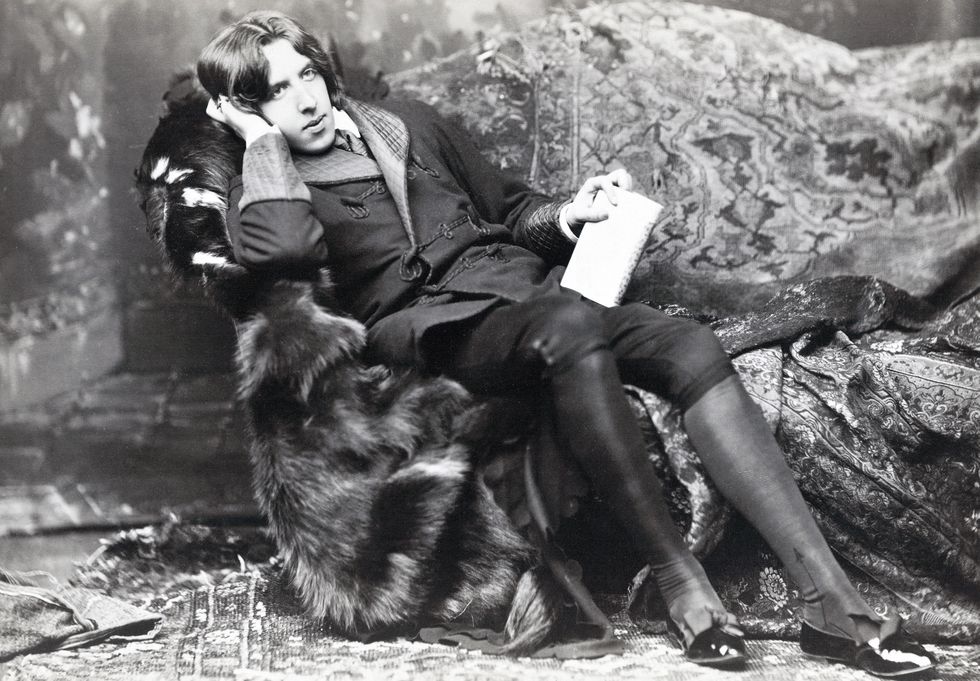
Upon the conclusion of his American tour, Wilde returned home and immediately commenced another lecture circuit of England and Ireland that lasted until the middle of 1884. Through his lectures, as well as his early poetry, Wilde established himself as a leading proponent of the aesthetic movement, a theory of art and literature that emphasized the pursuit of beauty for its own sake rather than to promote any political or social viewpoint.
Wilde was hired to run Lady’s World, a once-popular English magazine that had recently fallen out of fashion, in 1885. During his two years editing Lady’s World, Wilde revitalized the magazine by expanding its coverage to “deal not merely with what women wear, but with what they think and what they feel. The Lady’s World,” wrote Wilde, “should be made the recognized organ for the expression of women’s opinions on all subjects of literature, art and modern life, and yet it should be a magazine that men could read with pleasure.”
Books and Plays
Beginning in 1888, while he was still serving as editor of Lady’s World, Wilde entered a seven-year period of furious creativity, during which he produced nearly all of his great literary works. In 1888, seven years after he released Poems, Wilde published The Happy Prince and Other Tales, a collection of children’s stories. In 1891, he published Intentions, an essay collection arguing the tenets of aestheticism.
His first and only novel, The Picture of Dorian Gray, was also published in 1891. The book is a cautionary tale about a beautiful young man, Dorian Gray, who is granted his wish for his portrait to age while he remains youthful and lives a life of sin and pleasure. Today, the novel is revered as a classic, but at the time, critics were outraged by the its apparent lack of morality. Wilde defended Dorian Gray and said: “There is no such thing as a moral or an immoral book. Books are well written, or badly written. That is all.”
The Complete Works of Oscar Wilde: Stories, Plays, Poems & Essays

The Complete Works of Oscar Wilde: Stories, Plays, Poems & Essays
Wilde’s first play, Lady Windermere’s Fan, opened in February 1892 to widespread popularity and critical acclaim, encouraging Wilde to adopt playwriting as his primary literary form. Over the next few years, Wilde produced several great plays—witty, highly satirical comedies of manners that nevertheless contained dark and serious undertones. His most notable plays were A Woman of No Importance (1893), An Ideal Husband (1895), and The Importance of Being Earnest (1895).
The Importance of Being Earnest remains Wilde’s most famous play. The story centers on a man named Jack Worthing who pretends to have a black sheep brother named Ernest, but in truth, Jack pretends to be Ernest when he goes to London to have fun and be irresponsible. Mistaken identity is one theme of the play, and one of its most famous lines is: “I hope you have not been leading a double life, pretending to be wicked and being good all the time. That would be hypocrisy.” The quote refers to the two faces of Victorian society, in which people had to behave “properly” in public, even though they misbehaved behind closed doors.
Throughout his life, Wilde remained deeply committed to the principles of aestheticism, principles that he expounded through his lectures and demonstrated through his works as well as anyone of his era. “All art is at once surface and symbol,” Wilde wrote in the preface to The Picture of Dorian Gray. “Those who go beneath the surface do so at their peril. Those who read the symbol do so at their peril. It is the spectator, and not life, that art really mirrors. Diversity of opinion about a work of art shows that the work is new, complex and vital.”
Was Oscar Wilde Gay?

Wilde was married to Constance Lloyd, a wealthy Englishwoman, for more than a decade. The couple wed on May 29, 1884, the same year Wilde finished his British lecture series. They had two sons: Cyril, born in 1885, and Vyvyan, born in 1886.
Multiple accounts report Wilde and his wife were very much in love, but a few years into their marriage, the writer began a series of affairs with men. The first was with Robbie Ross, not long after Vyvyan was born. Then, around the same time that he was enjoying his greatest literary success, Wilde commenced an affair with a young man named Lord Alfred Douglas. His father, the Marquis of Queensberry, had gotten wind of the relationship and on February 18, 1895, left a calling card at Wilde’s home addressed to “Oscar Wilde: Posing Somdomite,” a misspelling of sodomite. Although Wilde’s homosexuality was something of an open secret, he was so outraged by Queensberry’s note that he sued him for libel. The decision ruined his life.
When the trial began that March, Queensberry and his lawyers presented evidence of Wilde’s homosexuality—homoerotic passages from his literary works as well as his love letters to Douglas—that quickly resulted in the dismissal of Wilde’s libel case and his arrest on charges of “gross indecency.” Wilde was convicted on May 25, 1895, and sentenced to two years in prison.
Constance, seeking anonymity, then fled to Europe with their children and changed their last name to Holland. She died in 1898.
Meanwhile, Wilde emerged from prison in 1897, physically depleted, emotionally exhausted, and flat broke. He went into exile in France, where, living in cheap hotels and friends’ apartments, he briefly reunited with Douglas. Wilde wrote very little during these last years; his only notable work was a poem he completed in 1898 about his experiences in prison, “The Ballad of Reading Gaol.”
Death and Legacy
Wilde never fully recovered physically from his time in prison. He had lost a lot of weight and had a bad fall. Some mishaps led to surgery by a questionable physician. During one of the operations, he developed an infection, and that led to meningitis. False rumors spread that he had contracted syphilis, among other diseases.
In truth, Wilde died of meningitis at the Hôtel d’Alsace in Saint-Germain-des-Prés, Paris, on November 30, 1900. He was 46.
Room 16, in which he was staying, has long been a tourist attraction and even Anthony Bourdain visited in 2005. His supposed last words were, “My wallpaper and I are fighting a duel to the death. One or the other of us must go.”
More than a century after his death, Wilde is remembered both for his personal life—his exuberant personality, consummate wit, and infamous imprisonment for homosexuality—as much as for his literary accomplishments. The Picture of Dorian Gray and The Importance of Being Earnest are considered among the great literary masterpieces of the late Victorian period. Wilde’s novel has been adapted for the stage many times, and, in 2025, actor Sarah Snook played all 26 roles in a Tony-nominated production of The Picture of Dorian Gray on Broadway. As with Wilde’s other works, the themes are timeless. Take this line, for example: “Nowadays people know the price of everything and the value of nothing.”
Likewise, even 130 years after its premiere, The Importance of Being Earnest remains popular and as relevant in the 21st century as it was in the 19th. Throughout the 20th century, it was performed around the world, and filmed, too, with three movie versions released in the 2000s alone. A 2002 movie of the play starred Reese Witherspoon, Rupert Everett, Colin Firth, and Judi Dench, while the Royal National Theater in London had a hit with the play in 2025.
Today, one of his early Dublin homes is called the Oscar Wilde House and features tours and writing classes. A New York City bar and restaurant also bears his name.
Quotes
- We are all in the gutter, but some of us are looking at the stars.
- I can resist everything except temptation.
- America had often been discovered before Columbus, but it had always been hushed up.
Fact Check: We strive for accuracy and fairness. If you see something that doesn’t look right, contact us!
The Biography.com staff is a team of people-obsessed and news-hungry editors with decades of collective experience. We have worked as daily newspaper reporters, major national magazine editors, and as editors-in-chief of regional media publications. Among our ranks are book authors and award-winning journalists. Our staff also works with freelance writers, researchers, and other contributors to produce the smart, compelling profiles and articles you see on our site. To meet the team, visit our About Us page: https://www.biography.com/about/a43602329/about-us
Since 2010, Donna Raskin, a longtime writer and editor, has taught history classes at the College of New Jersey. As a child, she read and re-read every book in the Childhood of Famous Americans series. As an adult, she collects fashion history books and has traveled to Paris on a fashion history tour. In addition to contributing to Biography.com, she is the senior health and fitness editor at Bicycling and Runner’s World.


