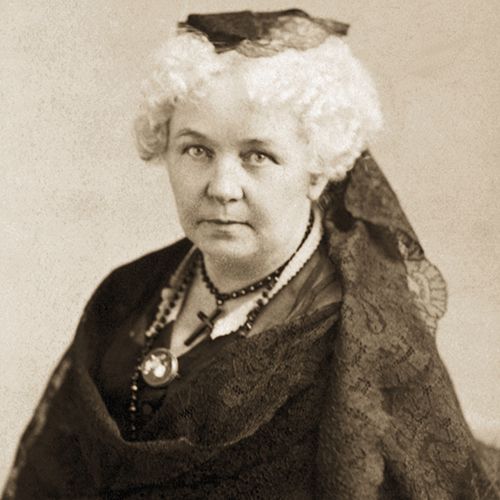
(1815-1902)
Who Was Elizabeth Cady Stanton?
Elizabeth Cady Stanton was an abolitionist and leading figure of the early woman's movement. An eloquent writer, her Declaration of Sentiments was a revolutionary call for women's rights across a variety of spectrums. Stanton was the president of the National Woman Suffrage Association for 20 years and worked closely with Susan B. Anthony.
Quick Facts
FULL NAME: Elizabeth Cady Stanton
BORN: November 12, 1815
BIRTHPLACE: Johnstown, New York
DEATH: October 26, 1902
SPOUSE: Henry Brewster Stanton (m. 1840–1887)
ASTROLOGICAL SIGN: Scorpio
Early Life
Stanton was born on November 12, 1815, in Johnstown, New York. The daughter of a lawyer who made no secret of his preference for another son, she early showed her desire to excel in intellectual and other "male" spheres. She graduated from Emma Willard's Troy Female Seminary in 1832, and then was drawn to the abolitionist, temperance and women's rights movements through visits to the home of her cousin, the reformer Gerrit Smith.
In 1840, Elizabeth Cady Stanton married a reformer Henry Stanton (omitting “obey” from the marriage oath), and they went at once to the World's Anti-Slavery Convention in London, where she joined other women in objecting to their exclusion from the assembly. On returning to the United States, Stanton and Henry had seven children while he studied and practiced law, and eventually, they settled in Seneca Falls, New York.
Elizabeth Cady Stanton: An American Life


Women's Rights Movement
With Lucretia Mott and several other women, Stanton held the famous Seneca Falls Convention in July 1848. At this meeting, the attendees drew up its “Declaration of Sentiments” and took the lead in proposing that women be granted the right to vote. She continued to write and lecture on women's rights and other reforms of the day. After meeting Susan B. Anthony in the early 1850s, she was one of the leaders in promoting women's rights in general (such as divorce) and the right to vote in particular.
During the Civil War, Stanton concentrated her efforts on abolishing slavery, but afterward she became even more outspoken in promoting women suffrage. In 1868, she worked with Anthony on the Revolution, a militant weekly paper. The two then formed the National Woman Suffrage Association (NWSA) in 1869. Stanton was the NWSA’s first president, a position she held until 1890. At that time, the organization merged with another suffrage group to form the National American Woman Suffrage Association. Stanton served as the president of the new organization for two years.

Later Work and Death
As a part of her work on behalf of women’s rights, Stanton often traveled to give lectures and speeches. She called for an amendment to the U.S. Constitution giving women the right to vote. Stanton also worked with Anthony on the first three volumes of the History of Woman Suffrage (1881–1886). Matilda Joslyn Gage also worked with the pair on parts of the project.
Besides chronicling the history of the suffrage movement, Stanton took on the role religion played in the struggle for equal rights for women. She had long argued that the Bible and organized religion played in denying women their full rights. With her daughter, Harriet Stanton Blatch, she published a critique, The Woman's Bible, which was published in two volumes. The first volume appeared in 1895 and the second in 1898. This brought considerable protest not only from expected religious quarters but from many in the woman suffrage movement.
Stanton died on October 26, 1902. More so than many other women in that movement, she was able and willing to speak out on a wide spectrum of issues - from the primacy of legislatures over the courts and constitution to women's right to ride bicycles - and she deserves to be recognized as one of the more remarkable individuals in American history.
Fact Check: We strive for accuracy and fairness. If you see something that doesn't look right, contact us!
The Biography.com staff is a team of people-obsessed and news-hungry editors with decades of collective experience. We have worked as daily newspaper reporters, major national magazine editors, and as editors-in-chief of regional media publications. Among our ranks are book authors and award-winning journalists. Our staff also works with freelance writers, researchers, and other contributors to produce the smart, compelling profiles and articles you see on our site. To meet the team, visit our About Us page: https://www.biography.com/about/a43602329/about-us