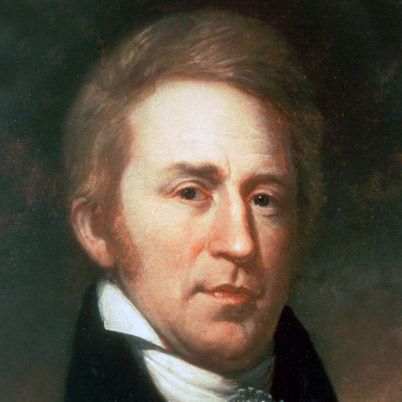
(1770-1838)
Who Was William Clark?
William Clark was part of the legendary exploration team of Lewis and Clark. The journey began when Meriwether Lewis invited him to share command of an expedition of the lands west of the Mississippi River. After more than two years and over 8,000 miles, the expedition helped mapmakers understand the geography of the American West.
Early Life
Clark was born on August 1, 1770, in Caroline County, Virginia. His parents, John and Ann Rogers Clark, were both born in Virginia and were of Scottish and English ancestry. Clark grew up in a large brood and was the ninth of 10 siblings. He had five older brothers who all fought in the American Revolutionary War. His eldest brother Jonathan Clark was a colonel and moved up the ranks to become a brigadier general, while his other brother, George Rogers Clark became a prominent general and spent most of his time in Kentucky fighting against the Indigenous peoples who were allied with the British. It was in Kentucky where the Clark Family, along with their enslaved people, would eventually make their home.
Clark entered the military at the age of 19. He became friends with Lewis while the two served together in the U.S. Army in 1795. The next year, Clark resigned from the army to become the manager of his family's estate.
Lewis and Clark Expedition
In 1803, Clark received a letter from his old friend Lewis, inviting him to share command of an expedition of the lands west of the Mississippi River. The expedition was prompted by the acquisition of more than 800 thousand square miles of land through the Louisiana Purchase. The legendary journey began the following May in St. Louis, Missouri. An experienced soldier and outdoorsman, Clark helped keep the expedition moving. He was also an excellent mapmaker and helped to figure what routes the expedition should take.
Sacagawea
The trip was not without hazards. Clark helped lead the expedition through treacherous terrain and hostile weather, encountering many Indigenous peoples along the way. While spending their first winter near a native Mandan village, they invited Sacagawea, a Shoshone Indian, and her husband Toussaint Charbonneau, a French Canadian trader, to join the expedition as interpreters. During the journey, Sacagawea gave birth to a child named Jean Baptiste in February 1805. The child was later nicknamed "Little Pomp" or "Pomp" by Clark.
The expedition made it to the present-day Oregon coast in November 1805. They built a fort they named Fort Clatsop and waited out the winter there. In March 1806, the expedition prepared to make the journey back to St. Louis. In early July, Lewis and Clark decided to divide into two groups to see more of the area. Clark took a group with him to explore the Yellowstone River. During this part of the journey, he named a rock formation after Sacagawea's son, calling it Pompy's Tower. The formation stands near what is now Billings, Montana, and bears the only physical trace of the entire expedition's path — "W Clark July 25 1806" carved on its surface.
Corps of Discovery
Clark and Lewis regrouped by the Missouri River in August, and the expedition reached St. Louis the next month. Traveling for more than two years and covering more than 8,000 miles, the epic journey had reached its conclusion. The return of the Corps of Discovery — the name commonly used by historians to describe this expedition — was marked by numerous celebrations. Clark and Lewis were treated like national heroes. They were rewarded for their trailblazing efforts with extra pay and land. Clark also received an appointment as the agent for Indigenous peoples affairs in the West and became a brigadier general of the militia.
Post-Expedition Life
Clark married Julia Hancock in 1808. Along with his own family, he cared for the children of Sacagawea after she died in 1812. The next year, he served as governor of the Missouri Territory, a position he held for seven years. Once the territory became a state in 1820, Clark ran for governor but lost the election. He continued his work in Indian affairs and was known for his fair treatment of Indigenous peoples.
Death and Legacy
Clark died on September 1, 1838, in St. Louis, Missouri. He has been remembered as one of the country's greatest explorers. The maps he drew helped the U.S. government — and the rest of the nation — understand the geography of the American West. His journal also provided insights into the lands, peoples and animal life of the region.
QUICK FACTS
- Name: Clark
- Birth Year: 1770
- Birth date: August 1, 1770
- Birth State: Virginia
- Birth City: Caroline County
- Birth Country: United States
- Gender: Male
- Best Known For: William Clark was half of the exploration team Lewis and Clark, who in the early 1800s explored and mapped the lands west of the Mississippi River.
- Astrological Sign: Leo
- Interesting Facts
- William Clark had nine siblings.
- The Lewis and Clark Expedition lasted for more than two years and covered more than 8,000 miles.
- Death Year: 1838
- Death date: September 1, 1838
- Death State: Missouri
- Death City: St. Louis
- Death Country: United States
Fact Check
We strive for accuracy and fairness.If you see something that doesn't look right,contact us!
CITATION INFORMATION
- Article Title: William Clark Biography
- Author: Biography.com Editors
- Website Name: The Biography.com website
- Url: https://www.biography.com/history-culture/william-clark
- Access Date:
- Publisher: A&E; Television Networks
- Last Updated: September 23, 2020
- Original Published Date: April 2, 2014


