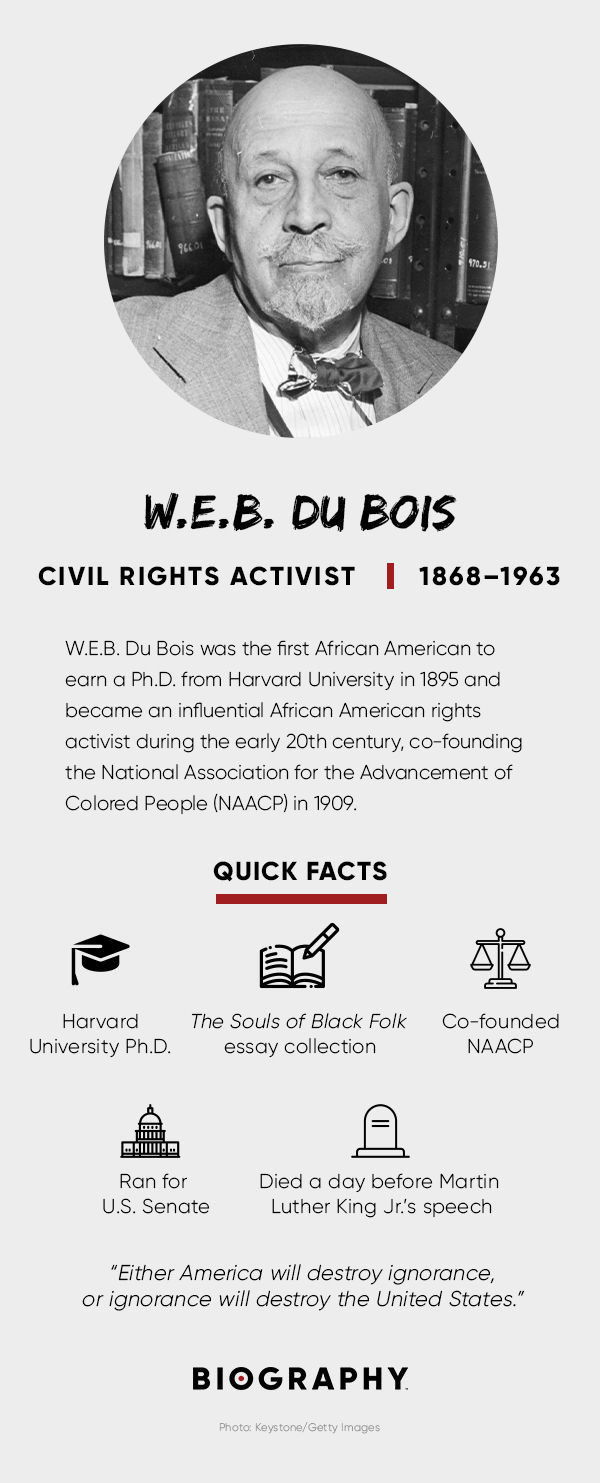
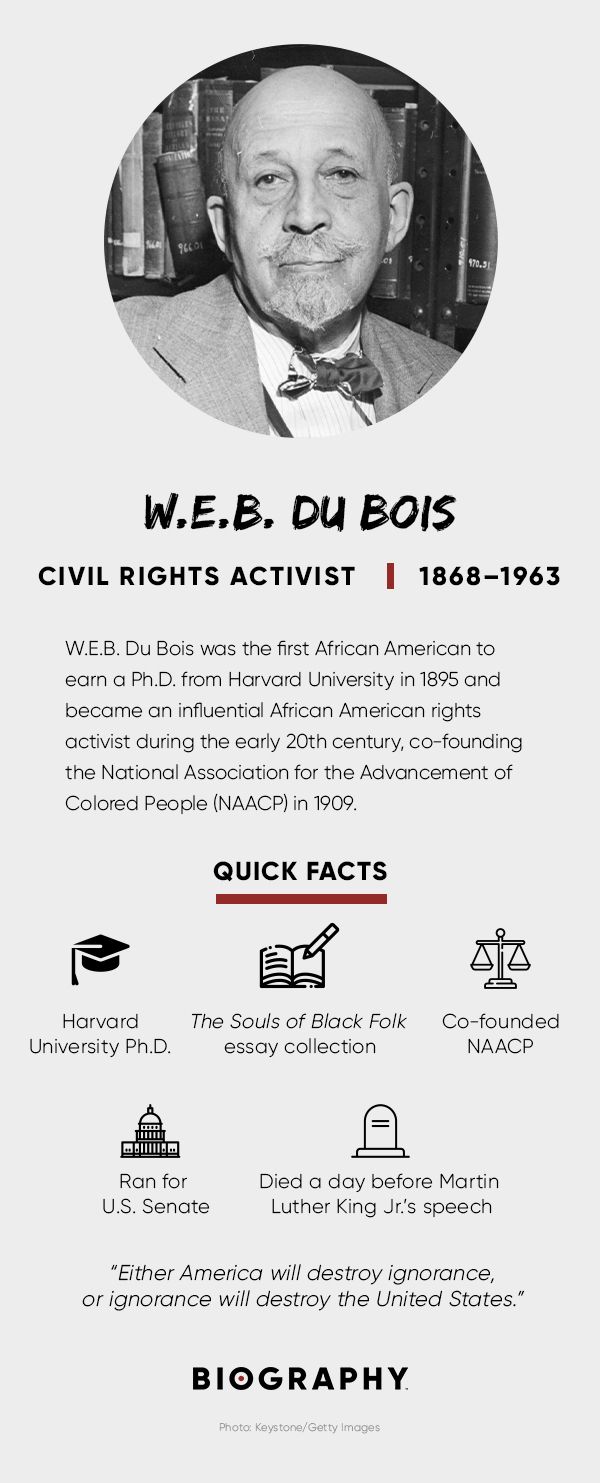
(1868-1963)
Who Was W.E.B. Du Bois?
Scholar and activist W.E.B. Du Bois became the first African American to earn a Ph.D. from Harvard University in 1895. He wrote extensively and was the best-known spokesperson for African American rights during the first half of the 20th century. Du Bois co-founded the National Association for the Advancement of Colored People (NAACP) in 1909.
Early Life and Education
William Edward Burghardt Du Bois, better known as W.E.B. Du Bois, was born on February 23, 1868, in Great Barrington, Massachusetts.
While growing up in a mostly white American town, Du Bois identified himself as mulatto, but freely attended school with white people and was enthusiastically supported in his academic studies by his white teachers.
In 1885, he moved to Nashville, Tennessee, to attend Fisk University. It was there that he first encountered Jim Crow laws. For the first time, he began analyzing the deep troubles of American racism.
After earning his bachelor's degree at Fisk, Du Bois entered Harvard University. He paid his way with money from summer jobs, scholarships and loans from friends. After completing his master's degree, he was selected for a study-abroad program at the University of Berlin.
While a pupil in Germany, he studied with some of the most prominent social scientists of his day and was exposed to political perspectives that he touted for the remainder of his life.
Harvard Ph.D.
Du Bois became the first African American to earn a Ph.D. from Harvard University in 1895.
He went on to enroll as a doctoral student at Friedrich-Wilhelms-Universität (now Humboldt-Universität). He would be awarded an honorary doctoral degree from Humboldt decades later, in 1958.
Writing and Activism
Du Bois published his landmark study — the first case study of an African American community — The Philadelphia Negro: A Social Study (1899), marking the beginning of his expansive writing career.
In the study, he coined the phrase "the talented tenth," a term that described the likelihood of one in 10 Black men becoming leaders of their race.
Du Bois and Booker T. Washington
While working as a professor at Atlanta University, Du Bois rose to national prominence when he very publicly opposed Booker T. Washington's "Atlanta Compromise," an agreement that asserted that vocational education for Black people was more valuable to them than social advantages like higher education or political office.
Du Bois criticized Washington for not demanding full equality for African Americans, as granted by the 14th Amendment. Du Bois fought what he believed was an inferior strategy, subsequently becoming a spokesperson for full and equal rights in every realm of a person's life.
'The Souls of Black Folks'
In 1903, Du Bois published a seminal work, The Souls of Black Folk, a collection of 14 essays. In the years following, he adamantly opposed the idea of biological white superiority and vocally supported women's rights.
In 1909, Du Bois co-founded the National Association for the Advancement of Colored People (NAACP) and served as editor of its monthly magazine, The Crisis.
Pan-Africanism
A proponent of Pan-Africanism, Du Bois helped organize several Pan-African Congresses to free African colonies from European powers.
Death
Du Bois died on August 27, 1963 — one day before Martin Luther King Jr. delivered his "I Have a Dream" speech at the March on Washington — at the age of 95, in Accra, Ghana, while working on an encyclopedia of the African Diaspora.
QUICK FACTS
- Name: W.E.B. Du Bois
- Birth Year: 1868
- Birth date: February 23, 1868
- Birth State: Massachusetts
- Birth City: Great Barrington
- Birth Country: United States
- Gender: Male
- Best Known For: W.E.B. Du Bois was an influential African American rights activist during the early 20th century. He co-founded the NAACP and wrote 'The Souls of Black Folk.'
- Industries
- Education and Academia
- Writing and Publishing
- Civil Rights
- Journalism and Nonfiction
- Astrological Sign: Pisces
- Schools
- Harvard University
- University of Berlin
- Fisk University
- Friedrich-Wilhelms-Universität (now Humboldt-Universität)
- Interesting Facts
- W.E.B. Du Bois was the first African American to receive a Ph.D. from Harvard University (1895).
- The first case study of an African American community was conducted by W.E.B. Du Bois, published as The Philadelphia Negro: A Social Study (1899).
- W.E.B. Du Bois co-founded the NAACP in 1909.
- W.E.B. Du Bois died one day before Martin Luther King Jr. delivered his "I Have a Dream" speech at the March on Washington (August 28, 1963).
- Death Year: 1963
- Death date: August 27, 1963
- Death City: Accra
- Death Country: Ghana
Fact Check
We strive for accuracy and fairness.If you see something that doesn't look right,contact us!
CITATION INFORMATION
- Article Title: W.E.B. Du Bois Biography
- Author: Biography.com Editors
- Website Name: The Biography.com website
- Url: https://www.biography.com/activists/web-du-bois
- Access Date:
- Publisher: A&E; Television Networks
- Last Updated: January 7, 2021
- Original Published Date: April 3, 2014
QUOTES
- One ever feels his 'twoness' — an American, a Negro; two souls, two thoughts, two unreconciled strivings; two warring ideals in one dark body, whose dogged strength alone keeps it from being torn asunder.
- The problem of the 20th century is the problem of the color line.
- If there is anybody in this land who thoroughly believes that the meek shall inherit the earth, they have not often let their presence be known.
- There is but one coward on earth, and that is the coward that dare not know.
- The cost of liberty is less than the price of repression.
- To be a poor man is hard, but to be a poor race in a land of dollars is the very bottom of hardships.
- To the real question, 'How does it feel to be a problem?' I answer seldom a word.
- Honest and earnest criticism from those whose interests are most nearly touched—criticism of writers by readers, of government by those governed, of leaders by those led—this is the soul of democracy and the safeguard of modern society.
- The American Negro Academy believes that upon those of the race who have had the advantage of higher education and culture, rests the responsibility of taking concerted steps for the employment of these agencies to uplift the race to higher planes of thought and action. Two great obstacles to this consummation are apparent: (a) The lack of unity, want of harmony, absence of a self-sacrificing spirit, and no well-defined line of policy seeking definite aims; and (b) The persistent, relentless, at times covert opposition employed to thwart the Negro at every step of his upward struggles to establish the justness of his claim to the highest physical, intellectual and moral possibilities.
- The world still wants to ask that a woman primarily be pretty and if she is not, the mob pouts and asks querulously, 'What else are women for?'
- Ignorance is a cure for nothing.
- The history of the American Negro is the history of this strife — this longing to attain self-conscious manhood, to merge his double self into a better and truer self. In this merging, he wishes neither of the older selves to be lost. ...He simply wishes to make it possible for a man to be both a Negro and an American.
- Either America will destroy ignorance, or ignorance will destroy the United States.