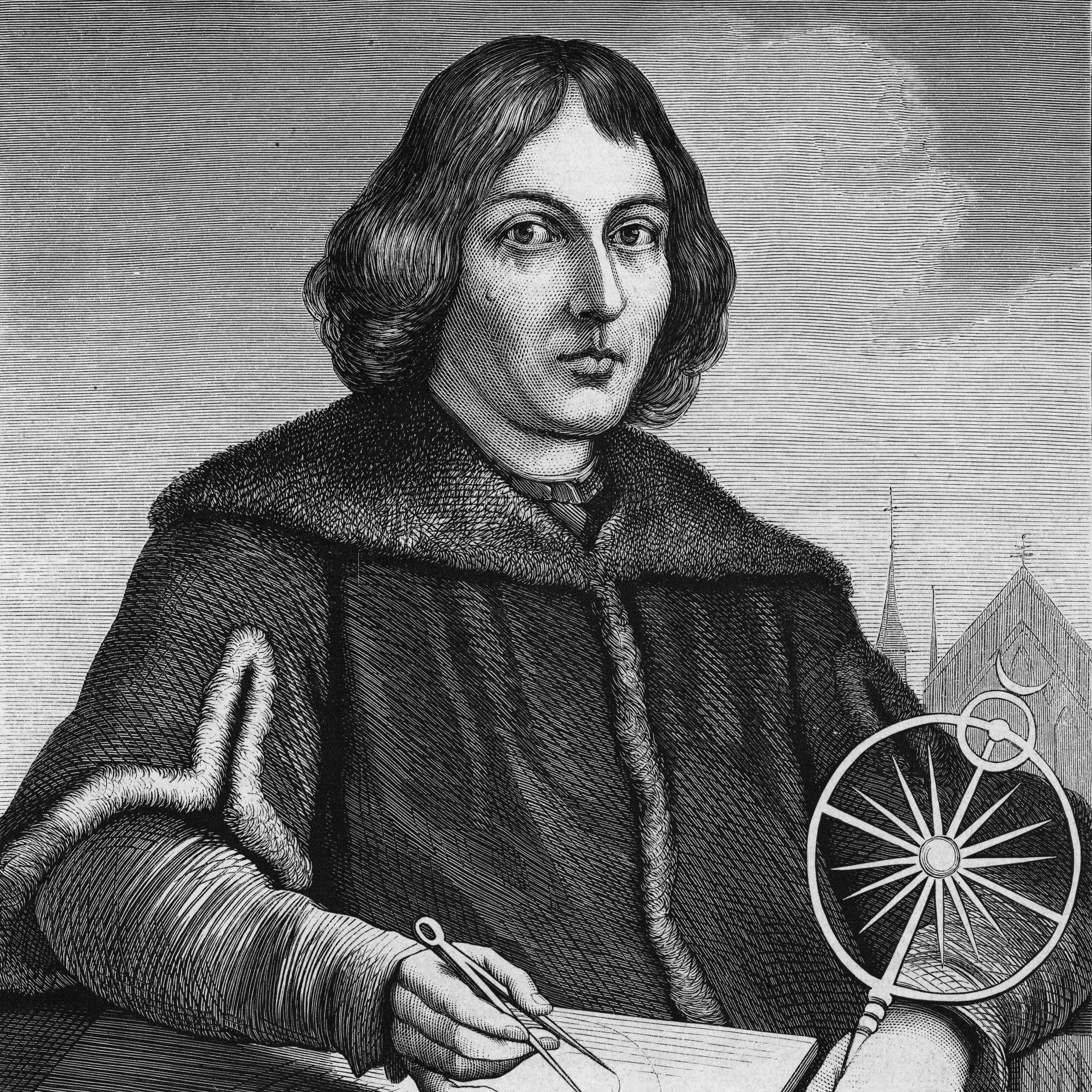
(1473-1543)
Who Was Copernicus?
Circa 1508, Nicolaus Copernicus developed his own celestial model of a heliocentric planetary system. Around 1514, he shared his findings in the Commentariolus. His second book on the topic, De revolutionibus orbium coelestium, was banned by the Roman Catholic Church decades after his May 24, 1543 death in Frombork.
Early Life and Education
Famed astronomer Nicolaus Copernicus (Mikolaj Kopernik, in Polish) came into the world on February 19, 1473. The fourth and youngest child born to Nicolaus Copernicus Sr. and Barbara Watzenrode, an affluent copper merchant family in Torun, West Prussia, Copernicus was technically of German heritage. By the time he was born, Torun had ceded to Poland, rendering him a citizen under the Polish crown. German was Copernicus' first language, but some scholars believe that he spoke some Polish as well.
During the mid-1480s, Copernicus' father passed away. His maternal uncle, Bishop of Varmia Lucas Watzenrode, generously assumed a paternal role, taking it upon himself to ensure that Copernicus received the best possible education. In 1491, Copernicus entered the University of Cracow, where he studied painting and mathematics. He also developed a growing interest in the cosmos and started collecting books on the topic.
Established as Canon
By mid-decade, Copernicus received a Frombork canon cathedral appointment, holding onto the job for the rest of his life. It was a fortunate stroke: The canon's position afforded him the opportunity to fund the continuation of his studies for as long as he liked. Still, the job demanded much of his schedule; he was only able to pursue his academic interests intermittently, during his free time.
In 1496, Copernicus took leave and traveled to Italy, where he enrolled in a religious law program at the University of Bologna. There, he met astronomer Domenico Maria Novara — a fateful encounter, as the two began exchanging astronomical ideas and observations, ultimately becoming housemates. Historian Edward Rosen described the relationship as follows: "In establishing close contact with Novara, Copernicus met, perhaps for the first time in his life, a mind that dared to challenge the authority of [astrologist Claudius Ptolemy] the most eminent ancient writer in his chosen fields of study."
In 1501, Copernicus went on to study practical medicine at the University of Padua. He did not, however, stay long enough to earn a degree, since the two-year leave of absence from his canon position was nearing expiration. In 1503, Copernicus attended the University of Ferrara, where he took the necessary exams to earn his doctorate in canon law. He hurried back home to Poland, where he resumed his position as canon and rejoined his uncle at an Episcopal palace. Copernicus remained at the Lidzbark-Warminski residence for the next several years, working and tending to his elderly, ailing uncle and exploring astronomy.
In 1510, Copernicus moved to a residence in the Frombork cathedral chapter. He would live there as a canon for the duration of his life.
Copernicus' Theory: Heliocentric Solar System
Throughout the time he spent in Lidzbark-Warminski, Copernicus continued to study astronomy. Among the sources that he consulted was Regiomontanus's 15th-century work Epitome of the Almagest, which presented an alternative to Ptolemy's model of the universe and significantly influenced Copernicus' research.
Scholars believe that by around 1508, Copernicus had begun developing his own celestial model, a heliocentric planetary system. During the second century A.D., Ptolemy had invented a geometric planetary model with eccentric circular motions and epicycles, significantly deviating from Aristotle's idea that celestial bodies moved in a fixed circular motion around the earth. In an attempt to reconcile such inconsistencies, Copernicus' heliocentric solar system named the sun, rather than the earth, as the center of the solar system. Subsequently, Copernicus believed that the size and speed of each planet's orbit depended on its distance from the sun.
Though his theory was viewed as revolutionary and met with controversy, Copernicus was not the first astronomer to propose a heliocentric system. Centuries prior, in the third century B.C., the ancient Greek astronomer Aristarchus of Samos had identified the sun as a central unit orbited by a revolving earth. But a heliocentric theory was dismissed in Copernicus' era because Ptolemy's ideas were far more accepted by the influential Roman Catholic Church, which adamantly supported the earth-based solar system theory. Still, Copernicus' heliocentric system proved to be more detailed and accurate than Aristarchus', including a more efficient formula for calculating planetary positions.
In 1513, Copernicus' dedication prompted him to build his own modest observatory. Nonetheless, his observations did, at times, lead him to form inaccurate conclusions, including his assumption that planetary orbits occurred in perfect circles. As German astronomer Johannes Kepler would later prove, planetary orbits are actually elliptical in shape.
Contributions
Around 1514, Copernicus completed a written work, Commentariolus (Latin for "Small Commentary"), a 40-page manuscript which summarized his heliocentric planetary system and alluded to forthcoming mathematical formulas meant to serve as proof.
The sketch set forth seven axioms, each describing an aspect of the heliocentric solar system: 1) Planets don't revolve around one fixed point; 2) The earth is not at the center of the universe; 3) The sun is at the center of the universe, and all celestial bodies rotate around it; 4) The distance between the Earth and Sun is only a tiny fraction of stars' distance from the Earth and Sun; 5) Stars do not move, and if they appear to, it is only because the Earth itself is moving; 6) Earth moves in a sphere around the Sun, causing the Sun's perceived yearly movement; and 7) Earth's own movement causes other planets to appear to move in an opposite direction.
Commentariolus also went on to describe in detail Copernicus' assertion that a mere 34 circles could sufficiently illustrate planetary motion. Copernicus sent his unpublished manuscript to several scholarly friends and contemporaries, and while the manuscript received little to no response among his colleagues, a buzz began to build around Copernicus and his unconventional theories.
Courting Controversy with the Catholic Church
Copernicus raised a fair share of controversy with Commentariolus and De revolutionibus orbium coelestium ("On the Revolutions of the Heavenly Spheres"), with the second work published right before his death. His critics claimed that he failed to solve the mystery of the parallax — the seeming displacement in the position of a celestial body, when viewed along varying lines of sight — and that his work lacked a sufficient explanation for why the Earth orbits the Sun.
Copernicus' theories also incensed the Roman Catholic Church and were considered heretical. When De revolutionibus orbium coelestium was published in 1543, religious leader Martin Luther voiced his opposition to the heliocentric solar system model. His underling, Lutheran minister Andreas Osiander, quickly followed suit, saying of Copernicus, "This fool wants to turn the whole art of astronomy upside down."
Osiander even went so far as to write a disclaimer stating that the heliocentric system was an abstract hypothesis that need not be seen as truth. He added his text to the book's preface, leading readers to assume that Copernicus himself had written it. By this time, Copernicus was ailing and unfit for the task of defending his work.
Ironically, Copernicus had dedicated De revolutionibus orbium coelestium to Pope Paul III. If his tribute to the religious leader was an attempt to cull the Catholic Church's softer reception, it was to no avail. The church ultimately banned De revolutionibus in 1616, though the book was eventually removed from the list of forbidden reading material.
Death
In May 1543, mathematician and scholar Georg Joachim Rheticus presented Copernicus with a copy of a newly published De revolutionibus orbium coelestium. Suffering the aftermath of a recent stroke, Copernicus was said to have been clutching the book when he died in his bed on May 24, 1543, in Frombork, Poland.
Legacy
Kepler later revealed to the public that the preface for De revolutionibus orbium coelestium had indeed been written by Osiander, not Copernicus. As Kepler worked on expanding upon and correcting the errors of Copernicus' heliocentric theory, Copernicus became a symbol of the brave scientist standing alone, defending his theories against the common beliefs of his time.
"],[""]]" tml-render-layout="inline">QUICK FACTS
- Name: Nicolaus Copernicus
- Birth Year: 1473
- Birth date: February 19, 1473
- Birth City: Torun
- Birth Country: Poland
- Gender: Male
- Best Known For: Astronomer Nicolaus Copernicus was instrumental in establishing the concept of a heliocentric solar system, in which the sun, rather than the earth, is the center of the solar system.
- Industries
- Science and Medicine
- Education and Academia
- Astrological Sign: Pisces
- Schools
- University of Bologna
- University of Cracow
- University of Ferrara
- University of Padua
- Death Year: 1543
- Death date: May 24, 1543
- Death City: Frombork
- Death Country: Poland
Fact Check
We strive for accuracy and fairness.If you see something that doesn't look right,contact us!
CITATION INFORMATION
- Article Title: Nicolaus Copernicus Biography
- Author: Biography.com Editors
- Website Name: The Biography.com website
- Url: https://www.biography.com/scientists/nicolaus-copernicus
- Access Date:
- Publisher: A&E; Television Networks
- Last Updated: September 14, 2022
- Original Published Date: April 3, 2014
QUOTES
- I am not so enamored of my own opinions that I disregard what others may think of them.
- [T]he motion of the earth can unquestionably produce the impression that the entire universe is rotating.
- For, the sun is not inappropriately called by some people the lantern of the universe, its mind by others, and its ruler by still others.
- Thus indeed, as though seated on a royal throne, the sun governs the family of planets revolving around it.
- But if one believed that the earth revolved, he would certainly be of the opinion that this movement was natural and not arbitrary.
- For my part I believe that gravity is nothing but a certain natural desire, which the divine providence of the Creator of all things has implanted in parts, to gather as a unity and a whole by combining in the form of a globe.
- So far as hypotheses are concerned, let no one expect anything certain from astronomy, which cannot furnish it, lest he accept as the truth ideas conceived for another purpose, and depart from this study a greater fool than when he entered it.
- [T]he astronomer will take as his first choice that hypothesis which is the easiest to grasp. The philosopher will perhaps rather seek the semblance of the truth. But neither of them will understand or state anything certain, unless it has been divinely revealed to him.
- Of all things visible, the highest is the heaven of the fixed stars.
- Even though what I am now saying may be obscure, it will nevertheless become clearer in the proper place.
- To know that we know what we know, and to know that we do not know what we do not know, that is true knowledge.
- For a traveler going from any place toward the north, that pole of the daily rotation gradually climbs higher, while the opposite pole drops down an equal amount.
- At rest, however, in the middle of everything is the sun.