(1341-1323)
Who Was King Tut?
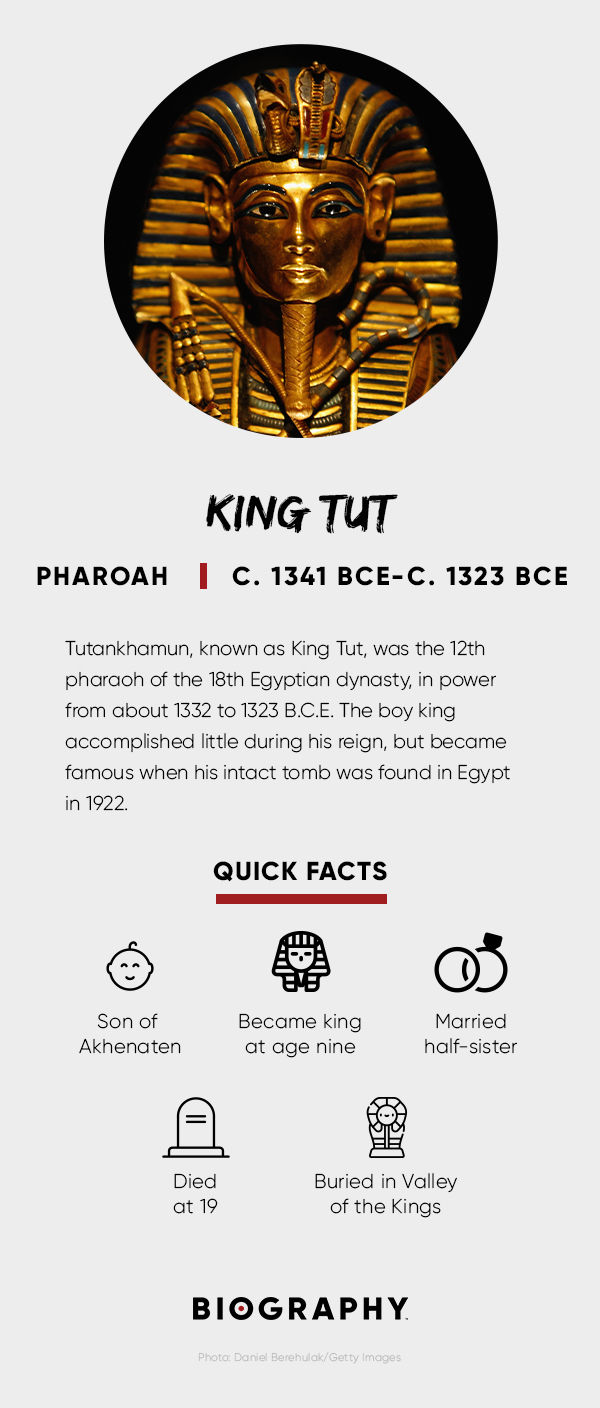
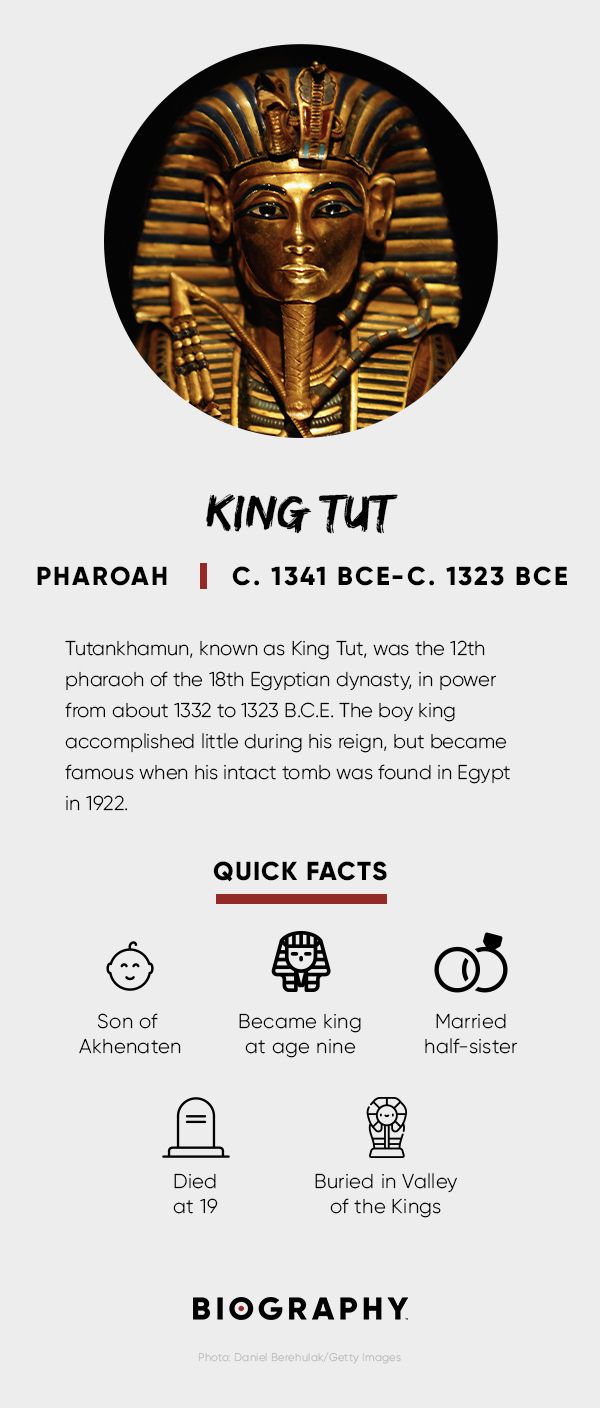
Tutankhamun, colloquially known as King Tut, was the 12th pharaoh of the 18th Egyptian dynasty, in power from approximately 1332 to 1323 B.C.E.
During his reign, Tutankhamun accomplished little. However, his powerful advisers restored the traditional Egyptian religion, which had been set aside by his father, Akhenaten, who led the "Amarna Revolution."
After his death at age 19, King Tut disappeared from history until the discovery of his tomb in 1922. Since then, studies of his tomb and remains have revealed much information about his life and times, making Tutankhamun one of the best known ancient Egyptian kings.
King Tut's Full Name
King Tut was born circa 1341 B.C.E. in ancient Egypt. He was given the name Tutankhaten, meaning "the living image of Aten."
After taking power, the boy king changed his name to Tutankhamun, which means "the living image of Amun."
King Tut's Father
King Tut was the son of the powerful Akhenaten (also known as Amenhotep IV). His mother was probably one of Akhenaten's sisters.
At the time of his birth, ancient Egypt was going through great social and political upheaval. Tutankhaten's father had forbidden the worship of many gods in favor of worshiping one, Aten, the sun disk. For this, he is known as the "heretic king."
Historians differ on how extensive the change from polytheism to monotheism was, or whether Akhenaten was only attempting to elevate Aten above the other gods. It does seem, however, that his intent was to reduce the power of the priests and shift the traditional temple-based economy to a new regime run by local government administrators and military commanders.
As the populace was forced to honor Aten, the religious conversion threw the society into chaos. The capital was changed from Thebes to Armana, and Akhenaten put all of his efforts into the religious transition, neglecting domestic and foreign affairs.
As the power struggle between old and new intensified, Akhenaten became more autocratic and his regime more corrupt. Following a 17-year reign, he was gone, probably forced to abdicate, and died soon after. His nine-year-old son, Tutankhaten, took over around 1332 B.C.E.
Boy King
Because Tutankhaten was just nine years old when he assumed power in 1332 B.C.E., the first years of his reign were probably controlled by an elder known as Ay, who bore the title of Vizier.
Ay was assisted by Horemheb, Egypt's top military commander at the time. Both men reversed Akhenaten's decree to worship Aten in favor of the traditional polytheistic beliefs.
King Tut had the royal court moved back to Thebes. He sought to restore the old order, hoping that the gods would once again look favorably on Egypt. He ordered the repair of the holy sites and continued construction at the temple of Karnak. He also oversaw the completion of the red granite lions at Soleb.
While foreign policy was neglected during Akhenaten's reign, Tutankhamun sought to restore better relations with Egypt's neighbors. While there is some evidence to suggest that Tutankhamun's diplomacy was successful, during his reign battles took place between Egypt and the Nubians and Asiatics over territory and control of trade routes.
Tutankhamun was trained in the military, and there is some evidence that he was good at archery. However, it is unlikely that he saw any military action.
King Tut's Wife
Around 1332 B.C.E., the same year that Tutankhaten took power, he married Ankhesenamun, his half-sister and the daughter of Akhenaten and Queen Nefertiti. While the young couple had no surviving children, it is known they had two daughters, both likely to have been stillborn.
Evidence indicates that following King Tut’s death at age 19, his wife Ankhesenamun contacted the king of the Hittites, asking for one of his sons as a husband. The Hittite king sent a candidate, but he died during the journey, most likely assassinated before he got to the royal palace.
This attempt to forge an alliance with a foreign power was most likely prevented by Ay and Horemheb, who were still in control behind the scenes. Evidence shows that Ankhesenamun later married Ay, before disappearing from history.
Death
Research suggests King Tut died circa 1323 B.C.E. from a gangrene infection at age 19. The infection was possibly the result of a broken leg.
Early investigations pointed to bone fragments in Tutankhamun’s skull to propose the theory that he died from a blow to the head by political rivals. However, a full scan of his body in 2006 found the damage to King Tut’s skull occurred after his death due to bad handling of his mummy.
Another 2010 study of Tutankhamun’s DNA found he had malaria and was disabled, requiring a cane to walk, which could have precipitated his fall and made his leg infection worse
King Tut's Tomb
King Tut was buried in a tomb in the Valley of the Kings. It's believed that his early death necessitated a hasty burial in a smaller tomb most likely built for a lesser noble.
Seventy days after his death, Tutankhamun's body was laid to rest and the tomb was sealed. There are no known records of Tutankhamun after his death, and, as a result, he remained virtually unknown for centuries. Even the location of his tomb was lost, as its entrance had been covered by the debris from a tomb structure built later.
Much of what is known about Tutankhamun today derives from the discovery of his tomb in 1922. British archaeologist Howard Carter had begun excavating in Egypt in 1891, and after World War I he began an intensive search for Tutankhamun's tomb in the Valley of the Kings.
On November 26, 1922, Carter and fellow archaeologist George Herbert, the Earl of Carnarvon, entered the interior chambers of the tomb. To their amazement, they found much of its contents and structure miraculously intact.
Inside one of the chambers, murals were painted on the walls that told the story of Tutankhamun's funeral and his journey to the afterworld. Also in the room were various artifacts for his journey — oils, perfumes, toys from his childhood, precious jewelry and statues of gold and ebony.
Over the next 17 years, Carter and his associates carefully excavated the four-room tomb, uncovering an incredible collection of thousands of priceless objects from antiquity.
King Tut's Mummy and Mask
The most fascinating item found in King Tut’s tomb was the stone sarcophagus containing three coffins, one inside the other, with a final coffin made of gold.
When the lid of the third coffin was raised, King Tut's royal mummy was revealed, preserved for more than 3,000 years. As archaeologists examined the mummy, they found other artifacts, including bracelets, rings and collars.
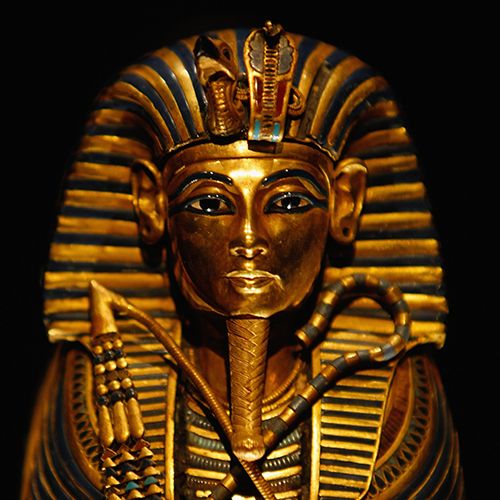
King Tut's mask, an elaborate golden death mask, bears the likeness of Osiris, the Egyptian god of the afterlife. It's made from more than 22 pounds of gold and gemstones, and is among the most famous works of art in history.
King Tut Exhibit
The priceless artifacts discovered in King Tut's tomb went on a worldwide tour beginning in 2018 and scheduled to last until 2021. The extravagant tour includes hundreds of sacred ritual objects, precious jewelry, musical instruments and sculptures, many of which have never left Egypt.
The King Tut: Treasures of the Golden Pharaoh tour is expected to be the last international tour ever, before the artifacts are returned permanently to the new Grand Egyptian Museum near the Giza Pyramids in Egypt, which is scheduled to open in 2021.
"],["
"]]" tml-render-layout="inline">
QUICK FACTS
- Name: King Tut
- Birth Year: 1341
- Birth Country: Egypt
- Gender: Male
- Best Known For: King Tut was an Egyptian pharaoh famed for his opulent tomb, discovered intact in 1922, with his mask and mummy in his original sarcophagus.
- Industries
- World Politics
- Nacionalities
- Egyptian
- Interesting Facts
- King Tut was only 19 at the time of his death. Scientists believe he may have died from a gangrene infection to the leg.
- Tut married his half-sister.
- Death Year: 1323
- Death Country: Egypt
Fact Check
We strive for accuracy and fairness.If you see something that doesn't look right,contact us!
CITATION INFORMATION
- Article Title: King Tut Biography
- Author: Biography.com Editors
- Website Name: The Biography.com website
- Url: https://www.biography.com/royalty/king-tut
- Access Date:
- Publisher: A&E; Television Networks
- Last Updated: January 13, 2021
- Original Published Date: April 3, 2014