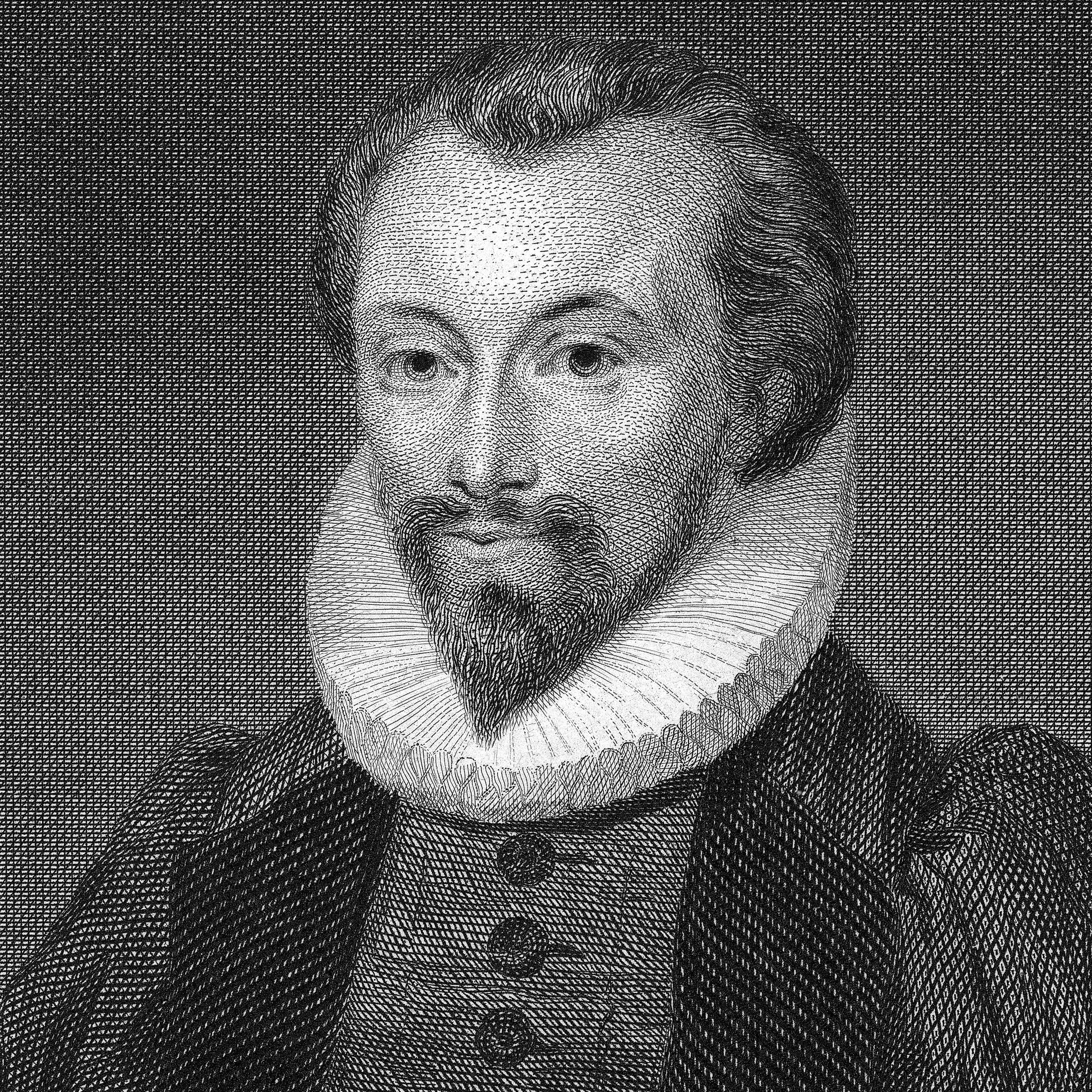
(1572-1631)
Who Was John Donne?
The first two editions of John Donne's poems were published posthumously, in 1633 and 1635, after having circulated widely in manuscript copies. Readers continue to find stimulus in his fusion of witty argument with passion, his dramatic rendering of complex states of mind, and his ability to make common words yield up rich poetic meaning. Donne also wrote songs, sonnets and prose.
Early Life and Family
John Donne was born into a Catholic family in 1572, during a strong anti-Catholic period in England. Donne’s father, also named John, was a prosperous London merchant. His mother, Elizabeth Heywood, was the grand-niece of Catholic martyr Thomas More. Religion would play a tumultuous and passionate role in John’s life.
Donne’s father died in 1576, and his mother remarried a wealthy widower. He entered Oxford University at age 11 and later the University of Cambridge, but never received degrees, due to his Catholicism. At age 20, Donne began studying law at Lincoln’s Inn and seemed destined for a legal or diplomatic career. During the 1590s, he spent much of his inheritance on women, books and travel. He wrote most of his love lyrics and erotic poems during this time. His first books of poems, “Satires” and “Songs and Sonnets,” were highly prized among a small group of admirers.
Family and Wife
In 1593, John Donne’s brother, Henry, was convicted of Catholic sympathies and died in prison soon after. The incident led John to question his Catholic faith and inspired some of his best writing on religion. At age 25, Donne was appointed private secretary to Sir Thomas Egerton, Lord Keeper of the Great Seal of England. He held his position with Egerton for several years and it's likely that around this period Donne converted to Anglicanism.
On his way to a promising career, Donne became a Member of Parliament in 1601. That same year, he married 16-year-old Anne More, the niece of Sir Egerton. Both Lord Egerton and Anne’s father, George More, strongly disapproved of the marriage, and, as punishment, More did not provide a dowry. Lord Egerton fired Donne and had him imprisoned for a short time. The eight years following Donne’s release would be a struggle for the married couple until Anne’s father finally paid her dowry.
Poems and Writing Career
In 1610, Donne published his anti-Catholic polemic “Pseudo-Martyr,” renouncing his faith. In it, he proposed the argument that Roman Catholics could support James I without compromising their religious loyalty to the pope. This won him the king’s favor and patronage from members of the House of Lords. In 1615, Donne was ordained soon thereafter was appointed Royal Chaplain. His elaborate metaphors, religious symbolism and flair for drama soon established him as a great preacher.
In 1617, Donne’s wife died shortly after giving birth to their 12th child. The time for writing love poems was over, and Donne devoted his energies to more religious subjects. In 1621, Donne became dean of St. Paul’s Cathedral. During a period of severe illness, he wrote “Devotions upon Emergent Occasions,” published in 1624. This work contains the immortal lines “No man is an island” and “never send to know for whom the bell tolls; it tolls for thee.” That same year, Donne was appointed Vicar of St. Dunstan’s-in-the-West and became known for his eloquent sermons.
Death
As Donne’s health continued to fail him, he became obsessed with death. Shortly before he died, he delivered a pre-funeral sermon, “Death’s Duel.” His writing was charismatic and inventive. His compelling examination of the mortal paradox influenced English poets for generations. He died on March 31, 1631. Donne’s work fell out of favor for a time, but was revived in the 20th century by high-profile admirers such as T.S. Eliot and William Butler Yeats.
QUICK FACTS
- Name: John Donne
- Birth Year: 1572
- Birth City: London
- Birth Country: England
- Gender: Male
- Best Known For: John Donne, leading English poet of the Metaphysical school, is often considered the greatest loved poet in the English language.
- Industries
- Journalism and Nonfiction
- Fiction and Poetry
- Astrological Sign: Cancer
- Schools
- Lincoln’s Inn
- University of Cambridge
- University of Oxford
- Death Year: 1631
- Death date: March 31, 1631
- Death City: London
- Death Country: England
Fact Check
We strive for accuracy and fairness.If you see something that doesn't look right,contact us!
CITATION INFORMATION
- Article Title: John Donne Biography
- Author: Biography.com Editors
- Website Name: The Biography.com website
- Url: https://www.biography.com/authors-writers/john-donne
- Access Date:
- Publisher: A&E; Television Networks
- Last Updated: November 12, 2021
- Original Published Date: April 2, 2014
QUOTES
- Art is the most passionate orgy within man’s grasp.
- Death be not proud, though some have called thee Mighty and dreadful, for thou art not so.
- Love built on beauty, soon as beauty, dies.
- Affection is a treasure, and scarce any man hath enough of it.