1904-1967
Latest News: Oppenheimer Movie Wins 2024 Golden Globe for Best Drama Motion Picture
On January 7, producer Emma Thomas accepted the 2024 Golden Globe for Best Motion Picture - Drama for Oppenheimer, the 2023 biopic which explores the life of famed physicist J. Robert Oppenheimer and his role in the development of the atomic bomb through the Manhattan Project.
The movie picked up a total of five awards during the 81st annual ceremony. In addition to one of the best picture trophies, filmmaker Christopher Nolan, who is married to Thomas, earned Best Director - Motion Picture; star Cillian Murphy won Best Actor in a Motion Picture - Drama; Robert Downey Jr. took home Best Supporting Actor in any Motion Picture for his role as Lewis Strauss; and composer Ludwig Göransson won Best Original Score - Motion Picture.
The summer blockbuster put the little-known yet highly influential scientist on the map as it grossed more than $950 million at the global box office. You can rent or purchase Oppenheimer on Amazon Prime Video, Apple TV+, the Google Play store, Vudu, or YouTube. It’s expected to eventually stream on Peacock, though no plans have been announced.
Watch Oppenheimer on Amazon Prime Video, Apple TV+, or Vudu.
Who Was J. Robert Oppenheimer?
Physicist J. Robert Oppenheimer served as director of the Los Alamos Laboratory during the development of the atomic bomb. After the 1939 invasion of Poland by Nazi Germany, Oppenheimer was selected to administer a laboratory to carry out the Manhattan Project, the program that developed the first nuclear weapon during World War II. After resigning from his post in 1945, he became the chairman of the General Advisory Committee of the Atomic Energy Commission. Prior to John F. Kennedy’s assassination in 1963, the president announced Oppenheimer would receive the Enrico Fermi Award for his achievements in physics. President Lyndon B. Johnson presented him the award that December. The “Father of the Atomic Bomb” died from cancer at the age of 62 in 1967.
Quick Facts
FULL NAME: Julius Robert Oppenheimer
BORN: April 22, 1904
DIED: February 18, 1967
BIRTHPLACE: New York, New York
SPOUSE: Katherine “Kitty” Oppenheimer (1940-1967)
CHILDREN: Peter and Katherine
ASTROLOGICAL SIGN: Taurus
Early Life, Education, and Professorships
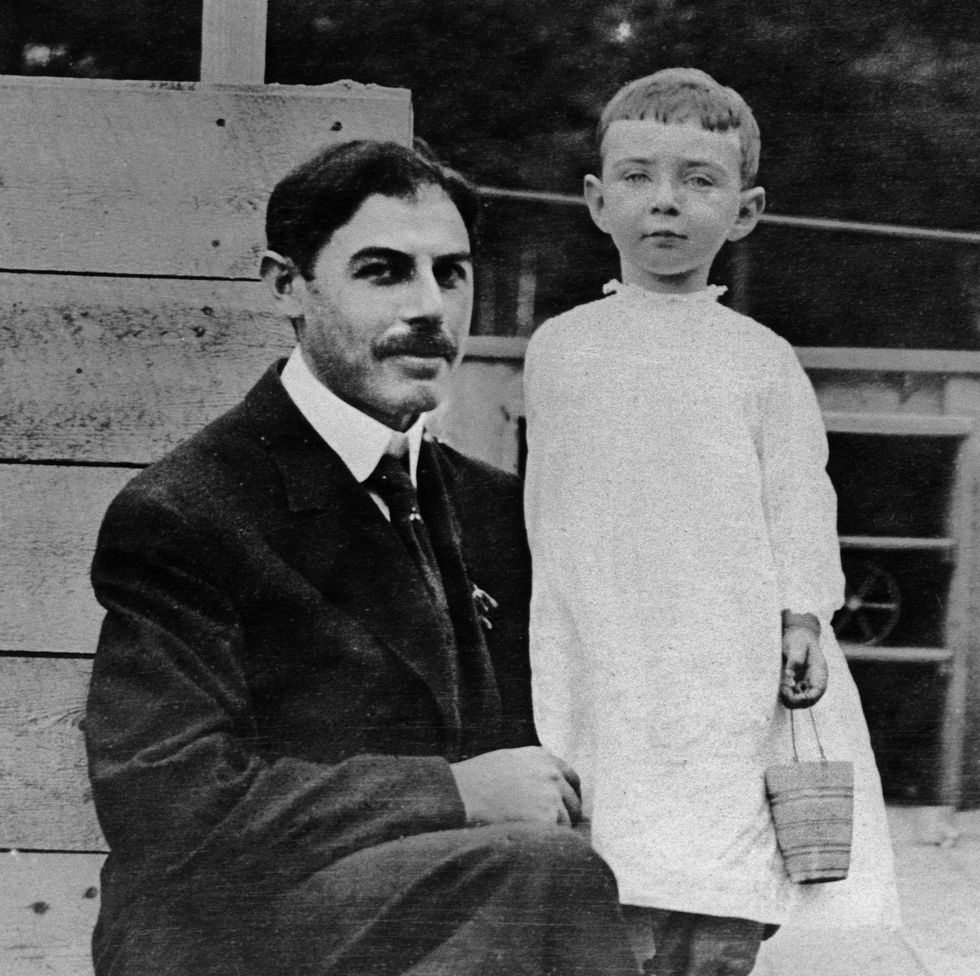
Julius Robert Oppenheimer was born on April 22, 1904, in New York City. His German Jewish parents were Julius Oppenheimer, a rich textile importer, and Ella (née Friedman), a painter. Both were immigrants.
After graduating from Harvard University, Oppenheimer sailed to England and enrolled at the University of Cambridge, where he began his atomic research at the Cavendish Laboratory in 1925. Oppenheimer experienced bouts of depression throughout his life, telling his brother Frank: “It is occasionally true that I need physics more than friends.”
Oppenheimer was miserable at Cambridge and found laboratory work uninteresting, preferring theoretical physics rather than experimental, according to American Prometheus: The Triumph and Tragedy of J. Robert Oppenheimer by Kai Bird and Martin J. Sherwin. Oppenheimer had such a poor relationship with his Cambridge tutor, Patrick Blackett, that at one point Oppenheimer left an apple doused with noxious chemicals on Blackett’s desk, according to J. Robert Oppenheimer: A Life by Abraham Pais and Robert P. Crease. Blackett wasn’t harmed, and Oppenheimer avoided discipline only with the intervention of his parents.
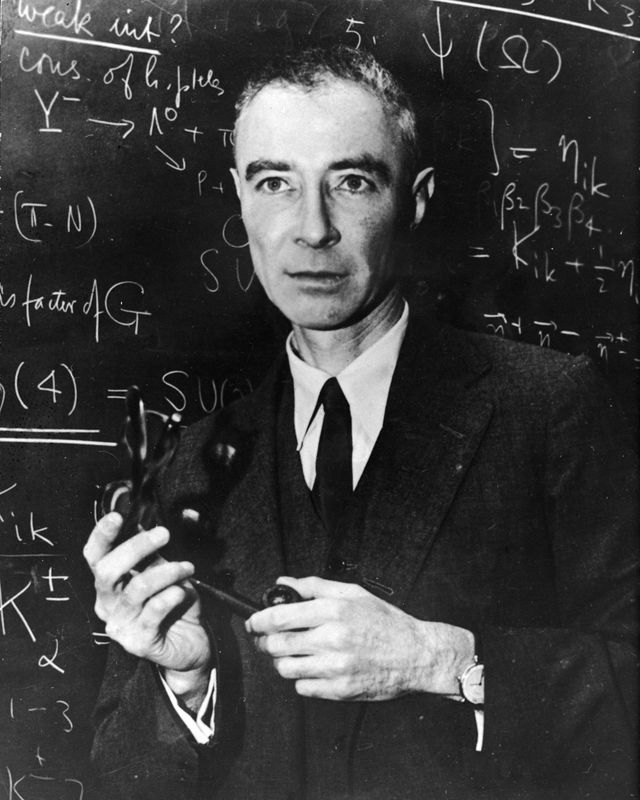
In 1926, he teamed with Max Born at Göttingen University, where he met a host of prominent physicists, including Niels Bohr. He received his doctorate at Göttingen while also developing what became known as the Born-Oppenheimer approximation, an important contribution to quantum molecular theory.
Oppenheimer held teaching positions at the University of California, Berkeley, and the California Institute of Technology, and did important research in such fields at theoretical astronomy, nuclear physics, quantum electrodynamics, and more, according to A Biographical Encyclopedia of Scientists and Inventors in American Film and TV Since 1930 by A. Bowdoin Van Riper.
The Manhattan Project

Oppenheimer became politically active in the 1930s and agreed with Albert Einstein and Leo Szilard that the Nazis could develop a nuclear weapon. Following the 1939 invasion of Poland by Nazi Germany, Oppenheimer was selected to administer a laboratory to carry out the Manhattan Project, a U.S. Army experiment aimed at harnessing atomic energy for military purposes.
The choice of Oppenheimer surprised some due to his left-wing politics, lack of leadership experience, and the fact he had never won a Nobel Prize. However, Brigadier General Leslie R. Groves Jr., the director of the Manhattan Project, felt Oppenheimer had an “overweening ambition” that would serve him well in the position, according to Life and Times of the Atomic Bomb by Albert Berger.
Oppenheimer led the scientific end of the Manhattan Project in Los Alamos, New Mexico, beginning in 1942. The project, which grew from a few hundred people to more than 6,000 by 1945, was populated by many scientists who had escaped fascist regimes in Europe, according to American Prometheus. Their mission was to explore a newly documented fission process involving uranium-235, with which they hoped to make a nuclear bomb before Adolf Hitler could develop one. The project was initially allotted $6,000 by the U.S. government, but by the time the work culminated in 1945, the budget had grown to $2 billion.
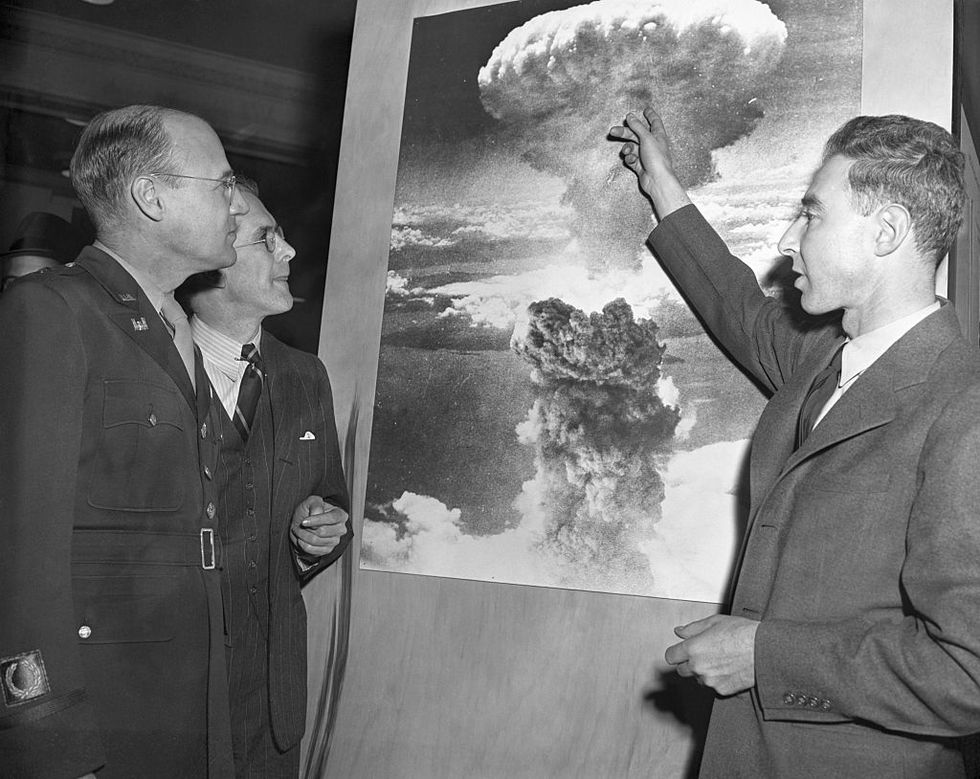
The work of Oppenheimer and his fellow scientists led to the world’s first nuclear explosion in the Jornada del Muerto desert in New Mexico, on July 16, 1945. The detonation was given the code name “Trinity,” inspired by a poem by John Donne. While witnessing the explosion, Oppenheimer recalled a verse from the Bhagavad Gita that read, “If the radiance of a thousand suns were to burst at once into the sky, that would be like the splendor of the mighty one,” according to the book Brighter Than a Thousand Suns: A Personal History of the Atomic Scientists by Robert Jungk. More famously, he later said he also reflected upon another Bhagavad Gita verse: “I am become Death, the destroyer of worlds.”
American Prometheus: The Triumph and Tragedy of J. Robert Oppenheimer
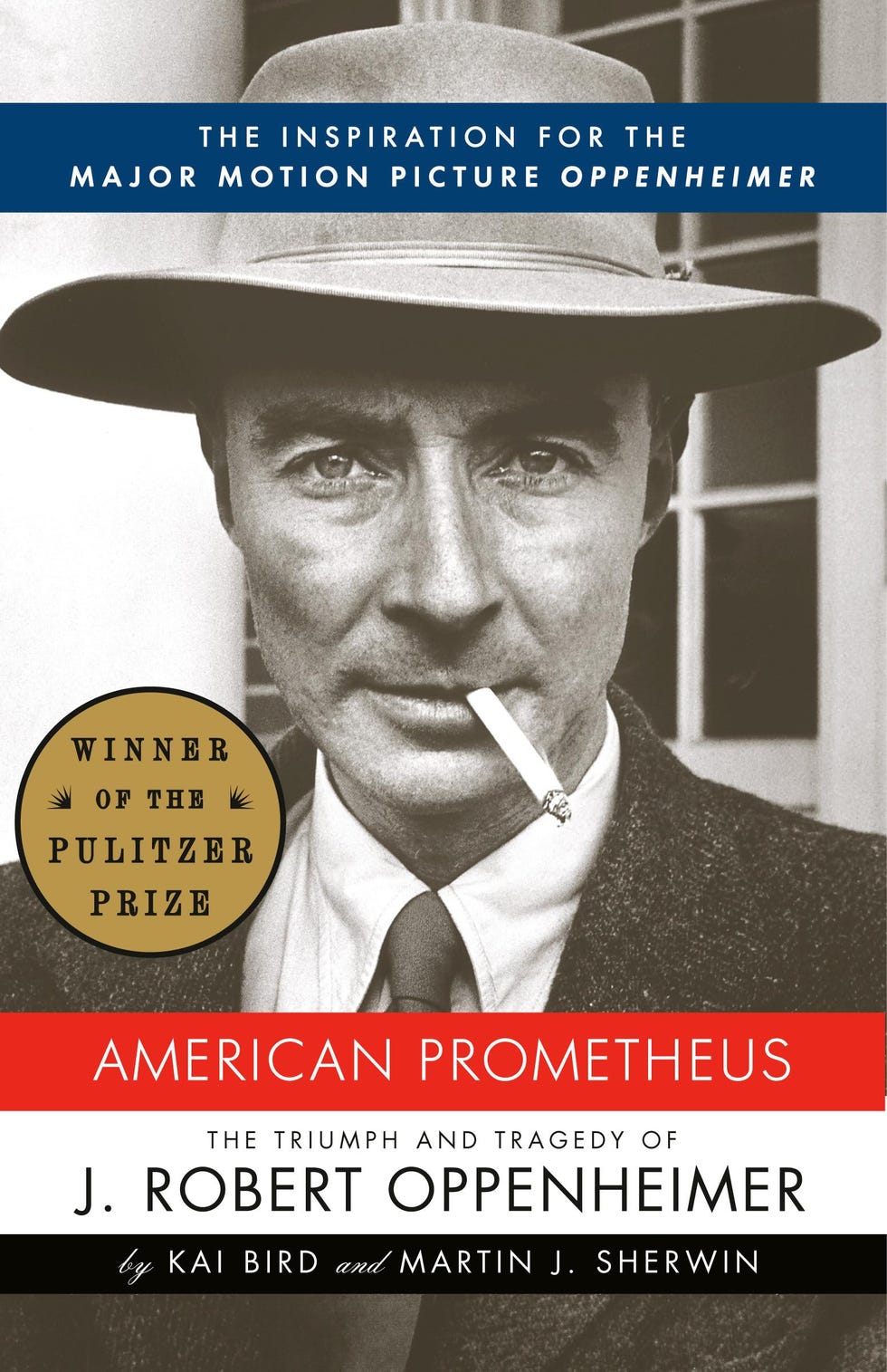
American Prometheus: The Triumph and Tragedy of J. Robert Oppenheimer
Oppenheimer was initially pleased with the atomic bomb, with physicist Isidor Rabi saying of him: “I’ll never forget his walk; I’ll never forget the way he stepped out of the car. His walk was like High Noon… This kind of strut. He had done it,” according to Robert Oppenheimer: A Life Inside the Center by Ray Monk.
But Oppenheimer’s feelings of elation following Trinity and the bombing of Hiroshima three weeks later changed after the bombing of Nagasaki, which he found unnecessary from a military perspective. During a White House meeting with Harry S. Truman, Oppenheimer famously claimed to have “blood on his hands,” a comment that infuriated the president. Although the Hiroshima and Nagasaki bombings effectively ended World War II, the weapons’s devastation prompted Oppenheimer to argue against its further development, and he resigned from his post that same year. Ultimately, his work for the Manhattan Project earned him the enduring nickname “father of the atomic bomb.”
Life After the Atomic Bomb
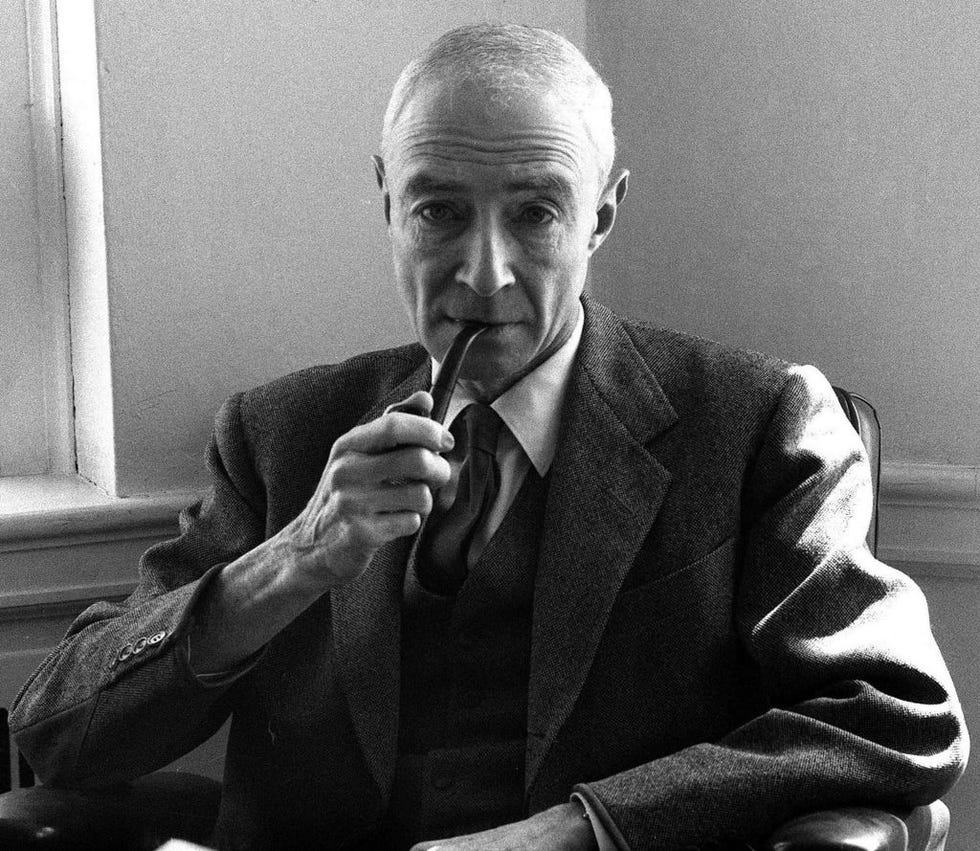
The Manhattan Project was top secret until after the bombings of Hiroshima and Nagasaki, when Oppenheimer became a household name. He returned to the California Institute of Technology but found he had little desire to each anymore. He went on to become chairman of the General Advisory Committee of the Atomic Energy Commission (AEC). The Soviet Union’s first atomic bomb test in 1949 came earlier than Americans had expected, increasing pressure for the United States to develop the more powerful hydrogen bomb, but Oppenheimer opposed this for practical and ethnical reasons, according to American Prometheus. Truman, however, decided to press forward with the weapon’s development anyway.
Oppenheimer’s shocking opposition to the bomb led to accusations that he was a Communist supporter. In 1954, the AEC held a security hearing regarding Oppenheimer, during which he was suspended from secret nuclear research and stripped of his security clearance. This served as a personal and professional humiliation for Oppenheimer, effectively ending his role in government and policy.
However, his reputation was partially rehabilitated in 1963, when President John F. Kennedy announced Oppenheimer would receive the Enrico Fermi Award, according to J. Robert Oppenheimer and the American Century by David Cassidy. After Kennedy’s assassination, President Lyndon B. Johnson presented the award to Oppenheimer that December.
Oppenheimer continued to support international control of atomic energy in his later years.
Relationship with Jean Tatlock

Oppenheimer was known for his romantic relationship with Jean Tatlock, a graduate student at the University of California, Berkeley, while Oppenheimer was a young physics professor there. Tatlock is credited with introducing Oppenheimer to radical communist politics, something that haunted him later in his career. Although Oppenheimer felt passionately toward Tatlock and reportedly proposed to her twice, they broke up before Oppenheimer joined the Manhattan Project, and Tatlock died by suicide in January 1944.
Wife and Children

In 1939, Oppenheimer met Katherine “Kitty” Puening, a Berkeley student who also had communist ties. The two married in 1940, and they had two children: Peter, who was born in 1941, and Katherine “Toni,” who was born in 1944.
Working as a biologist and botanist, Kitty became an alcoholic after her husband became a celebrity for his role in the Manhattan Project, according to American Prometheus. Kitty died of an embolism in 1972 years after Oppenheimer’s own death.
Death
A chain smoker, Oppenheimer died of throat cancer on February 18, 1967, in Princeton, New Jersey.
In December 2022, 55 years after Oppenheimer’s death, U.S. Energy Secretary Jennifer Granholm nullified the 1954 decision to revoke his national security clearance.
Oppenheimer in Movies and TV
Oppenheimer has been portrayed in several films, plays, and other works of media. A BBC television serial Oppenheimer was released in 1980, starring Sam Waterston as the famed physicist. It won three BAFTA Television Awards. That year also saw the release of The Day After Trinity, a documentary about Oppenheimer and the development of the atomic bomb. The film was nominated for an Academy Award for Best Documentary Feature and won a Peabody Award.
Dwight Schultz portrayed Oppenheimer in the film Fat Man and Little Boy (1989), and David Strathairn played him in the television movie Day One, also released in 1989. Filmmaker Christopher Nolan directs 2023’s Oppenheimer movie, in which Cillian Murphy plays the famed physicist.
Quotes
- I am become Death, the destroyer of worlds.
- If the radiance of a thousand suns were to burst at once into the sky, that would be like the splendor of the mighty one.
- Mr. President, I feel I have blood on my hands.
Fact Check: We strive for accuracy and fairness. If you see something that doesn’t look right, contact us!
The Biography.com staff is a team of people-obsessed and news-hungry editors with decades of collective experience. We have worked as daily newspaper reporters, major national magazine editors, and as editors-in-chief of regional media publications. Among our ranks are book authors and award-winning journalists. Our staff also works with freelance writers, researchers, and other contributors to produce the smart, compelling profiles and articles you see on our site. To meet the team, visit our About Us page: https://www.biography.com/about/a43602329/about-us
Colin McEvoy joined the Biography.com staff in 2023, and before that had spent 16 years as a journalist, writer, and communications professional. He is the author of two true crime books: Love Me or Else and Fatal Jealousy. He is also an avid film buff, reader, and lover of great stories.