1779-1843
Who Was Francis Scott Key?
Lawyer Francis Scott Key is remembered for writing the lyrics of “The Star-Spangled Banner,” which is now the national anthem of the United States. Born in 1779, Key lived much of his life in Maryland, though he also served as a district attorney for Washington, D.C. During the War of 1812, he witnessed the British’s unsuccessful attack on Fort McHenry in Baltimore and was inspired to write a poem titled “Defence of Fort M’Henry.” Set to music, the poem became “The Star-Spangled Banner,” which President Herbert Hoover made the national anthem in 1931, decades after Key’s death in 1843 at age 63. For his lyrics, Key was posthumously inducted into the Songwriters Hall of Fame in 1970.
Quick Facts
FULL NAME: Francis Scott Key
BORN: August 1, 1779
DIED: January 11, 1843
BIRTHPLACE: Frederick County, Maryland
SPOUSE: Mary Tayloe Lloyd
CHILDREN: 11
ASTROLOGICAL SIGN: Leo
Early Life, Family, and Career
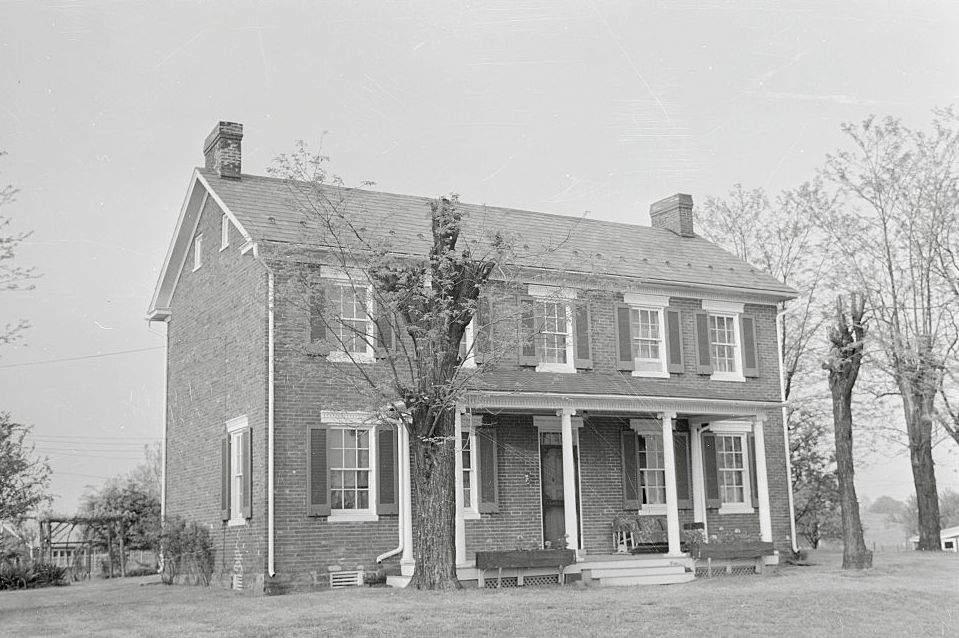
Francis Scott Key was born on August 1, 1779, in Frederick County, Maryland, to a wealthy clan on the Terra Rubra plantation. He was educated at home until age 10 then attended an Annapolis grammar school. He went on to study at St. John’s College, ultimately returning to his home county to set up practice as a lawyer. Key wed Mary “Polly” Tayloe Lloyd in the early 1800s, and the couple had 11 children. By 1805, he’d set up his legal practice in Georgetown, then an independent municipality within Washington, D.C., area.
War of 1812
By the early 1810s, the United States had entered into conflict with Britain over the kidnapping of American seamen and the disruption of trade with France. The ensuing hostilities became known as the War of 1812. Although opposed to the war due to his religious beliefs and believing that the disagreement could be settled without armed conflict, Key nonetheless served in the Georgetown Light Field Artillery.
British forces captured Washington, D.C., in 1814. Taken prisoner was Dr. William Beanes, who also happened to be a colleague of Key. Due to his work as an attorney, Key was asked to help in the negotiation of Beanes’ release and, in the process, traveled to Baltimore where British naval forces were located along Chesapeake Bay. He and Colonel John Skinner were able to secure Beanes’ freedom, though their return was delayed by a British attack on land.
Writing “The Star-Spangled Banner”
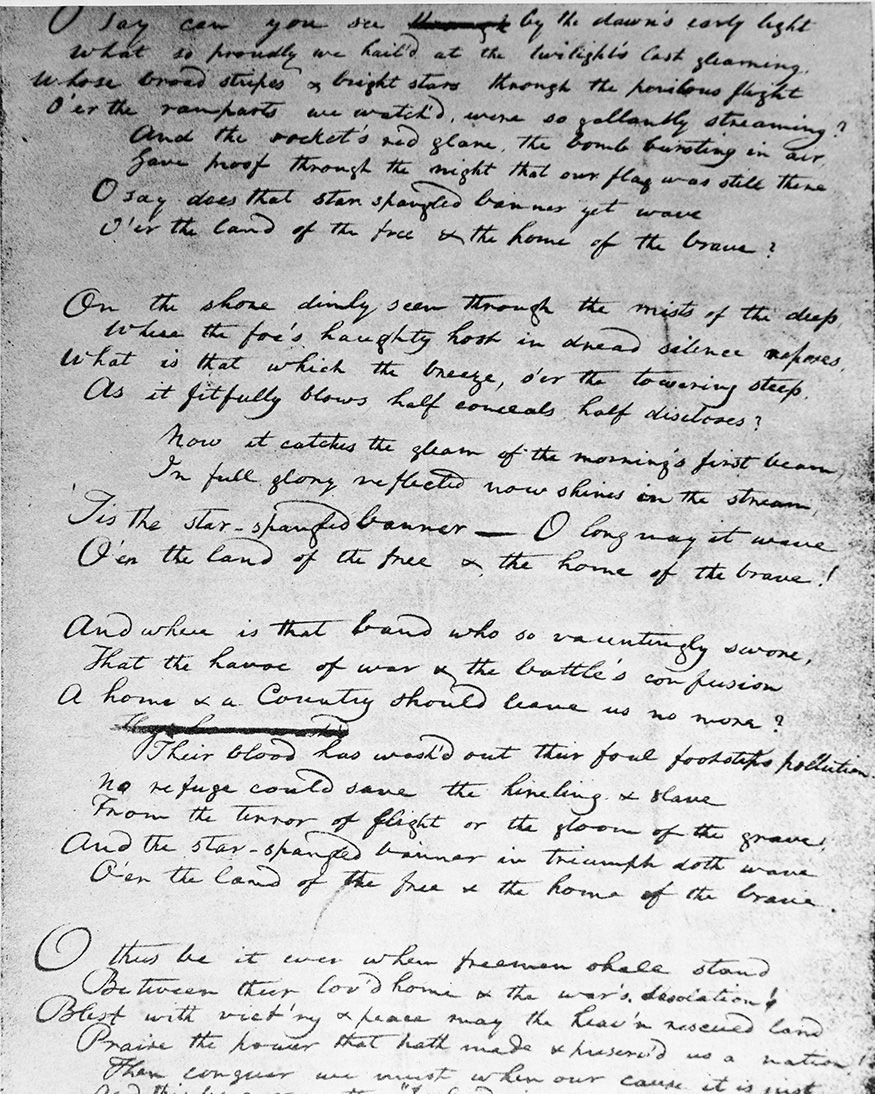
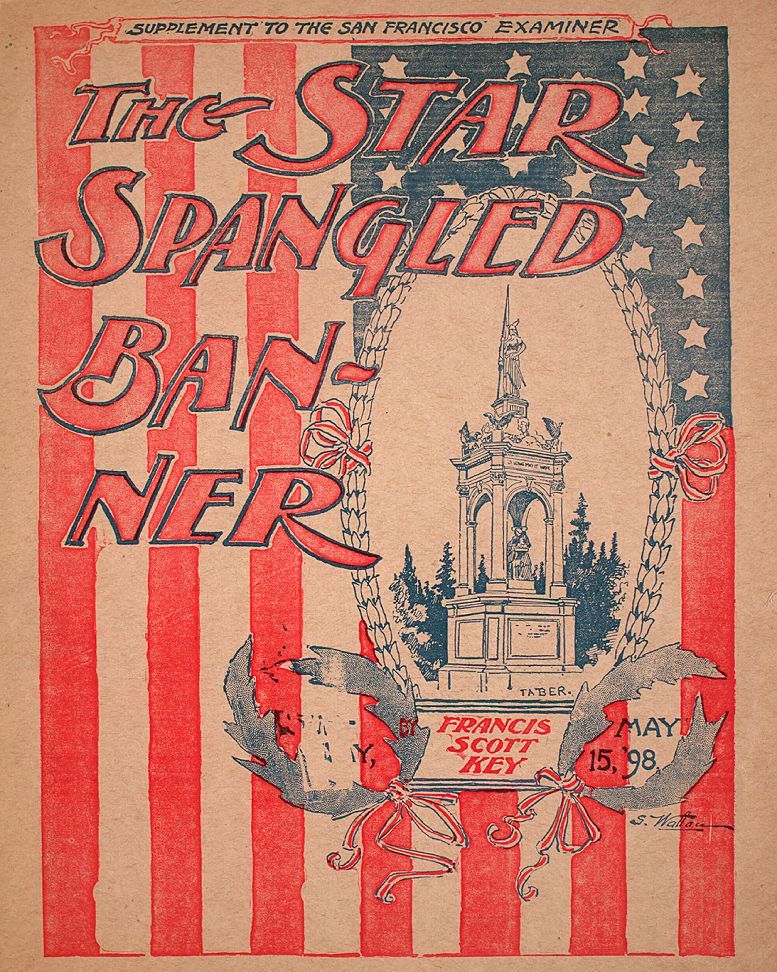
On September 13, 1814, Key was at sea off the coast of Baltimore with Colonel John Skinner and the now-free Dr. William Beanes. The three men watched the British wage a day-long assault on Fort McHenry. After continual bombing, to Key’s surprise, the British weren’t able to destroy the fort, and Key noted upon the dawning of the next morning a large U.S. flag was flying. (Mary Young Pickersgill had sewn it at the request of the fort commander.)
The British ceased their attack and left the area. Key immediately wrote down the words for a poem that he continued composing at an inn the next day. The work, which relied heavily on visualizations of what he witnessed, came to be known as the “Defence of Fort M’Henry” and was printed in handbills and newspapers, including the Baltimore Patriot. The poem was later set to the tune of a drinking song by John Stafford Smith, “To Anacreon in Heaven,” with the title “The Star-Spangled Banner.”
Over the years, “The Star-Spangled Banner” continued to be held up as a musical symbol of the United States, though it also faced critiques for its depiction of violence and unwieldy lyrics. In 1916, President Woodrow Wilson declared “The Star-Spangled Banner” should be played at official events. On March 3, 1931, President Herbert Hoover, along with Congress, declared the song the national anthem of the United States. Key’s lyrics earned him a posthumous induction to the Songwriters Hall of Fame in 1970.
Stance on Slavery
After the War of 1812, Key continued working in law and, in 1833, became Washington, D.C., district attorney. In this capacity, he oversaw proceedings that upheld the system of slavery by prosecuting abolitionists. Key was an enslaver himself, though he went on record as saying that the system of slavery was full of sin and “a bed of torture.”
His complex views on race also led him to help establish the American Colonization Society, which advocated for the transport of Black people to Africa. Information on Key’s relationship to race and his Washington legal career can be found in the Jefferson Morley book Snow-Storm in August: Washington City, Francis Scott Key, and the Forgotten Race Riot of 1835.
Death and Legacy
After falling ill with pleurisy, Key died on January 11, 1843, in Baltimore. He was 63 years old. Key is buried at Mount Olivet Cemetery near the city of Frederick, Maryland.
Although his legacy endures through “The Star-Spangled Banner,” Key has also been memorialized as the namesake of several schools and bridges. A monument for the famed lyricist and slaveholder stood in San Francisco’s Golden Gate Park for many years before protesters toppled it during a demonstration against racial injustice in June 2020. In March 2024, Baltimore’s Francis Scott Key Bridge on Interstate 695 collapsed after a cargo ship ran into one of its supporting pillars.
Fact Check: We strive for accuracy and fairness. If you see something that doesn’t look right, contact us!
The Biography.com staff is a team of people-obsessed and news-hungry editors with decades of collective experience. We have worked as daily newspaper reporters, major national magazine editors, and as editors-in-chief of regional media publications. Among our ranks are book authors and award-winning journalists. Our staff also works with freelance writers, researchers, and other contributors to produce the smart, compelling profiles and articles you see on our site. To meet the team, visit our About Us page: https://www.biography.com/about/a43602329/about-us