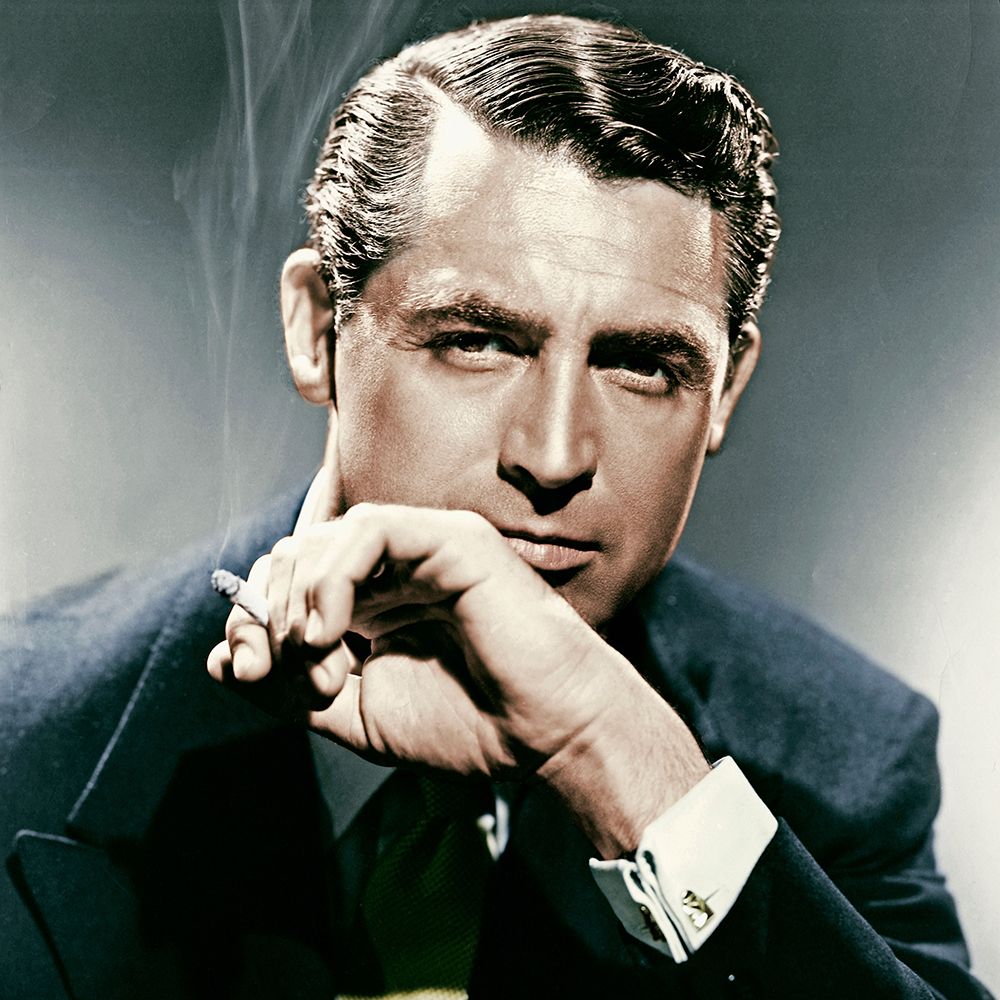
(1904-1986)
Who Was Cary Grant?
Actor Cary Grant ran away from home at 13 to perform as a juggler with a comedy troupe. They later toured the United States, where he honed his acting skills. In the 1930s he signed with Paramount Pictures. He made films well into the 1960s, establishing a debonair persona that made him a screen icon. Sometimes referred to as the "epitome of elegance," Grant exuded style, charm and sophistication. But that on-screen persona was a carefully crafted image, one that hid a very difficult personal life. He died in 1986, having received an honorary Oscar in 1970.
Early Life
Grant was born on January 18, 1904. He grew up in Bristol, England, as Archie Leach, the son of a clothing presser and a homemaker. His father, Elias, left the family for a job in Southampton, and there he took up with another woman. The couple soon had a child of their own.
When he was 10 years old, Grant was told that his mother was dead while, in fact, she had been committed to an institution by his father. Devastated by the loss, Grant was basically on his own, with little support from his father. At 13, he started hanging around a local theater, where he performed a few odd jobs. Grant then took up with Bob Pender's group of traveling performers, but his first attempt at a theatrical career was cut short by his father, who demanded that he return to school.
Grant got himself expelled the following year and, this time with his father's permission, rejoined Pender's troupe. He traveled with the group for two years, performing in all types of acts from juggling to comedy bits to acrobatics. In 1920, Grant branched out on his own, leaving the troupe during its visit to New York City. There he struggled to make it into show business, even working as a stilt walker for a time.
Career Breakthrough
By the late 1920s, Grant had made several appearances on Broadway. He got the lead part in the 1931 musical Nikki with Fay Wray, playing a soldier named Cary who fights for Wray's affections. While the production proved to be short-lived, Grant's role garnered him enough praise to land a role in a short film, Singapore Sue. Finally experiencing some studio interest, Grant decided to move out to Los Angeles.
Grant landed a contract with Paramount Studios and took on a new identity. Archie Leach became Cary Grant at the studio's request. According to Hollywood legend, his first name came from his earlier stage role and his last name from a list given to him by the studio. He made his first feature film, This Is The Night, in 1932, and more roles on the big screen soon followed. Grant starred opposite such famed leading ladies as Marlene Dietrich and Mae West.
Films of 1930s and 1940s
By the late 1930s, Grant had become an established leading man in Hollywood. He appeared in a range of movies, from war dramas to mysteries to comedies. His career, however, reached new heights starting in 1937, with Topper. In this screwball comedy, Grant played a sophisticated spirit who, along with his late wife, decides to haunt an old friend. He had a gift for both physical humor and comic timing.
Grant made some of his greatest films around this time; such comedies as The Awful Truth (1937) with Irene Dunne and The Philadelphia Story with Katharine Hepburn and Jimmy Stewart have become classics. In many of his roles, Grant played a similar type—a man with wit and polish. He did, however, occasionally try to defy the audience's expectations of him. He played a potentially lethal husband opposite Joan Fontaine in the 1941 thriller Suspicion, which marked his first film with director and master of suspense Alfred Hitchcock. In Penny Serenade (1941), Grant balanced humor with grief as a husband who experiences both joy and heartbreak in his marriage. His work in the film netted him an Academy Award nomination.
His greatest dramatic leap was in 1944's None but the Lonely Heart. Directed and co-written by Clifford Odets, the film featured Grant as a wandering prodigal son who returns home to help his sick mother (Ethel Barrymore). He picked up his second Academy Award nomination for this now mostly forgotten film. It was reportedly one of his personal favorites, saying "the part seemed to fit my nature better than the light-hearted fellows I was used to playing."
By the early 1940s, Grant became one of the first actors to land status as a free agent, choosing not to be under contract to one of the many film studios that ruled Hollywood at the time. Instead, he picked his own parts, becoming increasingly selective about what roles he'd take. One of his first decisions as a free agent was to appear in another Hitchcock film—1946's Notorious. Starring opposite Ingrid Bergman, Grant played an American agent on the trail of some neo-Nazis. Around this time, Grant also appeared in several comedies, including 1947's The Bachelor and the Bobby-Soxer and 1949's I Was a Male War Bride.
Later Films
Two of Grant's most memorable later roles had him once again working with Hitchcock. He played a reformed criminal accused of a robbery he didn't commit in 1955's To Catch a Thief. In the film, Grant starred opposite Grace Kelly. Hitchcock then put Grant through his paces in 1959's North by Northwest. As an advertising man who gets mixed up in murder and espionage, his character is on the run from sinister forces and battling for his life for much of the movie.
Grant also teamed up with Audrey Hepburn for the 1963 humorous and romantic thriller Charade, which gently poked fun at the genre. For his final film, Walk Don't Run (1966), he had moved from romantic lead to mature matchmaker in this comedy. Grant retired from filmmaking after this movie.
Final Years and Death
After walking away from acting, Grant still appeared in public. He became a director of the Fabergé company and served as the fragrance firm's brand ambassador, traveling around to promote its products.
Grant received numerous honors for his contributions to film in his later years, including a special Academy Award in 1970 for his "unique mastery of the art of screen acting." In 1981, he earned the prestigious Kennedy Center Honor for Career Achievement in the Performing Arts alongside such greats as Helen Hayes and Count Basie. Grant agreed to a special public appearance in Davenport, Iowa, on November 29, 1986, but he never made it to the theater that night. He suffered a fatal stroke in his hotel room.
As he had in life, Grant continued to seek privacy after his death. No public funeral was held for the great star, but many who knew him expressed their grief over his passing. President Ronald Reagan said that "He was one of the brightest stars in Hollywood and his elegance, wit and charm will endure on film and in our hearts."
Personal Life
Unlike his suave film characters, Grant seemed to struggle in his romantic life off-screen. He was married five times and went through four divorces. Several of his ex-wives described him as controlling. His fourth wife, actress Dyan Cannon, said that he tried to tell her what to wear. She has also claimed that he forced her to take LSD, a drug he took himself. She later explained that Grant took LSD as "a gateway to peace inside himself." Cannon wrote about their marriage in 2011's Dear Cary: My Life with Cary Grant.
Some have said, including Cannon herself, that Grant's troubled childhood affected his romantic relationships. After believing her to be dead, Grant discovered his mother was still alive when he was 30 years old. He was reunited with his mother, but they never regained the close bond they had once shared.
While his romantic relationships may have been troubled, Grant was an attentive father. He only had one child, a daughter Jennifer, who was born in 1966, with wife Dyan Cannon. Grant became a doting and adoring parent. After he and Cannon divorced, Grant spent as much time as he could with his daughter. Jennifer Grant told the world what it was like to be the screen legend's child in her 2011 memoir Good Stuff: A Reminiscence of My Father, Cary Grant.
QUICK FACTS
- Name: Cary Grant
- Birth Year: 1904
- Birth date: January 18, 1904
- Birth City: Bristol
- Birth Country: England
- Gender: Male
- Best Known For: Actor Cary Grant performed in films from the 1930s through the 1960s. He starred in several Alfred Hitchcock films, including the 1959 hit 'North by Northwest.'
- Industries
- Comedy
- Drama
- Theater and Dance
- Astrological Sign: Capricorn
- Death Year: 1986
- Death date: November 29, 1986
- Death State: Iowa
- Death City: Davenport
- Death Country: United States
Fact Check
We strive for accuracy and fairness.If you see something that doesn't look right,contact us!
CITATION INFORMATION
- Article Title: Cary Grant Biography
- Author: Biography.com Editors
- Website Name: The Biography.com website
- Url: https://www.biography.com/actors/cary-grant
- Access Date:
- Publisher: A&E; Television Networks
- Last Updated: April 23, 2021
- Original Published Date: April 2, 2014
QUOTES
- I've often been accused by the critics of being myself on the screen. But being oneself is more difficult than you'd suppose.