1706-1790
Jump to:
- Who Was Benjamin Franklin?
- Quick Facts
- Early Life
- Silence Dogood
- Living in London
- Wife and Children
- Life in Philadelphia
- Poor Richard's Almanack
- Scientist and Inventor
- Inventions
- Electricity
- Slavery
- Election to the Government
- Stamp Act and Declaration of Independence
- Life in Paris
- Drafting the U.S. Constitution
- Death
- Accomplishments
Who Was Benjamin Franklin?
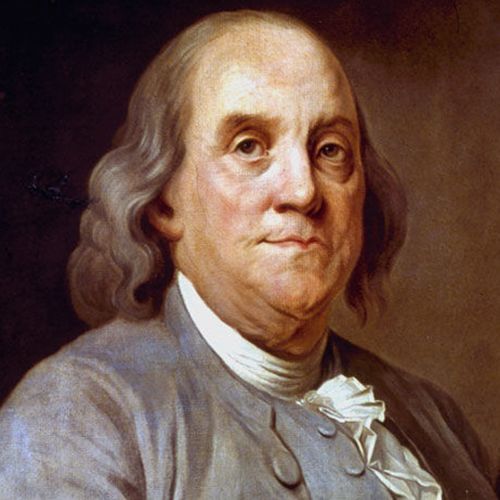
Benjamin Franklin was a Founding Father and a polymath, inventor, scientist, printer, politician, freemason and diplomat. Franklin helped to draft the Declaration of Independence and the U.S. Constitution, and he negotiated the 1783 Treaty of Paris ending the Revolutionary War.
His scientific pursuits included investigations into electricity, mathematics and mapmaking. A writer known for his wit and wisdom, Franklin also published Poor Richard’s Almanack, invented bifocal glasses and organized the first successful American lending library.
Quick Facts
FULL NAME: Benjamin Franklin
BORN: January 17, 1706
DIED: April 17, 1790
BIRTHPLACE: Boston, Massachusetts
SPOUSE: Deborah Read (1730-1774)
CHILDREN: William, Francis, Sarah
ASTROLOGICAL SIGN: Capricorn
Early Life
Franklin was born on January 17, 1706, in Boston, in what was then known as the Massachusetts Bay Colony.
Franklin’s father, English-born soap and candlemaker Josiah Franklin, had seven children with first wife, Anne Child, and 10 more with second wife, Abiah Folger. Franklin was his 15th child and youngest son.
Franklin learned to read at an early age, and despite his success at the Boston Latin School, he stopped his formal schooling at 10 to work full-time in his cash-strapped father’s candle and soap shop. Dipping wax and cutting wicks didn’t fire the young boy’s imagination, however.
Perhaps to dissuade him from going to sea as one of his other sons had done, Josiah apprenticed 12-year-old Franklin at the print shop run by his older brother James.
Although James mistreated and frequently beat his younger brother, Franklin learned a great deal about newspaper publishing and adopted a similar brand of subversive politics under the printer’s tutelage.
Silence Dogood
When James refused to publish any of his brother’s writing, 16-year-old Franklin adopted the pseudonym Mrs. Silence Dogood, and “her” 14 imaginative and witty letters delighted readers of his brother’s newspaper, The New England Courant. James grew angry, however, when he learned that his apprentice had penned the letters.
Tired of his brother’s “harsh and tyrannical” behavior, Franklin fled Boston in 1723 although he had three years remaining on a legally binding contract with his master.
He escaped to New York before settling in Philadelphia and began working with another printer. Philadelphia became his home base for the rest of his life.
Living in London
Encouraged by Pennsylvania Governor William Keith to set up his own print shop, Franklin left for London in 1724 to purchase supplies from stationers, booksellers and printers. When the teenager arrived in England, however, he felt duped when Keith’s letters of introduction never arrived as promised.
Although forced to find work at London’s print shops, Franklin took full advantage of the city’s pleasures—attending theater performances, mingling with the locals in coffee houses and continuing his lifelong passion for reading.
A self-taught swimmer who crafted his own wooden flippers, Franklin performed long-distance swims on the Thames River. (In 1968, he was inducted as an honorary member of the International Swimming Hall of Fame.)
In 1725 Franklin published his first pamphlet, "A Dissertation upon Liberty and Necessity, Pleasure and Pain," which argued that humans lack free will and, thus, are not morally responsible for their actions. (Franklin later repudiated this thought and burned all but one copy of the pamphlet still in his possession.)
Wife and Children
In 1723, after Franklin moved from Boston to Philadelphia, he lodged at the home of John Read, where he met and courted his landlord’s daughter Deborah.
After Franklin returned to Philadelphia in 1726, he discovered that Deborah had married in the interim, only to be abandoned by her husband just months after the wedding.
The future Founding Father rekindled his romance with Deborah Read and he took her as his common-law wife in 1730. Around that time, Franklin fathered a son, William, out of wedlock who was taken in by the couple. The pair’s first son, Francis, was born in 1732, but he died four years later of smallpox. The couple’s only daughter, Sarah, was born in 1743.
The two times Franklin moved to London, in 1757 and again in 1764, it was without Deborah, who refused to leave Philadelphia. His second stay was the last time the couple saw each other. Franklin would not return home before Deborah passed away in 1774 from a stroke at the age of 66.
In 1762, Franklin’s son William took office as New Jersey’s royal governor, a position his father arranged through his political connections in the British government. Franklin’s later support for the patriot cause put him at odds with his loyalist son. When the New Jersey militia stripped William Franklin of his post as royal governor and imprisoned him in 1776, his father chose not to intercede on his behalf.
Life in Philadelphia
After his return to Philadelphia in 1726, Franklin held varied jobs including bookkeeper, shopkeeper and currency cutter. In 1728 he returned to a familiar trade - printing paper currency - in New Jersey before partnering with a friend to open his own print shop in Philadelphia that published government pamphlets and books.
In 1730 Franklin was named the official printer of Pennsylvania. By that time, he had formed the “Junto,” a social and self-improvement study group for young men that met every Friday to debate morality, philosophy and politics.
When Junto members sought to expand their reading choices, Franklin helped to incorporate America’s first subscription library, the Library Company of Philadelphia, in 1731.
In 1729 Franklin published another pamphlet, "A Modest Enquiry into The Nature and Necessity of a Paper Currency," which advocated for an increase in the money supply to stimulate the economy.
With the cash Franklin earned from his money-related treatise, he was able to purchase The Pennsylvania Gazette newspaper from a former boss. Under his ownership, the struggling newspaper was transformed into the most widely-read paper in the colonies and became one of the first to turn a profit.
He had less luck in 1732 when he launched the first German-language newspaper in the colonies, the short-lived Philadelphische Zeitung. Nonetheless, Franklin’s prominence and success grew during the 1730s.
Franklin amassed real estate and businesses and organized the volunteer Union Fire Company to counteract dangerous fire hazards in Philadelphia. He joined the Freemasons in 1731 and was eventually elected grand master of the Masons of Pennsylvania.
Poor Richard's Almanack
At the end of 1732, Franklin published the first edition of Poor Richard’s Almanack.
In addition to weather forecasts, astronomical information and poetry, the almanac—which Franklin published for 25 consecutive years—included proverbs and Franklin’s witty maxims such as “Early to bed and early to rise, makes a man healthy, wealthy and wise” and “He that lies down with dogs, shall rise up with fleas.”
Scientist and Inventor
In the 1740s, Franklin expanded into science and entrepreneurship. His 1743 pamphlet "A Proposal for Promoting Useful Knowledge" underscored his interests and served as the founding document of the American Philosophical Society, the first scientific society in the colonies.
By 1748, the 42-year-old Franklin had become one of the richest men in Pennsylvania, and he became a soldier in the Pennsylvania militia. He turned his printing business over to a partner to give himself more time to conduct scientific experiments. He moved into a new house in 1748.
Inventions
Franklin was a prolific inventor and scientist who was responsible for the following inventions:
- Franklin stove: Franklin’s first invention, created around 1740, provided more heat with less fuel.
- Bifocals: Anyone tired of switching between two pairs of glasses understands why Franklin developed bifocals that could be used for both distance and reading.
- Armonica: Franklin’s inventions took on a musical bent when, in 1761, he commenced development on the armonica, a musical instrument composed of spinning glass bowls on a shaft. Both Ludwig van Beethoven and Wolfgang Amadeus Mozart composed music for the strange instrument.
- Rocking chair
- Flexible catheter
- American penny
Franklin also discovered the Gulf Stream after his return trip across the Atlantic Ocean from London in 1775. He began to speculate about why the westbound trip always took longer, and his measurements of ocean temperatures led to his discovery of the existence of the Gulf Stream. This knowledge served to cut two weeks off the previous sailing time from Europe to North America.
Franklin even devised a new “scheme” for the alphabet that proposed to eliminate the letters C, J, Q, W, X and Y as redundant.
Franklin’s self-education earned him honorary degrees from Harvard, Yale, England’s University of Oxford and the University of St. Andrews in Scotland.
In 1749, Franklin wrote a pamphlet concerning the education of youth in Pennsylvania that resulted in the establishment of the Academy of Philadelphia, now the University of Pennsylvania.
Electricity
In 1752, Franklin conducted the famous kite-and-key experiment to demonstrate that lightning was electricity and soon after invented the lightning rod.
His investigations into electrical phenomena were compiled into “Experiments and Observations on Electricity,” published in England in 1751. He coined new electricity-related terms that are still part of the lexicon, such as battery, charge, conductor and electrify.
Slavery
In 1748, Franklin acquired the first of several enslaved people to work in his new home and in the print shop. Franklin’s views on slavery evolved over the following decades to the point that he considered the institution inherently evil, and thus, he freed his enslaved people in the 1760s.
Later in life, he became more vociferous in his opposition to slavery. Franklin served as president of the Pennsylvania Society for Promoting the Abolition of Slavery and wrote many tracts urging the abolition of slavery. In 1790 he petitioned the U.S. Congress to end slavery and the trade.
Election to the Government
Franklin became a member of Philadelphia’s city council in 1748 and a justice of the peace the following year. In 1751, he was elected a Philadelphia alderman and a representative to the Pennsylvania Assembly, a position to which he was re-elected annually until 1764. Two years later, he accepted a royal appointment as deputy postmaster general of North America.
When the French and Indian War began in 1754, Franklin called on the colonies to band together for their common defense, which he dramatized in The Pennsylvania Gazette with a cartoon of a snake cut into sections with the caption “Join or Die.”
He represented Pennsylvania at the Albany Congress, which adopted his proposal to create a unified government for the 13 colonies. Franklin’s “Plan of Union,” however, failed to be ratified by the colonies.
In 1757 Franklin was appointed by the Pennsylvania Assembly to serve as the colony’s agent in England. Franklin sailed to London to negotiate a long-standing dispute with the proprietors of the colony, the Penn family, taking William and his two enslaved people but leaving behind Deborah and Sarah.
He spent much of the next two decades in London, where he was drawn to the high society and intellectual salons of the cosmopolitan city.
After Franklin returned to Philadelphia in 1762, he toured the colonies to inspect its post offices.
Stamp Act and Declaration of Independence
After Franklin lost his seat in the Pennsylvania Assembly in 1764, he returned to London as the colony’s agent. Franklin returned at a tense time in Great Britain’s relations with the American colonies.
The British Parliament’s passage of the Stamp Act in March 1765 imposed a highly unpopular tax on all printed materials for commercial and legal use in the American colonies. Since Franklin purchased stamps for his printing business and nominated a friend as the Pennsylvania stamp distributor, some colonists thought Franklin implicitly supported the new tax, and rioters in Philadelphia even threatened his house.
Franklin’s passionate denunciation of the tax in testimony before Parliament, however, contributed to the Stamp Act’s repeal in 1766.
Two years later he penned a pamphlet, “Causes of the American Discontents before 1768,” and he soon became an agent for Massachusetts, Georgia and New Jersey as well. Franklin fanned the flames of revolution by sending the private letters of Massachusetts Governor Thomas Hutchinson to America.
The letters called for the restriction of the rights of colonists, which caused a firestorm after their publication by Boston newspapers. In the wake of the scandal, Franklin was removed as deputy postmaster general, and he returned to North America in 1775 as a devotee of the patriot cause.
In 1775, Franklin was elected to the Second Continental Congress and appointed the first postmaster general for the colonies. In 1776, he was appointed commissioner to Canada and was one of five men to draft the Declaration of Independence.
Life in Paris
After voting for independence in 1776, Franklin was elected commissioner to France, making him essentially the first U.S. ambassador to France. He set sail to negotiate a treaty for the country’s military and financial support.
Much has been made of Franklin’s years in Paris, chiefly his rich romantic life in his nine years abroad after Deborah’s death. At the age of 74, he even proposed marriage to a widow named Madame Helvetius, but she rejected him.
Franklin was embraced in France as much, if not more, for his wit and intellectual standing in the scientific community as for his status as a political appointee from a fledgling country.
His reputation facilitated respect and entrees into closed communities, including the court of King Louis XVI. And it was his adept diplomacy that led to the Treaty of Paris in 1783, which ended the Revolutionary War. After almost a decade in France, Franklin returned to the United States in 1785.
Drafting the U.S. Constitution
Franklin was elected in 1787 to represent Pennsylvania at the Constitutional Convention, which drafted and ratified the new U.S. Constitution.
The oldest delegate at the age of 81, Franklin initially supported proportional representation in Congress, but he fashioned the Great Compromise that resulted in proportional representation in the House of Representatives and equal representation by state in the Senate. In 1787, he helped found the Society for Political Inquiries, dedicated to improving knowledge of government.
Franklin was never elected president of the United States. However, he played an important role as one of eight Founding Fathers, helping draft the Declaration of Independence and the U.S. Constitution.
He also served several roles in the government: He was elected to the Pennsylvania Assembly and appointed as the first postmaster general for the colonies as well as diplomat to France. He was a true polymath and entrepreneur, which is no doubt why he is often called the "First American."
Death
Franklin died on April 17, 1790, in Philadelphia, Pennsylvania, at the home of his daughter, Sarah Bache. He was 84, suffered from gout and had complained of ailments for some time, completing the final codicil to his will a little more than a year and a half prior to his death.
He bequeathed most of his estate to Sarah and very little to his son William, whose opposition to the patriot cause still stung him. He also donated money that funded scholarships, schools and museums in Boston and Philadelphia.
Franklin had actually written his epitaph when he was 22: “The body of B. Franklin, Printer (Like the Cover of an Old Book Its Contents torn Out And Stript of its Lettering and Gilding) Lies Here, Food for Worms. But the Work shall not be Lost; For it will (as he Believ'd) Appear once More In a New and More Elegant Edition Revised and Corrected By the Author.”
In the end, however, the stone on the grave he shared with his wife in the cemetery of Philadelphia’s Christ Church reads simply, “Benjamin and Deborah Franklin 1790.”
Accomplishments
The image of Franklin that has come down through history, along with his likeness on the $100 bill, is something of a caricature—a bald man in a frock coat holding a kite string with a key attached. But the scope of things he applied himself to was so broad it seems a shame.
Founding universities and libraries, the post office, shaping the foreign policy of the fledgling United States, helping to draft the Declaration of Independence, publishing newspapers, warming us with the Franklin stove, pioneering advances in science, letting us see with bifocals and lighting our way with electricity—all from a man who never finished school but shaped his life through abundant reading and experience, a strong moral compass and an unflagging commitment to civic duty. Franklin illuminated corners of American life that still have the lingering glow of his attention.
Quotes
- A house is not a home unless it contains food and fire for the mind as well as the body.
- Do not fear mistakes. You will know failure. Continue to reach out.
- From a child I was fond of reading, and all the little money that came into my hands was ever laid out in books.
- So convenient a thing it is to be a reasonable creature, since it enables one to find or make a reason for everything one has a mind to do.
- In reality, there is, perhaps, no one of our natural passions so hard to subdue as pride. Disguise it, struggle with it, beat it down, stifle it, mortify it as much as one pleases, it is still alive, and will every now and then peep out and show itself; you will see it, perhaps, often in this history; for, even if I could conceive that I had compleatly overcome it, I should probably be proud of my humility.
- Human felicity is produced not so much by great pieces of good fortune that seldom happen, as by little advantages that occur every day.
- There never was a good war or a bad peace.
- In this world nothing is certain but death and taxes.
- Freedom of speech is a principal pillar of a free government; when this support is taken away, the constitution of a free society is dissolved, and tyranny is erected on its ruins.
- He does not possess wealth, it possesses him.
- Experience keeps a dear school, yet fools will learn in no other.
Fact Check: We strive for accuracy and fairness. If you see something that doesn't look right, contact us!
The Biography.com staff is a team of people-obsessed and news-hungry editors with decades of collective experience. We have worked as daily newspaper reporters, major national magazine editors, and as editors-in-chief of regional media publications. Among our ranks are book authors and award-winning journalists. Our staff also works with freelance writers, researchers, and other contributors to produce the smart, compelling profiles and articles you see on our site. To meet the team, visit our About Us page: https://www.biography.com/about/a43602329/about-us