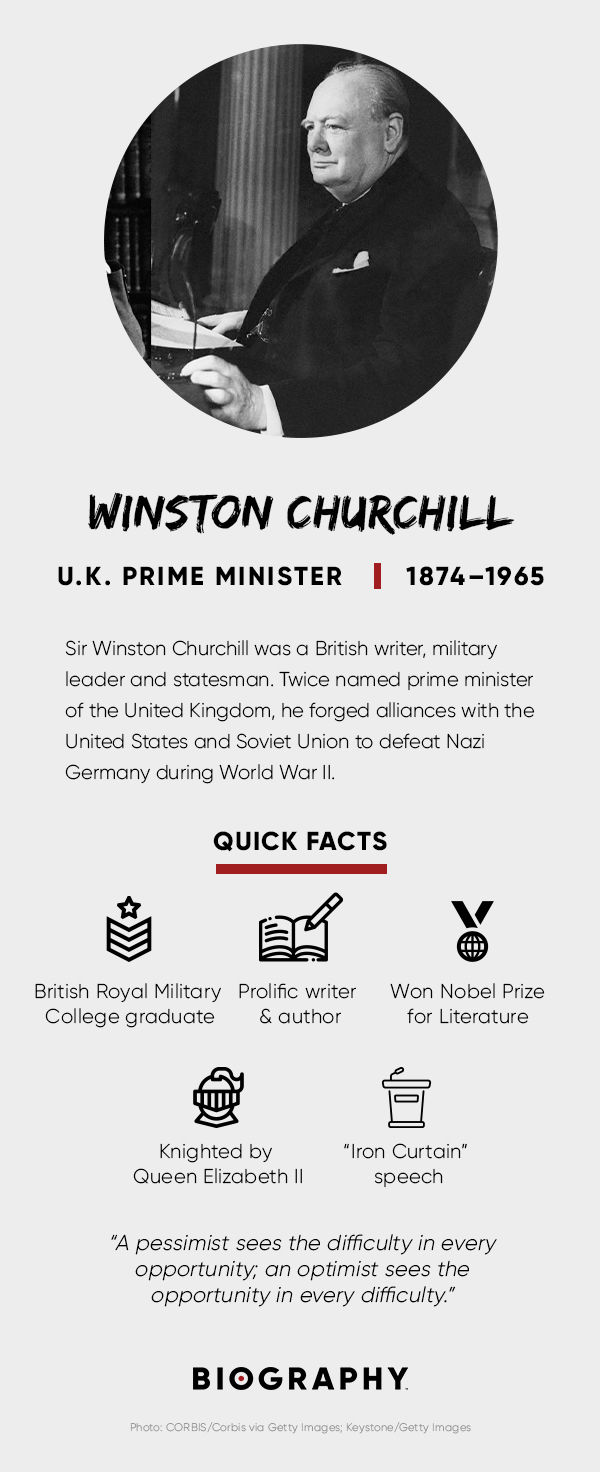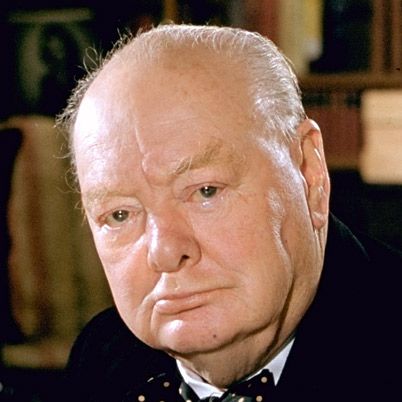
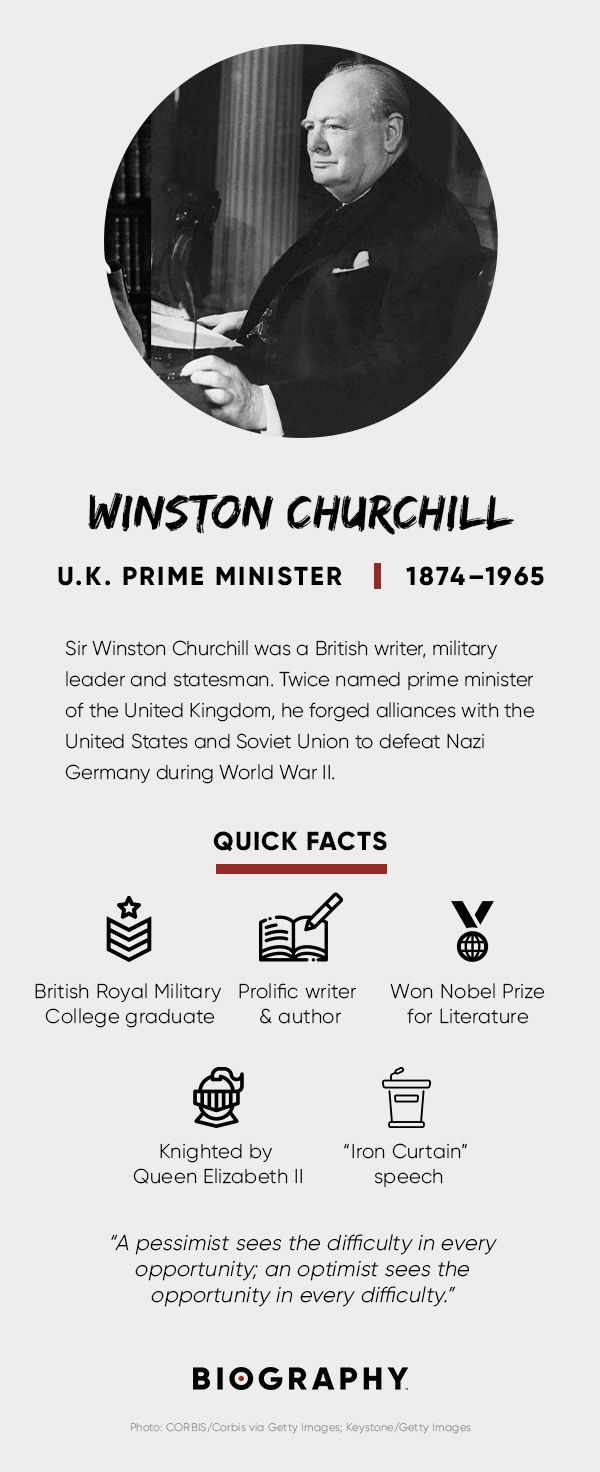
(1874-1965)
Who Was Winston Churchill?
Sir Winston Leonard Spencer-Churchill was a British politician, military officer and writer who served as the prime minister of Great Britain from 1940 to 1945 and from 1951 to 1955. After becoming prime minister in 1940, Churchill helped lead a successful Allied strategy with the U.S. and Soviet Union during World War II to defeat the Axis powers and craft postwar peace.
Early Years
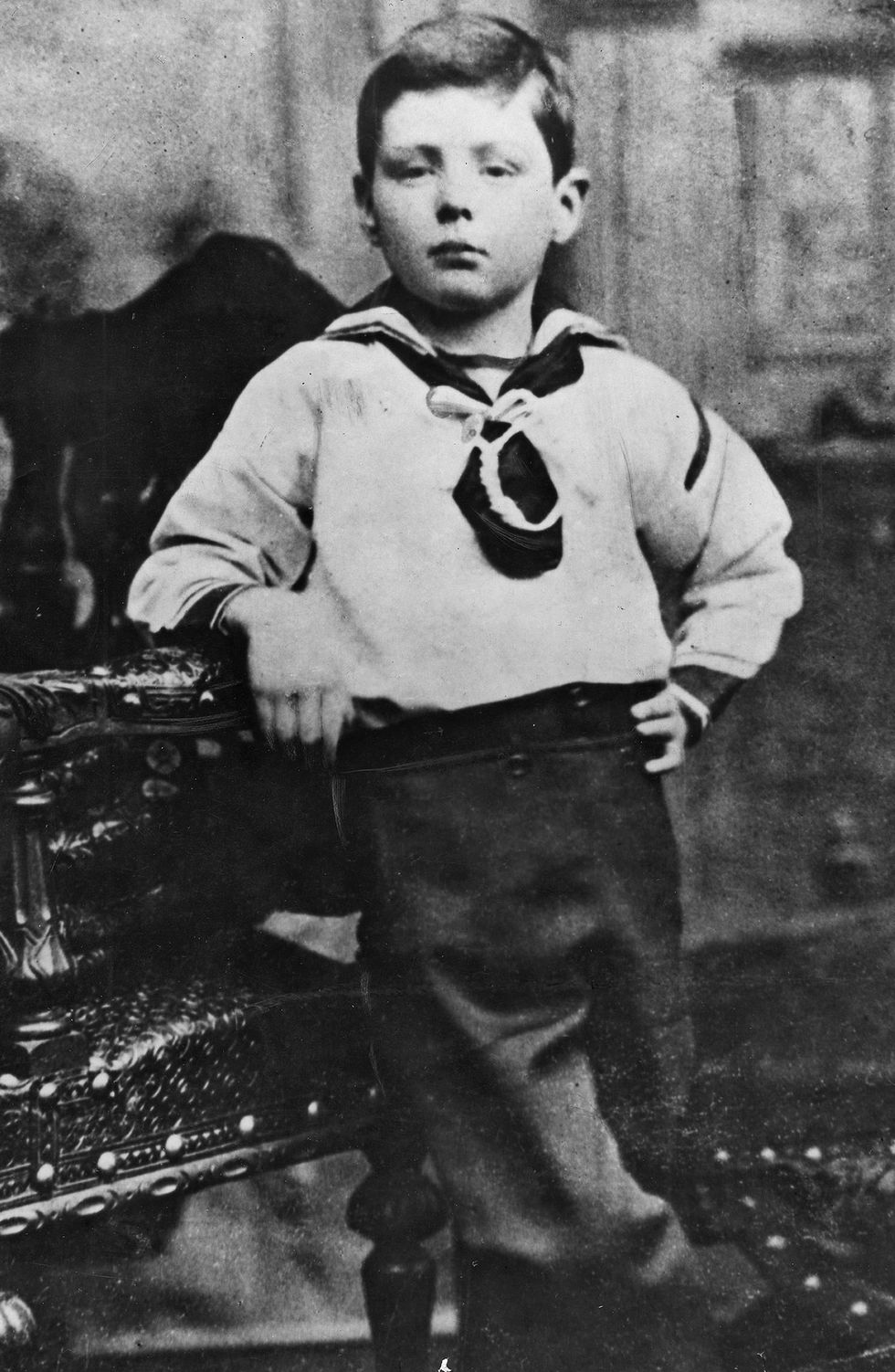
Churchill was born on November 30, 1874, at Blenheim Palace in Oxfordshire, England.
From an early age, young Churchill displayed the traits of his father, Lord Randolph Churchill, a British statesman from an established English family, and his mother, Jeanette "Jennie" Jerome, an independent-minded New York socialite.
Churchill grew up in Dublin, Ireland, where his father was employed by his grandfather, the 7th Duke of Marlborough, John Spencer-Churchill.
Churchill proved to be an independent and rebellious student; after performing poorly at his first two schools, Churchill in April 1888 began attending Harrow School, a boarding school near London. Within weeks of his enrollment, he joined the Harrow Rifle Corps, putting him on a path to a military career.
At first, it didn't seem the military was a good choice for Churchill; it took him three tries to pass the exam for the British Royal Military College. However, once there, he fared well and graduated 20th in his class of 130.
Up to this time, his relationship with both his mother and father was distant, though he adored them both. While at school, Churchill wrote emotional letters to his mother, begging her to come see him, but she seldom came.
His father died when he was 21, and it was said that Churchill knew him more by reputation than by any close relationship they shared.
Military Career
Churchill enjoyed a brief but eventful career in the British Army at a zenith of British military power. He joined the Fourth Queen's Own Hussars in 1895 and served in the Indian northwest frontier and the Sudan, where he saw action in the Battle of Omdurman in 1898.
While in the Army, he wrote military reports for the Pioneer Mail and the Daily Telegraph, and two books on his experiences, The Story of the Malakand Field Force (1898) and The River War (1899).
In 1899, Churchill left the Army and worked as a war correspondent for the Morning Post, a conservative daily newspaper. While reporting on the Boer War in South Africa, he was taken prisoner by the Boers during a scouting expedition.
He made headlines when he escaped, traveling almost 300 miles to Portuguese territory in Mozambique. Upon his return to Britain, he wrote about his experiences in the book London to Ladysmith via Pretoria (1900).
Parliament and Cabinet
In 1900, Churchill became a member of the British Parliament in the Conservative Party for Oldham, a town in Manchester. Following his father into politics, he also followed his father's sense of independence, becoming a supporter of social reform.
Unconvinced that the Conservative Party was committed to social justice, Churchill switched to the Liberal Party in 1904. He was elected a member of Parliament in 1908 and was appointed to the prime minister's cabinet as president of the Board of Trade.
As president of the Board of Trade, Churchill joined newly appointed Chancellor David Lloyd George in opposing the expansion of the British Navy. He introduced several reforms for the prison system, introduced the first minimum wage and helped set up labor exchanges and unemployment insurance.
Churchill also assisted in the passing of the People's Budget, which introduced taxes on the wealthy to pay for new social welfare programs. The budget passed in the House of Commons in 1909 and was initially defeated in the House of Lords before being passed in 1910.
In January 1911, Churchill showed his tougher side when he made a controversial visit to a police siege in London, with two alleged robbers holed up in a building.
Churchill's degree of participation is still in some dispute: Some accounts have him going to the scene only to see for himself what was going on; others state that he allegedly gave directions to police on how to best storm the building.
What is known is that the house caught fire during the siege and Churchill prevented the fire brigade from extinguishing the flames, stating that he thought it better to "let the house burn down," rather than risk lives rescuing the occupants. The bodies of the two robbers were later found inside the charred ruins.
Wife and Children
In 1908, Winston Churchill married Clementine Ogilvy Hozier after a short courtship.
The couple had five children together: Diana, Randolph, Sarah, Marigold (who died as a toddler of tonsillitis) and Mary.
First Lord of the Admiralty
Named First Lord of the Admiralty in 1911, Churchill helped modernize the British Navy, ordering that new warships be built with oil-fired instead of coal-fired engines.
He was one of the first to promote military aircraft and set up the Royal Navy Air Service. He was so enthusiastic about aviation that he took flying lessons himself to understand firsthand its military potential.
Churchill also drafted a controversial piece of legislation to amend the Mental Deficiency Act of 1913, mandating sterilization of the feeble-minded. The bill, which mandated only the remedy of confinement in institutions, eventually passed in both houses of Parliament.
World War I
Churchill remained in his post as First Lord of the Admiralty through the start of World War I, but was forced out for his part in the disastrous Battle of Gallipoli. He resigned from the government toward the end of 1915.
For a brief period, Churchill rejoined the British Army, commanding a battalion of the Royal Scots Fusiliers on the Western Front and seeing action in "no man's land."
In 1917, he was appointed minister of munitions for the final year of the war, overseeing the production of tanks, airplanes and munitions.
After World War I
From 1919 to 1922, Churchill served as minister of war and air and colonial secretary under Prime Minister David Lloyd George.
As colonial secretary, Churchill was embroiled in another controversy when he ordered air power to be used on rebellious Kurdish tribesmen in Iraq, a British territory. At one point, he suggested that poisonous gas be used to put down the rebellion, a proposal that was considered but never enacted.
Fractures in the Liberal Party led to the defeat of Churchill as a member of Parliament in 1922, and he rejoined the Conservative Party. He served as Chancellor of the Exchequer, returning Britain to the gold standard, and took a hard line against a general labor strike that threatened to cripple the British economy.
With the defeat of the Conservative government in 1929, Churchill was out of government. He was perceived as a right-wing extremist, out of touch with the people.
Painting
In the 1920s, after his ouster from government, Churchill took up painting. “Painting came to my rescue in a most trying time,” he later wrote.
Churchill went on to create over 500 paintings, typically working en plein air, though also practicing with still lifes and portraits. He claimed that painting helped him with his powers of observation and memory.
Sutherland Portrait
Churchill himself was the subject of a famous - and famously controversial - portrait by renowned artist Graham Sutherland.
Commissioned in 1954 by members of Parliament to mark Churchill's 80th birthday, the portrait was first unveiled in a public ceremony in Westminster Hall, where it met with considerable derision and laughter.
The unflattering modernist painting was reportedly loathed by Churchill and members of his family. Churchill's wife Clementine had the Sutherland portrait secretly destroyed in a bonfire several months after it was delivered to their country estate, Chartwell, in Kent.
'Wilderness Years'
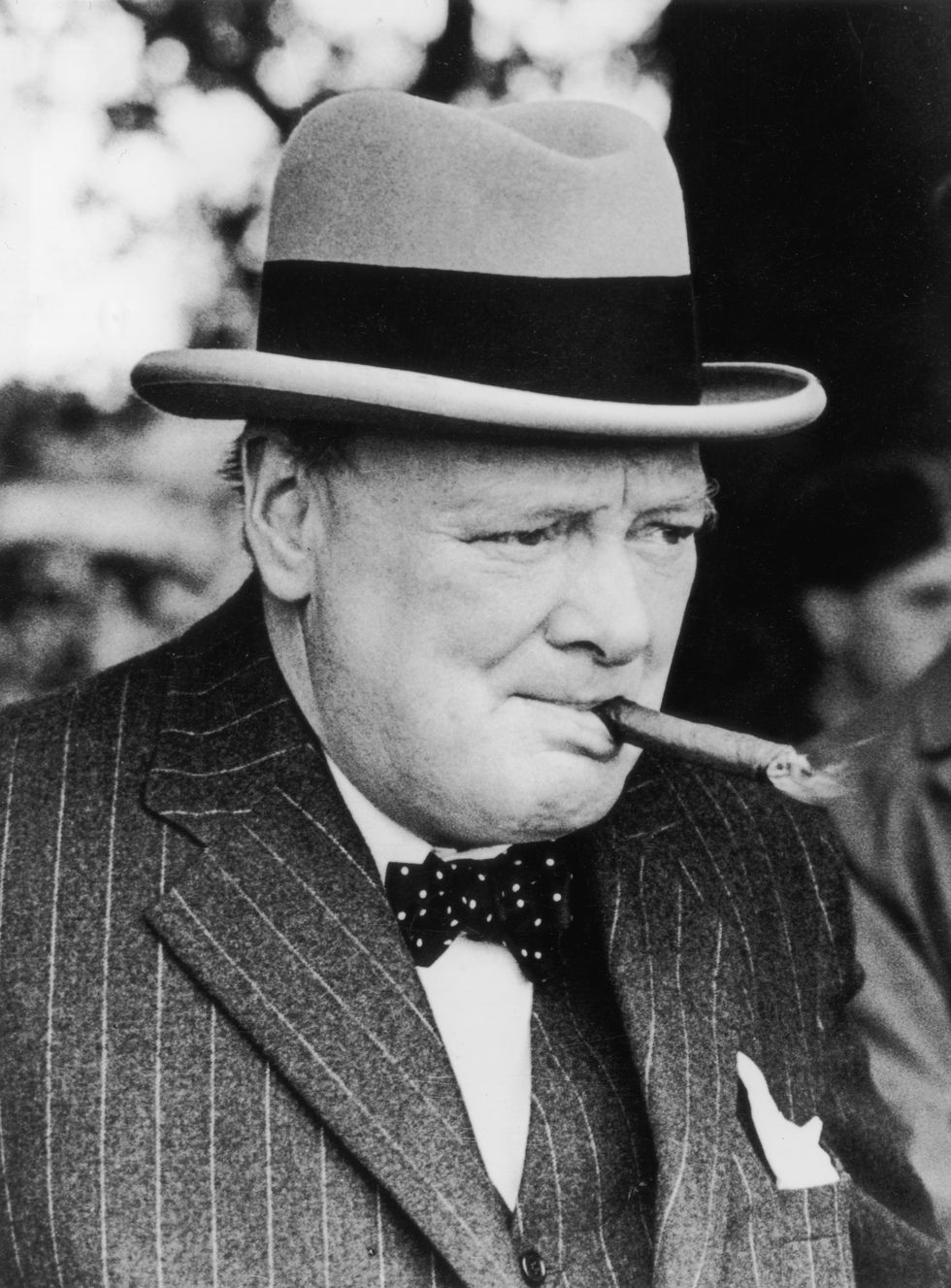
Through the 1930s, known as his "wilderness years," Churchill concentrated on his writing, publishing a memoir and a biography of the First Duke of Marlborough.
During this time, he also began work on his celebrated A History of the English-Speaking Peoples, though it wouldn't be published for another two decades.
As activists in 1930s India clamored for independence from British rule, Churchill cast his lot with opponents of independence. He held particular scorn for Mahatma Gandhi, stating that "it is alarming and also nauseating to see Mr Gandhi, a seditious Middle Temple lawyer ... striding half-naked up the steps of the Vice-regal palace ... to parley on equal terms with the representative of the King-Emperor."
World War II
Although Churchill didn't initially see the threat posed by Adolf Hitler's rise to power in the 1930s, he gradually became a leading advocate for British rearmament.
By 1938, as Germany began controlling its neighbors, Churchill had become a staunch critic of Prime Minister Neville Chamberlain's policy of appeasement toward the Nazis.
On September 3, 1939, the day Britain declared war on Germany, Churchill was again appointed First Lord of the Admiralty and a member of the war cabinet; by April 1940, he became chairman of the Military Coordinating Committee.
Later that month, Germany invaded and occupied Norway, a setback for Chamberlain, who had resisted Churchill's proposal that Britain preempt German aggression by unilaterally occupying vital Norwegian iron mines and seaports.
Prime Minister
On May 10, 1940, Chamberlain resigned and King George VI appointed Churchill as prime minister and minister of defense.
Within hours, the German army began its Western Offensive, invading the Netherlands, Belgium and Luxembourg. Two days later, German forces entered France. As clouds of war darkened over Europe, Britain stood alone against the onslaught.
Churchill was to serve as prime minister of Great Britain from 1940 to 1945, leading the country through World War II until Germany’s surrender.
Battle of Britain
Quickly, Churchill formed a coalition cabinet of leaders from the Labor, Liberal and Conservative parties. He placed intelligent and talented men in key positions.
On June 18, 1940, Churchill made one of his iconic speeches to the House of Commons, warning that "the Battle of Britain" was about to begin. Churchill kept resistance to Nazi dominance alive and created the foundation for an alliance with the United States and the Soviet Union.
Churchill had previously cultivated a relationship with U.S. President Franklin D. Roosevelt in the 1930s, and by March 1941, he was able to secure vital U.S. aid through the Lend Lease Act, which allowed Britain to order war goods from the United States on credit.
After the United States entered World War II in December 1941, Churchill was confident that the Allies would eventually win the war. In the months that followed, Churchill worked closely with Roosevelt and Soviet leader Joseph Stalin to forge an Allied war strategy and postwar world.
In a meeting in Tehran (1943), at the Yalta Conference (1945) and the Potsdam Conference (1945), Churchill collaborated with the two leaders to develop a united strategy against the Axis Powers and helped craft the postwar world with the United Nations as its centerpiece.
As the war wound down, Churchill proposed plans for social reforms in Britain but was unable to convince the public. Despite Germany's surrender on May 7, 1945, Churchill was defeated in the general election in July 1945.
'Iron Curtain' Speech
In the six years after Churchill’s defeat, he became the leader of the opposition party and continued to have an impact on world affairs.
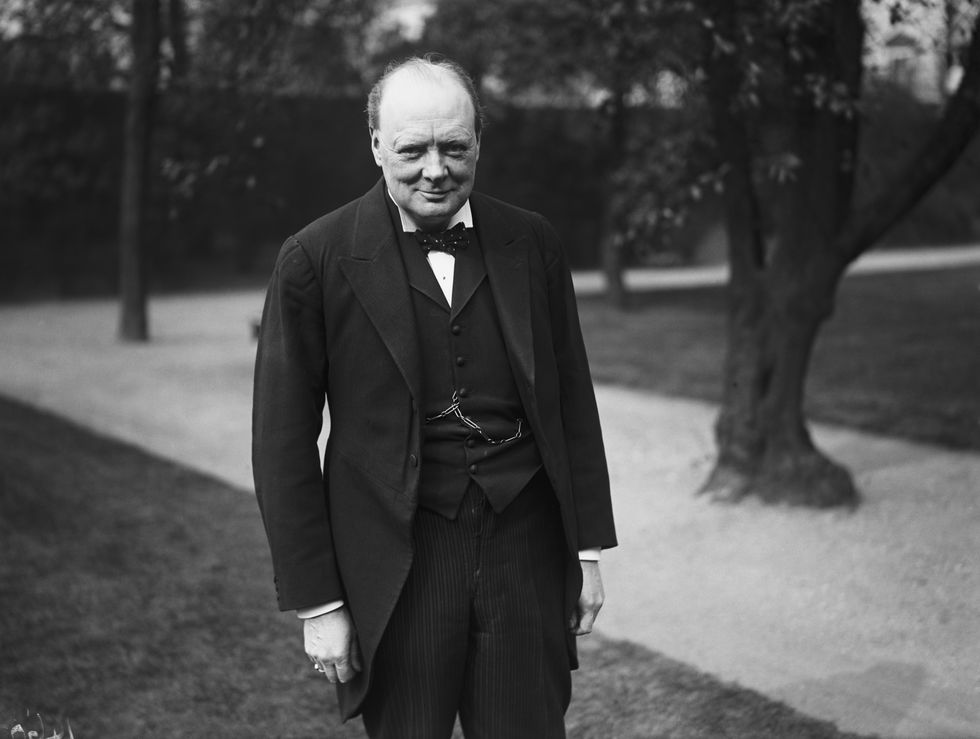
In March 1946, while on a visit to the United States, he made his famous "Iron Curtain" speech, warning of Soviet domination in Eastern Europe. He also advocated that Britain remain independent from European coalitions.
With the general election of 1951, Churchill returned to government. He became prime minister for the second time in October 1951 and served as minister of defense between October 1951 and March 1952.
Churchill went on to introduce reforms such as the Mines and Quarries Act of 1954, which improved working conditions in mines, and the Housing Repairs and Rent Act of 1955, which established standards for housing.
These domestic reforms were overshadowed by a series of foreign policy crises in the colonies of Kenya and Malaya, where Churchill ordered direct military action. While successful in putting down the rebellions, it became clear that Britain was no longer able to sustain its colonial rule.
Nobel Prize
In 1953, Churchill was knighted by Queen Elizabeth II.
The same year, he was named the recipient of the Nobel Prize for Literature for "his mastery of historical and biographical description as well as for brilliant oratory in defending exalted human values," according to the Nobel Prize committee.
Death
Churchill died on January 24, 1965, at age 90, in his London home nine days after suffering a severe stroke. Britain mourned for more than a week.
Churchill had shown signs of fragile health as early as 1941 when he suffered a heart attack while visiting the White House. Two years later, he had a similar attack while battling a bout of pneumonia.
In June 1953, at age 78, he endured a series of strokes at his office. That particular news was kept from the public and Parliament, with the official announcement stating that he had suffered from exhaustion.
Churchill recuperated at home and returned to his work as prime minister in October. However, it was apparent even to the great statesman that he was physically and mentally slowing down, and he retired as prime minister in 1955. Churchill remained a member of Parliament until the general election of 1964 when he did not seek reelection.
There was speculation that Churchill suffered from Alzheimer's disease in his final years, though medical experts pointed to his earlier strokes as the likely cause of reduced mental capacity.
Despite his poor health, Churchill was able to remain active in public life, albeit mostly from the comfort of his homes in Kent and Hyde Park Gate in London.
Legacy
As with other influential world leaders, Churchill left behind a complicated legacy.
Honored by his countrymen for defeating the dark regime of Hitler and the Nazi Party, he topped the list of greatest Britons of all time in a 2002 BBC poll, outlasting other luminaries like Charles Darwin and William Shakespeare.
To critics, his steadfast commitment to British imperialism and his withering opposition to independence for India underscored his disdain for other races and cultures.
Churchill Movies and Books
Churchill has been the subject of numerous portrayals on the big and small screen over the years, with actors from Richard Burton to Christian Slater taking a crack at capturing his essence. John Lithgow delivered an acclaimed performance as Churchill in the Netflix series The Crown, winning an Emmy for his work in 2017.
That year also brought the release of two biopics: In June, Brian Cox starred in the titular role of Churchill, about the events leading up to the World War II invasion of Normandy. Gary Oldman took his turn by undergoing an eye-popping physical transformation to become the iconic statesman in Darkest Hour.
Churchill's standing as a towering figure of the 20th century is such that his two major biographies required multiple authors and decades of research between volumes. William Manchester published volume 1 of The Last Lion in 1983 and volume 2 in 1986, but died while working on part 3; it was finally completed by Paul Reid in 2012.
The official biography, Winston S. Churchill, was begun by the former prime minister's son Randolph in the early 1960s; it passed on to Martin Gilbert in 1968, and then into the hands of an American institution, Hillsdale College, some three decades later. In 2015, Hillsdale published volume 18 of the series.
QUICK FACTS
- Name: Winston Churchill
- Birth Year: 1874
- Birth date: November 30, 1874
- Birth City: Blenheim Palace, Woodstock
- Birth Country: England
- Gender: Male
- Best Known For: Winston Churchill was a British military leader and statesman. Twice named prime minister of Great Britain, he helped to defeat Nazi Germany in World War II.
- Industries
- World Politics
- World War II
- Astrological Sign: Sagittarius
- Schools
- Harrow School
- Brunswick School
- Royal Military College (Academy) at Sandhurst
- St. George's School
- Interesting Facts
- Winston Churchill was a prolific writer and author and won the Nobel Prize for Literature in 1953.
- Churchill was a son of a British statesman father and an American socialite mother.
- In 1963 President JFK bestowed Churchill honorary U.S. citizenship, the first time a president gave such an award to a foreign national.
- Death Year: 1965
- Death date: January 24, 1965
- Death City: Hyde Park Gate, London
- Death Country: England
Fact Check
We strive for accuracy and fairness.If you see something that doesn't look right,contact us!
CITATION INFORMATION
- Article Title: Winston Churchill Biography
- Author: Biography.com Editors
- Website Name: The Biography.com website
- Url: https://www.biography.com/political-figures/winston-churchill
- Access Date:
- Publisher: A&E; Television Networks
- Last Updated: January 22, 2021
- Original Published Date: April 3, 2014
QUOTES
- An appeaser is one who feeds a crocodile, hoping it will eat him last.
- I have nothing to offer but blood, toil, tears and sweat.
- Never in the field of human conflict was so much owed by so many to so few.
- A pessimist sees the difficulty in every opportunity; an optimist sees the opportunity in every difficulty.
- Courage is rightly esteemed the first of human qualities ... because it is the quality which guarantees all others.
- From Stettin in the Baltic to Trieste in the Adriatic an iron curtain has descended across the Continent.