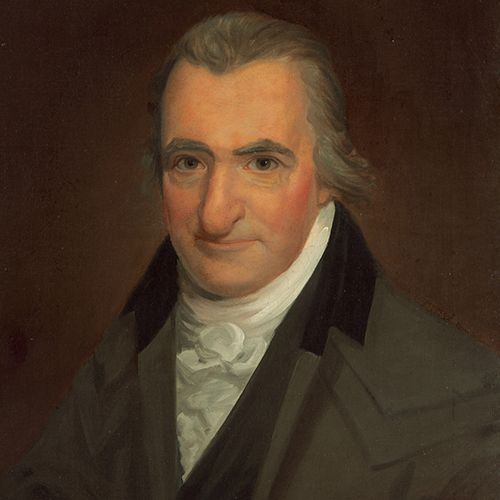
(1737-1809)
Who Was Thomas Paine?
Thomas Paine was an influential 18th-century writer of essays and pamphlets. Among them were "The Age of Reason," regarding the place of religion in society; "Rights of Man," a piece defending the French Revolution; and "Common Sense," which was published during the American Revolution. "Common Sense," Paine's most influential piece, brought his ideas to a vast audience, swaying the otherwise undecided public opinion to the view that independence from the British was a necessity.
Early Life
Paine was born in Thetford, England, in 1737, to a Quaker father and an Anglican mother. Paine received little formal education but did learn to read, write and perform arithmetic. At the age of 13, he began working with his father as stay maker (the thick rope stays used on sailing ships) in Thetford, a shipbuilding town. Some sources state he and his father were corset makers, but most historians cite this as an example of slanders spread by his enemies. He later worked as an officer of the excise, hunting smugglers and collecting liquor and tobacco taxes. He did not excel at this job, nor at any other early job, and his life in England was, in fact, marked by repeated failures.
To compound his professional hardships, around 1760, Paine's wife and child both died in childbirth, and his business, that of making stay ropes, went under. In the summer of 1772, Paine published "The Case of the Officers of Excise," a 21-page article in defense of higher pay for excise officers. It was his first political work, and he spent that winter in London, handing out the 4,000 copies of the article to members of Parliament and other citizens. In the spring of 1774, Paine was fired from the excise office and began to see his outlook as bleak. Luckily, he soon met Benjamin Franklin, who advised him to move to America and provided him with letters of introduction to the soon-to-be-formed nation.
The Move to America
Paine arrived in Philadelphia on November 30, 1774, taking up his first regular employment — helping to edit the Pennsylvania Magazine — in January 1775. At this time, Paine began writing in earnest, publishing several articles, anonymously or under pseudonyms. One of his early articles was a scathing condemnation of the African enslaved people trade, called "African Slavery in America," which he signed under the name "Justice and Humanity." Paine's propagandist ideas were just coming together, and he couldn't have arrived in America at a better time to advance his general views and thoughts on revolution and injustice, as the conflict between the colonists and England had reached a fever pitch.
Within five months of Paine's arrival, however, the precipitating event to his most famous work would occur. After the battles of Lexington and Concord (April 19, 1775), which were the first military engagements of the American Revolutionary War, Paine argued that America should not simply revolt against taxation, but demand independence from Great Britain entirely. He expanded this idea in a 50-page pamphlet called "Common Sense," which was printed on January 10, 1776.
'Common Sense'
Worded in a way that forces the reader to make an immediate choice, "Common Sense" presented the American colonists, who were generally still undecided, with a cogent argument for full-scale revolt and freedom from British rule. And while it likely had little effect on the actual writing of the Declaration of Independence, "Common Sense" forced the issue on the streets, making the colonists see that a grave issue was upon them and that a public discussion was direly needed. Once it initiated debate, the article offered a solution for Americans who were disgusted and alarmed at the presence of tyranny in their new land, and it was passed around and read aloud often, bolstering enthusiasm for independence and encouraging recruitment for the Continental Army. ("Common Sense" is referred to by one historian as "the most incendiary and popular pamphlet of the entire revolutionary era.")
Paine wrote "Common Sense" in an unadorned style, forgoing philosophical ponderings and Latin terms, and relying instead on biblical references to speak to the common man, as would a sermon. Within just a few months, the piece sold more than 500,000 copies. "Common Sense" presents as its chief option a distinctly American political identity and, more so than any other single publication, paved the way for the Declaration of Independence, which was unanimously ratified on July 4, 1776.
'Crisis' Papers
During the American Revolution, Paine served as a volunteer personal assistant to General Nathanael Greene, traveling with the Continental Army. While not a natural soldier, Paine contributed to the patriot cause by inspiring the troops with his 16 "Crisis" papers, which appeared between 1776 and 1783. "The American Crisis. Number I" was published on December 19, 1776, and began thusly: "These are the times that try men's souls." George Washington's troops were being decimated, and he ordered that the pamphlet be read to all of his troops at Valley Forge, in hopes of inflaming them to victory.
Government Appointment
In 1777, Congress named Paine secretary to the Committee for Foreign Affairs. The following year, however, Paine accused a member of the Continental Congress of trying to profit personally from French aid given to the United States. In revealing the scandal, Paine quoted from secret documents that he had accessed through his position at Foreign Affairs. Also around this time, in his pamphlets, Paine alluded to secret negotiations with France that were not fit for public consumption. These missteps eventually led to Paine's expulsion from the committee in 1779.
Paine soon found a new position as clerk of the General Assembly of Pennsylvania, and observed fairly quickly that American troops were disgruntled because of low (or no) pay and scarce supplies, so he started a drive at home and in France to raise what was needed. The wartime supplies that his effort provided were important to the final success of the Revolution, and the experience led him to appeal to the states, to pool resources for the well-being of the entire nation. Furthering his goal, he wrote "Public Good" (1780), calling for a national convention to replace the ineffectual Articles of Confederation with a strong central government under "a continental constitution."
Thomas Paine Books: 'Rights of Man,' 'The Age of Reason'
In April 1787, Paine headed back to England, where he soon became fascinated with what he heard of the roiling French Revolution. He immediately and passionately supported the Revolution, so when he read Edmund Burke's 1790 attack on it, he was inspired to write the book Rights of Man (1791) in a scathing response. The tract moved beyond supporting the French Revolution to discussing the basic reasons for discontent in European society, railing against an aristocratic society, and end of Europe’s inheritance laws. The British government banned the book and Paine was indicted for treason, although he was already on his way to France when the decree went out and avoided prosecution. He was later named an honorary citizen of France.
While rallying for the revolution, Paine also supported efforts to save the life of deposed King Louis XVI (instead favoring banishment), so when the radicals under Robespierre took power, Paine was sent to prison—from December 28, 1793, to November 4, 1794 — where he narrowly escaped execution. In 1794, while Paine was imprisoned, the first part of his The Age of Reason (The Age of Reason: Being an Investigation of True and Fabulous Theology in full) was published.
The book criticizes institutionalized religion for perceived corruption and political ambition, while challenging the validity of the Bible. The book was controversial, as was everything that Paine wrote, and the British government prosecuted anyone who tried to publish or distribute it. After his 1794 release from prison, Paine stayed in France, releasing the second and third parts of The Age of Reason before returning to the United States at President Thomas Jefferson's invitation.
Engineer and Inventor
Among his many talents, Paine was also an accomplished — though not widely-known — inventor. Some of his devices were never developed beyond the planning stage, but there are a few of note. He developed a crane for lifting heavy objects, a smokeless candle, and tinkered with the idea of using gunpowder as a method for generating power. For years, Paine had possessed a fascination with bridges. He made several attempts to build bridges in both America and England after the Revolutionary War. Perhaps his most impressive engineering achievement was the Sunderland Bridge across the Wear River at Wearmonth, England. His goal was to build a single span bridge with no piers. In 1796, the 240-foot span bridge was completed. It was the second iron bridge ever built and at the time the largest in the world. Renovated in 1857, the bridge remained until 1927, when it was replaced.
Final Years
Paine returned to the United States in 1802 or 1803, only to find that his revolutionary work, influence and reputation had mostly been forgotten, leaving only his status as a world-class rabble-rouser intact. It would take a century later before Paine's reputation would be reinstated as a vital figure to the American Revolution.
Death
Paine died alone on June 8, 1809. Only six mourners were present at his funeral — half of them formerly enslaved. To drive home the point of his tarnished image as a mere political rabble-rouser, the New York Citizen printed the following line in Paine's obituary: "He had lived long, did some good and much harm." For more than a century following his death, this was the historical verdict handed down upon the legacy of Paine. Finally, in January 1937, the Times of London turned the tide, referring to him as the "English Voltaire" — a view that has prevailed ever since, with Paine now regarded as a seminal figure of the American Revolution.
QUICK FACTS
- Name: Thomas Paine
- Birth Year: 1737
- Birth date: January 29, 1737
- Birth City: Thetford
- Birth Country: United Kingdom
- Gender: Male
- Best Known For: Thomas Paine was an English American writer and pamphleteer whose "Common Sense" and other writings influenced the American Revolution, and helped pave the way for the Declaration of Independence.
- Industries
- U.S. Politics
- Journalism and Nonfiction
- Astrological Sign: Aquarius
- Death Year: 1809
- Death date: June 8, 1809
- Death State: New York
- Death City: New York City
- Death Country: United States
Fact Check
We strive for accuracy and fairness.If you see something that doesn't look right,contact us!
CITATION INFORMATION
- Article Title: Thomas Paine Biography
- Author: Biography.com Editors
- Website Name: The Biography.com website
- Url: https://www.biography.com/political-figures/thomas-paine
- Access Date:
- Publisher: A&E; Television Networks
- Last Updated: March 31, 2021
- Original Published Date: April 2, 2014
QUOTES
- Any system of religion that has anything in it that shocks the mind of a child, cannot be true.
- An army of principles can penetrate where an army of soldiers cannot.