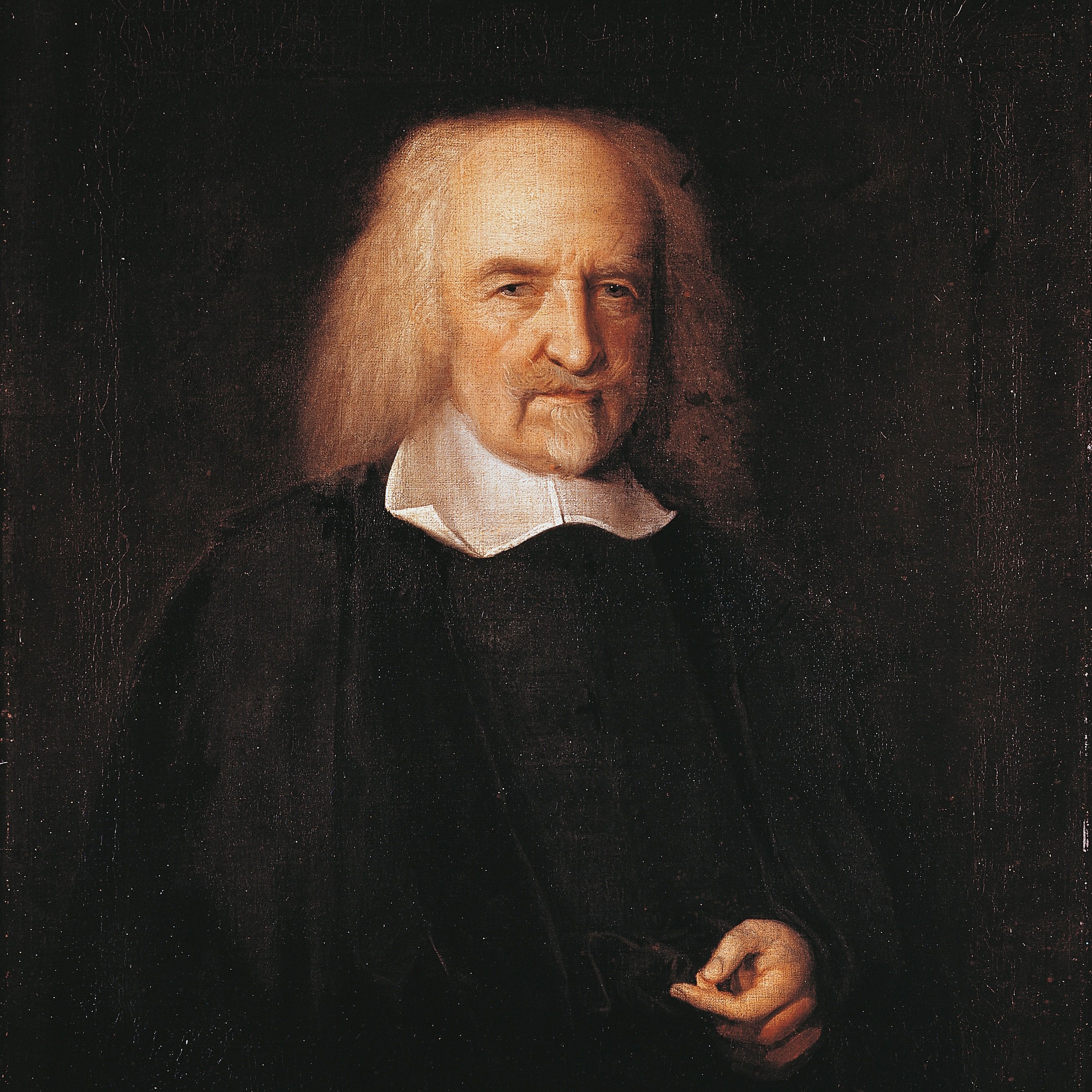
(1588-1679)
Who Was Thomas Hobbes?
Thomas Hobbes was known for his views on how humans could thrive in harmony while avoiding the perils and fear of societal conflict. His experience during a time of upheaval in England influenced his thoughts, which he captured in The Elements of Law (1640); De Cive [On the Citizen] (1642) and his most famous work, Leviathan (1651). Hobbes died in 1679.
Early Years
Thomas Hobbes was born in Westport, adjoining Malmesbury, England, on April 5, 1588. His father was the disgraced vicar of a local parish, and in the wake of the precipitating scandal (caused by brawling in front of his own church), he disappeared, abandoning his three children to the care of his brother. An uncle of Hobbes', a tradesman and alderman, provided for Hobbes' education. Already an excellent student of classical languages, at age 14, Hobbes went to Magdalen Hall in Oxford to study. He then left Oxford in 1608 and became the private tutor for William Cavendish, the eldest son of Lord Cavendish of Hardwick (later known as the first Earl of Devonshire). In 1610, Hobbes traveled with William to France, Italy and Germany, where he met other leading scholars of the day, such as Francis Bacon and Ben Jonson.
Hobbes' pupil died in 1628, and Hobbes was left searching for a new one (always finding himself working for various wealthy and aristocratic families), Hobbes later worked for the Marquess of Newcastle-upon-Tyne, a cousin of William Cavendish, and the marquess's brother, Sir Charles Cavendish. In 1631, while again tutoring a young Cavendish, Hobbes' philosophy began to take form, and his Short Tract on First Principles appeared.
Political Involvement
Through his association with the Cavendish family, Hobbes entered circles where the activities of the king, members of Parliament, and other wealthy landowners were discussed, and his intellectual abilities brought him close to power (although he never became a powerful figure himself). Through these channels, he began to observe the influence and structures of power and government. Also, the young William Cavendish was a member of Parliament (1614 and 1621), and Hobbes would have sat in on various parliamentary debates. In the late 1630s, Hobbes became linked with the royalists in disputes between the king and Parliament, as the two factions were in conflict over the scope of kingly powers, especially regarding raising money for armies.
In 1640, Hobbes wrote a piece defending King Charles I's wide interpretation of his own rights in these matters, and royalist members of Parliament used sections of Hobbes' treatise in debates. The treatise was circulated, and The Elements of Law, Natural and Politic became Hobbes' first work of political philosophy (although he never intended it to be published as a book). The conflict then culminated in the English Civil Wars (1642-1651), which led to the king being executed and a republic being declared, and Hobbes left the country to preserve his personal safety, living in France from 1640 to 1651.
Development of Scientific Interests
Hobbes had never been trained in mathematics or the sciences at Oxford, nor previously at Wiltshire. But one branch of the Cavendish family, the Wellbecks, were scientifically and mathematically minded, and Hobbes' growing interest in these realms was stirred mainly through his association with certain family members and through various conversations he'd had and reading he'd done on the Continent. In 1629 or 1630, it is reported that Hobbes found a volume of Euclid and fell in love with geometry and Euclid's method of demonstrating theorems.
Later, he had gained enough independent knowledge to pursue research in optics, a field he would lay claim to as a pioneer. In fact, Hobbes was gaining a reputation in many fields: mathematics (especially geometry), translation (of the classics) and law. He also became well known (notorious, in fact) for his writings and disputes on religious subjects. As a member of Mersenne's circle in Paris, he was also respected as a theorist in ethics and politics.
His love of mathematics and a fascination with the properties of matter--sizes, shapes, positions, etc.--laid the foundation for his great Elements of Philosophy trilogy: De Cive (1642; "Concerning the Citizen"), De Corpore (1655; "Concerning Body") and De Homine (1658; "Concerning Man"). The trilogy was his attempt to arrange the components of natural science, psychology and politics into a hierarchy, from the most fundamental to the most specific. The works incorporated Hobbes' findings on optics and the work of, among others, Galileo (on the motions of terrestrial bodies) and Kepler (on astronomy). The science of politics discussed in De Cive was further developed in Leviathan, which is the strongest example of his writings on morality and politics, the subjects for which Hobbes is most remembered.
Development of his Political Philosophy
In Paris in 1640, Hobbes sent to Mersenne a set of comments on both Descartes' Discourse and his Optics. Descartes saw some of the comments and sent a letter to Mersenne in response, to which Hobbes again responded. Hobbes disagreed with Descartes' theory that the mind was the primal certainty, instead using motion as the basis for his philosophy regarding nature, the mind and society. To expand the discussion, Mersenne convinced Hobbes to write a critique of Descartes' Meditationes de Prima Philosophia ("Meditations on First Philosophy"), and of course he did so. Hobbes' thoughts were listed third among the set of "Objections" appended to the work. "Replies" from Descartes then appeared in 1641. In these exchanges and elsewhere, Hobbes and Descartes regarded each other with a unique mixture of respect and disregard, and at their one personal meeting in 1648, they did not get along very well. The relationship, however, helped Hobbes develop his theories further.
In 1642, Hobbes released De Cive, his first published book of political philosophy. The book focuses more narrowly on the political (comprising sections titled "Liberty," "Empire" and "Religion") and was, as previously noted, conceived as part of a larger work (Elements of Philosophy). Although it was to be the third book in Elements, Hobbes wrote it first to address the particularly relevant civil unrest roiling in England at the time. Parts of the work anticipate the better-known Leviathan, which would come nine years later.
Leviathan
While still in Paris, Hobbes began work on what would become his magnum opus and one of the most influential books ever written: Leviathan, or The Matter, Forme and Power of a Common Wealth Ecclesiastical and Civil (usually referred to as simply Leviathan). Leviathan ranks high as an essential Western treatise on statecraft, on par with Machiavelli's The Prince.
In Leviathan, written during the English Civil Wars (1642-1651), Hobbes argues for the necessity and natural evolution of the social contract, a social construct in which individuals mutually unite into political societies, agreeing to abide by common rules and accept resultant duties to protect themselves and one another from whatever might come otherwise. He also advocates rule by an absolute sovereign, saying that chaos--and other situations identified with a "state of nature" (a pre-government state in which individuals' actions are bound only by those individuals' desires and restraints)--could be averted only by a strong central government, one with the power of the biblical Leviathan (a sea creature), which would protect people from their own selfishness. He also warned of "the war of all against all" (Bellum omnium contra omnes), a motto that went on to greater fame and represented Hobbes' view of humanity without government.
As Hobbes lays out his thoughts on the foundation of states and legitimate government, he does it methodically: The state is created by humans, so he first describes human nature. He says that in each of us can be found a representation of general humanity and that all acts are ultimately self-serving--that in a state of nature, humans would behave completely selfishly. He concludes that humanity's natural condition is a state of perpetual war, fear and amorality, and that only government can hold a society together.
Later Years and Death
After his return to England in 1651, Hobbes continued to write. De Corpore was published in 1655, and De Homine was published in 1658, completing the Elements of Philosophy trilogy. In his later years, Hobbes turned his attention to a boyhood favorite--classics--publishing translations of Homer's The Odyssey and The Iliad.
Hugely influential, Hobbes' ideas form the building blocks of nearly all Western political thought, including the right of the individual, the importance of republican government, and the idea that acts are allowed if they are not expressly forbidden. The historical importance of his political philosophy cannot be overstated, as it went on to influence the likes of John Locke, Jean-Jacques Rousseau and Immanuel Kant, to name a few.
Hobbes died on December 4, 1679.
QUICK FACTS
- Name: Thomas Hobbes
- Birth Year: 1588
- Birth date: April 5, 1588
- Birth City: Westport, near Mamesbury, Wiltshire
- Birth Country: England
- Gender: Male
- Best Known For: Thomas Hobbes, an English philosopher in the 17th century, was best known for his book 'Leviathan' (1651) and his political views on society.
- Industries
- Writing and Publishing
- Journalism and Nonfiction
- Law
- Education and Academia
- Politics and Government
- Astrological Sign: Aries
- Death Year: 1679
- Death date: December 4, 1679
- Death City: Derbyshire
- Death Country: England
Fact Check
We strive for accuracy and fairness. If you see something that doesn't look right, contact us!