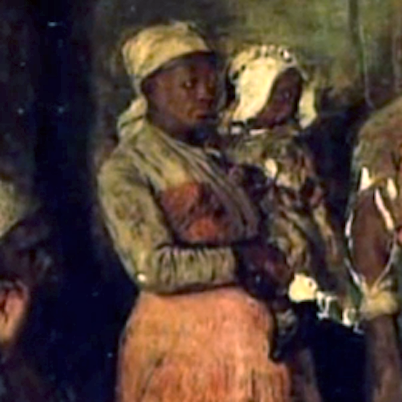
(1773-1835)
Who Was Sally Hemings?
Sally Hemings, born in 1773 in Virginia, worked on the Monticello plantation of Thomas Jefferson. She was a nursemaid to his daughter Mary and traveled with the family to Paris. Though it was rumored that she had several children with Jefferson, both the family and historians denied the claim. Recent DNA testing has concluded however that Hemings’ children are connected to the Jefferson bloodline.
Early Life
Hemings was believed to have been the mistress of Thomas Jefferson, author of the Declaration of Independence and third president of the United States. Born around 1773 in Virginia, Hemings was the youngest of six children born to Elizabeth (Betty) Hemings, an enslaved person of African and European descent; her probable given name was Sarah. Hemings' father was allegedly her mother's owner, John Wayles, a white lawyer and enslaved person trader of English descent who had emigrated to Virginia. As Wayles was also the father of Martha Wayles (Skelton) Jefferson, Jefferson's wife, Hemings and Martha Jefferson are believed to have been half-sisters.
After Wayles' death, Hemings, along with her mother and siblings, moved to Monticello, Jefferson's Virginia home, as part of Martha's inheritance. Hemings arrived at Monticello when she was about three years old. As a child and young teenager, Hemings performed the duties of a household servant. After Martha's death in 1782, Hemings became a companion for one of Jefferson's younger daughters, Mary.
Relationship with Thomas Jefferson
Jefferson traveled to Paris in 1784 to serve as the American minister to France. He took his eldest daughter, also named Martha, with him, while his two younger daughters, Mary and Lucy, stayed with their relatives, as did Hemings. After Lucy Jefferson died of whooping cough, Jefferson called Mary to Paris in the summer of 1787. The 14-year-old Hemings came with her. Hemings spent the next two years living with the Jeffersons in Paris, along with her brother, James, who served as Jefferson's personal servant. There is strong evidence to suggest that during this time, Jefferson and Hemings had a sexual relationship.
While Hemings was entitled to her freedom under French law, and for a time reportedly even considered staying in France after Jefferson's departure, she ended up returning to Virginia in 1789. According to one of her youngest sons, Madison Hemings (who published his memoirs in 1873), Jefferson convinced his mother to return to America by promising her privileged status in his household and pledging to free her children when they reached the age of 21. Shortly after Hemings arrived at Monticello, she gave birth to her first child. The fate of this child is uncertain. Madison Hemings stated that it lived only a short time, but the descendants of a man named Thomas Woodson claim that Woodson was the first child born to Jefferson and Hemings and that he left Monticello as a young boy after rumors of his parents' relationship began to spread.
Rumors and Scandal
Little concrete information is known about Sally Hemings’ life at Monticello. She was a seamstress, and was responsible for Jefferson's room and wardrobe. The only known descriptions of Hemings come from another enslaved person at Monticello, Isaac Jefferson, who stated that she was "mighty near white ... very handsome, long straight hair down her back," and Jefferson biographer Henry S. Randall, who once recalled Jefferson's grandson Thomas Jefferson Randolph's description of Hemings: "[She was] light colored and decidedly good looking."
The rumored relationship between Jefferson and his beautiful young servant began to circulate during the 1790s in both Virginia and Washington, D.C. The talk only intensified in 1802, when the journalist James Callender (once a Jefferson ally) published the accusation, which had been circling as gossip in Virginia for several years. Callender was the first to mention Hemings by name, as well as the first child, "Tom," allegedly born to Hemings and Jefferson. The fact that Hemings' light-skinned children bore a strong resemblance to Jefferson only increased the speculation.
Children
Of the seven children born to Hemings over the next two decades, only four (five, according to Woodson's descendants) lived to adulthood. Her second child, Harriet, died after only two years. Beverly (a son), born in 1798, left Monticello in 1822 and moved to Washington, D.C., where he lived as a white man. A second, unnamed daughter died in infancy. Harriet, born in 1801 and named for the first lost daughter, moved away near the same time as Beverly and also entered white society. Hemings' youngest children, Madison and Eston (born in 1805 and 1808, respectively) were freed by order of Jefferson’s will in 1826. While Madison Hemings lived as a Black man (first in Virginia and later in Ohio) all his life, his brother Eston changed his name to Jefferson and began living as a white man in Wisconsin at the age of 44.
Jefferson, in fact, freed all of Hemings' children; ironically, however, he never freed Hemings herself. After Jefferson's death, she remained at Monticello for two years, after which Martha Jefferson (acting on her father's wishes) gave her "her time," a form of unofficial freedom that allowed her to remain in Virginia (freed enslaved people were required by Virginia law to leave the state after a year). Before his death, Jefferson had also arranged for Madison and Eston Hemings to be allowed to stay in Virginia. After leaving Monticello, Hemings moved with her two youngest sons to nearby Charlottesville, Virginia, where she died in 1835.
Speculation Continues: Testimony and Research
A haze of controversy surrounded the possible Jefferson-Hemings liaison long after the two principal figures had passed away. In the latter half of the 19th century, contradictory evidence surfaced: In a memoir published in an Ohio newspaper in 1873, Madison Hemings claimed to be Jefferson's child. Just a year later, an account was published claiming that Jefferson's nephew, Peter Carr, had confessed to Jefferson's daughter Martha that he had been the father of all or most of Sally's children. Jefferson's direct descendants, Thomas Jefferson Randolph and Ellen Randolph Coolidge, stood by the conclusion that either Peter or Samuel Carr (both Jefferson's nephews) had fathered Hemings' children.
The Jefferson-Hemings debate was renewed in the 1970s with the publication of historian Fawn McKay Brodie's biography of Jefferson, which assumed her alleged relationship with Jefferson to be true, as well as a best-selling fictionalized account of Hemings's life written by novelist Barbara Chase-Riboud. In 1997, another historian, Annette Gordon-Reed, published Thomas Jefferson and Sally Hemings: An American Controversy, which stated that historians had underestimated the amount of evidence supporting the truth of the relationship.
Hemings-Jefferson Descendants
In November 1998, dramatic new scientific evidence became available through the analysis of the DNA of male descendants of Hemings, Jefferson, Samuel and Peter Carr, and Woodson. After comparing the Y-chromosome component of the DNA of five descendants of Jefferson's paternal uncle, Field Jefferson, with that of a descendant of another of Hemings' sons, Eston (born 1808), Dr. Eugene Foster of the University of Virginia matched certain portions of the DNA, linking the Hemings family to the Jefferson bloodline. (According to DNA researchers, the odds of a perfect match in a random sample are less than one in a thousand.) The study also found no match between the Hemings and Carr DNA, and showed that Thomas Woodson's father was not a Jefferson. In response to Foster's DNA evidence, in January 2000, the Thomas Jefferson Memorial Foundation stated its belief that Jefferson and Hemings had in fact been sexual partners, and that Jefferson was the father of Hemings' six children — including Beverly, Harriet, Madison and Eston — born between 1790 and 1808.
Sally Hemings Movie
In 1995, the historical drama film, Jefferson in Paris, told the tale of Jefferson during his time as an Ambassador of the United States to France and his burgeoning relationship with Hemings. Nick Nolte starred as Jefferson and Thandie Newton as Hemings.
On the small screen, a television miniseries, Sally Hemings: An American Scandal, premiered in 2000, starring Sam Neill as Thomas Jefferson and Carmen Ejogo as Hemings.
QUICK FACTS
- Name: Sally Hemings
- Birth Year: 1773
- Birth State: Virginia
- Birth City: Shadwell, Albermarle County
- Birth Country: United States
- Gender: Female
- Best Known For: Sally Hemings was an enslaved African American woman who’s believed to have had several children with one-time U.S. president Thomas Jefferson.
- Death Year: 1835
- Death State: Virginia
- Death City: Charlottesville
- Death Country: United States
Fact Check
We strive for accuracy and fairness.If you see something that doesn't look right,contact us!
CITATION INFORMATION
- Article Title: Sally Hemings Biography
- Author: Biography.com Editors
- Website Name: The Biography.com website
- Url: https://www.biography.com/history-culture/sally-hemings
- Access Date:
- Publisher: A&E; Television Networks
- Last Updated: July 28, 2020
- Original Published Date: April 3, 2014