(1965-2012)
Who Was Rodney King?
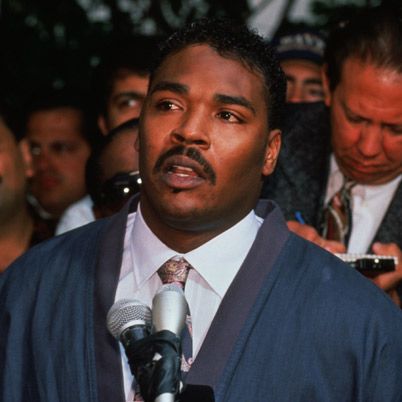
Rodney King was caught by the Los Angeles police after a high-speed chase on March 3, 1991. The officers pulled him out of the car and beat him brutally, while amateur cameraman George Holliday caught it all on videotape. The four L.A.P.D. officers involved were indicted on charges of assault with a deadly weapon and excessive use of force by a police officer. However, after a three-month trial, a predominantly white jury acquitted the officers, inflaming citizens and sparking the violent 1992 Los Angeles riots. Two decades after the riots, King told CNN that he had forgiven the officers. King was found dead in his swimming pool on June 17, 2012, in Rialto, California, at the age of 47.
Beating by LAPD
Born on April 2, 1965, in Sacramento, California, Rodney Glen King was an African American who became a symbol of racial tension in America, after his beating by Los Angeles police officers in 1991 was videotaped and broadcast to the nation.
The officers — Laurence Powell, Timothy Wind, Theodore Briseno and Stacey Koon — were charged with criminal offenses, including assault with a deadly weapon. Their trial was originally set to be held in Los Angeles, but defense attorneys successfully argued that a fair trial in Los Angeles would be impossible because of the publicity.
The trial was moved to Simi Valley, a predominantly white suburb of L.A. The jury was comprised of ten white people, one Hispanic person and one Asian person, and many objected to the fact that there were no African American jurors.
The L.A. Riots
The officers' acquittal in April 1992 triggered riots in South Central, Los Angeles. More than 50 people were killed, more than 2,000 were injured and 9,500 were arrested for rioting, looting and arson, resulting in $1 billion in property damage.
Rodney King's Famous Quote
On the third day of the riots, King made a public appearance, making his now-famous plea: "People, I just want to say, can't we all get along? Can't we all get along?"
The United States Department of Justice filed federal civil rights charges against the four officers, and in August 1992, two of them were found guilty while the other two were acquitted. King was eventually awarded $3.8 million in a civil trial for the injuries he sustained.
The riots and police response to the violent aftermath resulted in the resignation of L.A.P.D. Chief Darryl Gates, thought by many minorities to symbolize institutionalized racial intolerance. He was replaced by a Black chief, Willie Williams, who introduced several changes suggested by an independent commission that investigated the riots.
More than two decades after being brutally beaten by police officers, in May 2012, King discussed the incident with The Guardian, stating, "It's not painful to relive it. I'm comfortable with my position in American history. It was like being raped, stripped of everything, being beaten near to death there on the concrete, on the asphalt. I just knew how it felt to be a slave. I felt like I was in another world."
He went on to talk about his healing process, which included forgiving the officers who injured him. "I had to learn to forgive," he said. "I couldn't sleep at night. I got ulcers. I had to let go, to let God deal with it. No one wants to be mad in their own house. I didn't want to be angry my whole life. It takes so much energy out of you to be mean."
Troubled Life and Death
After the 1991 beating, King continued to lead a troubled life, struggling with alcoholism and having brushes with the law. In 2004, he pleaded guilty to driving under the influence of the drug PCP, after he lost control of his SUV and slammed into a power pole in Rialto, California. In 2005, he was arrested on suspicion of domestic violence, and in 2007, police found him drunk with non-life threatening gunshot wounds also believed to be the result of a domestic dispute.
King shared his struggles as a reality TV star on VH1's Celebrity Rehab, and in his 2012 memoir, The Riot Within: My Journey from Rebellion to Redemption.
Upon the 20th anniversary of the L.A. riots, King told CNN he had forgiven the officers who had beaten him, saying, "Yes, I have forgiven them because I have been forgiven so many times. My country's been good to me, and I've done some things that wasn't pleasant in my lifetime, and I've been forgiven for that."
In a final tragic twist, Rodney King's life ended on June 17, 2012. His fiancee, Cynthia Kelley, found him at the bottom of a swimming pool in Rialto, California. Kelley had previously served as a juror in King's civil law suit against the City of Los Angeles. According to police who responded to the scene, there were no preliminary signs of foul play. King was pronounced dead at a local hospital, 20 years after the L.A. riots threw him into the center of the fight against racial tension in America.
Documentaries
Upon the 25th anniversary of the L.A. Riots, a slew of documentaries were released in the spring of 2017. Among them were L.A. Burning, Let It Fall, and Spike Lee's Netflix special Rodney King.
QUICK FACTS
- Name: Rodney King
- Birth Year: 1965
- Birth date: April 2, 1965
- Birth State: California
- Birth City: Sacramento
- Birth Country: United States
- Gender: Male
- Best Known For: When a mostly white jury acquitted the police officers who were caught on video beating Rodney King, it set off the L.A. riots of 1992.
- Industries
- Law
- Crime and Terrorism
- Civil Rights
- Astrological Sign: Aries
- Death Year: 2012
- Death date: June 17, 2012
- Death State: California
- Death City: Rialto
- Death Country: United States
Fact Check
We strive for accuracy and fairness.If you see something that doesn't look right,contact us!
CITATION INFORMATION
- Article Title: Rodney King Biography
- Author: Biography.com Editors
- Website Name: The Biography.com website
- Url: https://www.biography.com/crime-figure/rodney-king
- Access Date:
- Publisher: A&E; Television Networks
- Last Updated: October 19, 2020
- Original Published Date: April 2, 2014
QUOTES
- As far as having peace within myself, the one way I can do that is forgiving the people who have done wrong to me. It causes more stress to build up anger. Peace is more productive.
- I had to learn to forgive. I couldn't sleep at night. I got ulcers. I had to let go, to let God deal with it. No one wants to be mad in their own house. I didn't want to be angry my whole life.
- It was like being raped, stripped of everything, being beaten near to death there on the concrete, on the asphalt. I just knew how it felt to be a slave. I felt like I was in another world."[On his brutal beating by L.A.P.D. officers in 1991.]
- It's not painful to relive it. I'm comfortable with my position in American history."[On his brutal beating by L.A.P.D. officers in 1991.]
- People, I just want to say, can't we all get along? Can't we all get along?