(1916-2009)
Who Was Robert McNamara?
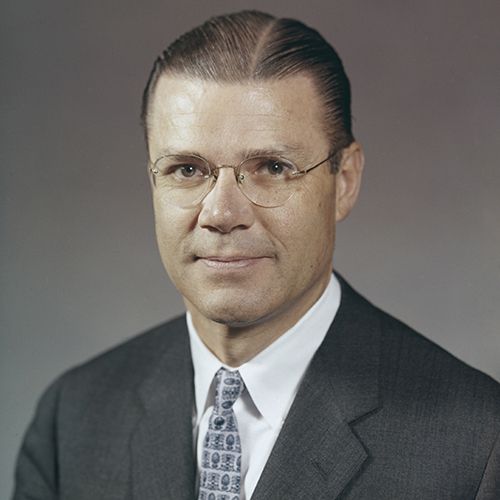
Robert McNamara was an American business executive and the eighth U.S. secretary of defense, serving under presidents John F. Kennedy and Lyndon B. Johnson. He is best known for helping lead the United States into the Vietnam War during the Kennedy Administration, an act for which he spent the remainder of his life wrestling with the moral consequences.
Early Life
Robert Strange McNamara was born on June 9, 1916, in San Francisco, California. In 1937, he graduated with a degree in economics from the University of California in Berkeley. An excellent student, McNamara went to study at Harvard Business School where he earned his master's degree in 1939.
After a short stint on the West Coast, McNamara was back at Harvard as an assistant professor. He took a break from the university to help out his country during World War II. In 1943, McNamara entered the U.S. Army Air Corps, putting his sharp analytical skills and talent for statistics to work in military situations. Not long after the war, he and nine other members from the army's statistical control group went to work for Henry Ford II at the Ford Motor Company.
Secretary of Defense
Ford hired this group of bright young men—sometimes referred to as "Whiz Kids"—to help reinvigorate his family's company, which was going through difficult times. Over the years, McNamara was promoted numerous times and advocated for such changes as making small cars and increasing safety. He also became known as a gifted, innovative manager with strong organizational abilities. In 1960, McNamara became the first non-Ford family member to hold the position of president. However, he did not stay in the job for long. President John F. Kennedy tapped him to become his secretary of defense, looking to him to reorganize the country's defense program. McNamara officially took over the post in January 1961.
Set on improving how the Pentagon operated, McNamara helped establish planning and budgeting systems. To revitalize the military, he emphasized the need for traditional troops and military hardware as well as improved weapons systems. The country had to be prepared for conventional and unconventional warfare, including guerilla warfare.
As secretary of defense, McNamara faced many challenges, including 1962's Cuban Missile Crisis, which brought the country to brink of war with the Soviet Union. But perhaps his most complicated crisis was the conflict in Vietnam. During the Kennedy Administration, he supported increasing the number of U.S. military advisers in Vietnam.
Vietnam War
Later, during the Johnson Administration, McNamara backed the escalation of U.S. involvement after the Gulf of Tonkin incident in 1964, during which U.S. ships were allegedly attacked by the communist North Vietnamese. President Lyndon B. Johnson retaliated with air strikes against the northern targets. Supporting the North Vietnamese was the Viet Cong, a militant communist group that opposed the U.S.-backed government in South Vietnam. Employing guerilla warfare tactics, the group began engaging in more military actions in 1965. In response, the United States advanced the conflict in Vietnam by the use of extensive bombing in the north and by deploying troops in the south.
Considered to be one of the major strategists behind the war, McNamara was reviled by many in the peace movement. Some were also critical of the information he conveyed about the situation in Vietnam. McNamara visited Vietnam several times during his tenure as secretary of defense. During a later visit, he reportedly began to develop reservations as to whether the United States would be able to secure a victory over the communists.
In 1967, McNamara ordered a study of the U.S. role in Indochina, which was later leaked to the press and published as The Pentagon Papers. The study covered from World War II to 1968 and contained many revelations about the extent of U.S. involvement in Vietnam during several administrations dating back to Harry S. Truman. One notable discovery was that Johnson had U.S. forces engage in covert warfare against the North Vietnamese in 1964.
Criticism
By 1968, McNamara had become disillusioned about the Vietnam War. Looking to take his life in a new direction, he resigned his position. Clark M. Clifford took over as secretary of defense while McNamara focused on helping developing countries as president of the World Bank. During his 13 years with the bank, he oversaw the expansion of its lending capabilities as well as numerous projects in borrowing nations.
After retiring in 1981, McNamara remained active in many areas of public affairs, including world poverty and nuclear policy. He wrote several books, most notably In Retrospect: The Tragedy and Lessons of Vietnam (1995). In it, McNamara stated that he had sought to get the United States to withdraw from Vietnam beginning in 1966. According to the book, he was at odds with President Johnson over this issue. McNamara wrote: "I do not know to this day, whether I quit or was fired." Written with Brian VanDeMark, the controversial book was a best-seller. While some found the book to be genuine and touching, others thought it was simply a way for him to relieve some of his guilt over his role in the Vietnam War.
Later Years and Death
In 2003, McNamara was once again in the spotlight with the release of the critically acclaimed documentary, The Fog of War: Eleven Lessons of Robert S. McNamara. Most of the documentary featured interviews with McNamara, providing some rationale for actions taken in Vietnam as well as insight into their flaws.
The following year, McNamara started a new chapter in his personal life. He married Diana Masieri Byfield in September 2004. This was his second marriage; he was married to his first wife, Margaret Craig, from 1947 until her death in 1981. McNamara died on July 6, 2009, in Washington, D.C., from natural causes. He was 93 years old. He was survived by Byfield, as well as a son and two daughters from his first marriage.
QUICK FACTS
- Name: Robert Strange McNamara
- Birth Year: 1916
- Birth date: June 9, 1916
- Birth State: California
- Birth City: San Francisco
- Birth Country: United States
- Gender: Male
- Best Known For: Robert S. McNamara was an American business executive and the eighth U.S. Secretary of Defense. He is best known for helping lead the United States into the Vietnam War.
- Industries
- World War II
- U.S. Politics
- Vietnam War
- Astrological Sign: Gemini
- Schools
- Harvard Business School
- University of California, Berkeley
- Death Year: 2009
- Death date: July 6, 2009
- Death State: Washington, D.C.
- Death Country: United States
Fact Check
We strive for accuracy and fairness.If you see something that doesn't look right,contact us!
CITATION INFORMATION
- Article Title: Robert S. McNamara Biography
- Author: Biography.com Editors
- Website Name: The Biography.com website
- Url: https://www.biography.com/political-figures/robert-s-mcnamara
- Access Date:
- Publisher: A&E; Television Networks
- Last Updated: April 9, 2021
- Original Published Date: April 2, 2014
QUOTES
- Coercion, after all, merely captures man. Freedom captivates him.