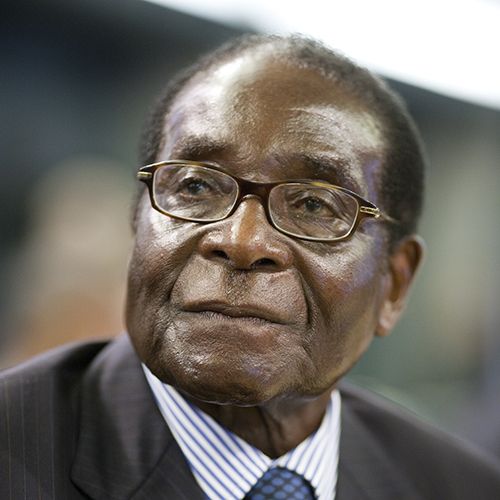
(1924-2019)
Who Was Robert Mugabe?
Robert Mugabe was born on February 21, 1924, in Kutama, Southern Rhodesia (now Zimbabwe). In 1963, he founded ZANU, a resistance movement against British colonial rule. Mugabe became prime minister of the new Republic of Zimbabwe after British rule ended in 1980, and he assumed the role of president seven years later. Mugabe retained a strong grip on power, through controversial elections, until he was forced to resign in November 2017, at age 93.
Early Years and Education
Robert Gabriel Mugabe was born on February 21, 1924, in Kutama, Southern Rhodesia (now Zimbabwe), just months after Southern Rhodesia had become a British Crown colony. As a result, the people of his village were oppressed by new laws and faced limitations to their education and job opportunities.
Mugabe's father was a carpenter. He went to work at a Jesuit mission in South Africa when Mugabe was just a boy, and mysteriously never came home. Mugabe's mother, a teacher, was left to bring up Mugabe and his three siblings on her own. As a child, Mugabe helped out by tending the family's cows and making money through odd jobs.
Although many people in Southern Rhodesia went only as far as grammar school, Mugabe was fortunate enough to receive a good education. He attended school at the local Jesuit mission under the supervision of school director Father O'Hea. A powerful influence on the boy, O'Hea taught Mugabe that all people should be treated equally and educated to the fulfillment of their abilities. Mugabe's teachers, who called him "a clever lad," were early to recognize his abilities as considerable.
The values that O'Hea imparted to his students resonated with Mugabe, prompting him to pass them on by becoming a teacher himself. Over the course of nine years, he studied privately while teaching at a number of mission schools in Southern Rhodesia. Mugabe continued his education at the University of Fort Hare in South Africa, graduating with a Bachelor of Arts degree in history and English in 1951. Mugabe then returned to his hometown to teach there. By 1953, he had earned his Bachelor of Education degree through correspondence courses.
In 1955, Mugabe moved to Northern Rhodesia. There, he taught for four years at Chalimbana Training College while also working toward his Bachelor of Science degree in economics through correspondence courses with the University of London. After moving to Ghana, Mugabe completed his economics degree in 1958. He also taught at St. Mary's Teacher Training College, where he met his first wife, Sarah Heyfron, whom he would marry in 1961. In Ghana, Mugabe declared himself a Marxist, supporting the Ghanaian government's goal of providing equal educational opportunities to the formerly designated lower classes.
Early Political Career
In 1960, Robert Mugabe returned to his hometown on leave, planning to introduce his fiancée to his mother. Unexpectedly, upon his arrival, Mugabe encountered a drastically changed Southern Rhodesia. Tens of thousands of Black families had been displaced by the new colonial government, and the white population had exploded. The government denied Black majority rule, resulting in violent protests. Mugabe too was outraged by this denial of Blacks' rights. In July 1960, he agreed to address the crowd at the protest March of 7,000, staged at Salisbury's Harare Town Hall. The purpose of the gathering was for members of the opposition movement to protest the recent arrest of their leaders. Steeling himself in the face of police threats, Mugabe told the protestors about how Ghana had successfully achieved independence through Marxism.
Just weeks later, Mugabe was elected public secretary of the National Democratic Party. In accordance with Ghanaian models, Mugabe quickly assembled a militant youth league to spread the word about achieving Black independence in Rhodesia. The government banned the party at the end of 1961, but the remaining supporters came together to form a movement that was the first of its kind in Rhodesia. The Zimbabwe African People's Union (ZAPU) soon grew to a staggering 450,000 members.
The union's leader, Joshua Nkomo, was invited to meet with the United Nations, who demanded that Britain suspend their constitution and readdress the topic of majority rule. But, as time passed and nothing had changed, Mugabe and others were frustrated that Nkomo didn't insist on a definite date for changes to the constitution. So great was his frustration, that by April of 1961, Mugabe publicly discussed starting a guerilla war — even going so far as to declare defiantly to a policeman, "We are taking over this country and we will not put up with this nonsense."
Formation of ZANU
In 1963, Mugabe and other former supporters of Nkomo founded their own resistance movement, called the Zimbabwe African National Union (ZANU), in Tanzania. Back in Southern Rhodesia later that year, the police arrested Mugabe and sent him to Hwahwa Prison. Mugabe would remain in jail for over a decade, being moved from Hwahwa Prison to Sikombela Detention Centre and later to Salisbury Prison. In 1964, while in prison, Mugabe relied on secret communications to launch guerrilla operations toward freeing Southern Rhodesia from British rule.
In 1974, Prime Minister Ian Smith, who claimed he would achieve true majority rule but still declared his allegiance to the British colonial government, allowed Mugabe to leave prison and go to a conference in Lusaka, Zambia (formerly Northern Rhodesia). Mugabe instead escaped back across the border to Southern Rhodesia, assembling a troop of Rhodesian guerrilla trainees along the way. The battles raged on throughout the 1970s. By the end of that decade, Zimbabwe's economy was in worse shape than ever. In 1979, after Smith had tried in vain to reach an agreement with Mugabe, the British agreed to monitor the changeover to Black majority rule and the UN lifted sanctions.
By 1980, Southern Rhodesia was liberated from British rule and became the independent Republic of Zimbabwe. Running under the ZANU party banner, Mugabe was elected prime minister of the new republic, after running against Nkomo. In 1981, a battle broke out between ZANU and ZAPU due to their differing agendas. In 1985, Mugabe was re-elected as the fighting continued. In 1987, when a group of missionaries were tragically murdered by Mugabe supporters, Mugabe and Nkomo at last agreed to merge their unions into the ZANU-Patriotic Front (ZANU-PF) and focus on the nation's economic recovery.
Presidency
Within just a week of the unity agreement, Mugabe was appointed president of Zimbabwe. He chose Nkomo as one of his senior ministers. Mugabe's first major goal was to restructure and repair the country's failing economy. In 1989, he set out to implement a five-year plan, which slackened price restrictions for farmers, allowing them to designate their own prices. By 1994, at the end of the five-year period, the economy had seen some growth in the farming, mining and manufacturing industries. Mugabe additionally managed to build clinics and schools for the Black population. Also over the course of that time, Mugabe's wife, Sarah, passed away, freeing him to marry his mistress, Grace Marufu.
By 1996, Mugabe's decisions had begun to create unrest among the citizens of Zimbabwe, who had once hailed him as a hero for leading the country to independence. Many resented his choice to support the seizure of white people's land without compensation to the owners, which Mugabe insisted was the only way to level out the economic playing field for the disenfranchised Black majority. Citizens were likewise outraged by Mugabe's refusal to amend Zimbabwe's one-party constitution. High inflation was another sore subject, resulting in a civil servant strike for pay increases. The self-awarded pay raises of government officials only compounded the public's resentment toward Mugabe's administration.
Objections to Mugabe's controversial political strategies continued to impede his success. In 1998, when he appealed to other countries to donate money for land distribution, the countries said they wouldn't donate unless he first devised a program for helping Zimbabwe's impoverished rural economy. Mugabe refused, and the countries refused to donate.
In 2000, Mugabe passed an amendment to the constitution that made Britain pay reparations for the land it had seized from Black people. Mugabe claimed that he would seize British land as restitution if they failed to pay. The amendment put further strain on Zimbabwe's foreign relations.
Still, Mugabe, a notably conservative dresser who during his campaign had worn colorful shirts with his own face on them, won the 2002 presidential election. Speculation that he had stuffed the ballot box led the European Union to place an arms embargo and other economic sanctions on Zimbabwe. At this time Zimbabwe's economy was in near ruins. Famine, an AIDS epidemic, foreign debt and widespread unemployment plagued the country. Yet Mugabe was determined to retain his office and did so by any means necessary—including alleged violence and corruption—winning the vote in the 2005 parliamentary elections.
Refusal to Cede Power
On March 29, 2008, when he lost the presidential election to Morgan Tsvangirai, leader of the opposing Movement for Democratic Change (MDC), Mugabe was unwilling to let go of the reins and demanded a recount. A runoff election was to be held that June. In the meantime, MDC supporters were being violently attacked and killed by members of Mugabe's opposition. When Mugabe publicly declared that as long as he was living, he would never let Tsvangirai rule Zimbabwe, Tsvangirai concluded that Mugabe's use of force would skew the vote in Mugabe's favor anyway, and withdrew.
Mugabe's refusal to hand over presidential power led to another violent outbreak that injured thousands and resulted in the death of 85 of Tsvangirai's supporters. That September, Mugabe and Tsvangirai agreed to a power-sharing deal. Ever determined to remain in control, Mugabe still managed to retain most of the power by controlling security forces and choosing leaders for the most vital ministry positions.
At the end of 2010, Mugabe took additional action to seize total control of Zimbabwe by selecting provisional governors without consulting Tsvangirai. A U.S. diplomatic cable indicated that Mugabe might be battling prostate cancer the following year. The allegation raised public concerns about a military coup in the event of Mugabe's death while in office. Others voiced concerns about the possibility of violent internal war within the ZANU-PF, if candidates sought to compete to become Mugabe's successor.
2013 Election
On December 10, 2011, at the National People's Conference in Bulawayo, Mugabe officially announced his bid for the 2012 Zimbabwe presidential election. The election was postponed, however, as both sides agreed to draft a new constitution, and rescheduled for 2013. People of Zimbabwe came out in support of the new document in March 2013, approving it in a constitution referendum, though many believed that the 2013 presidential election would be marred by corruption and violence.
According to a Reuters report, representatives from nearly 60 civic organizations within the country complained of a crackdown by Mugabe and his supporters. Critical of Mugabe, members of these groups were subject to intimidation, arrest and other forms of persecution. There was also the question as to who would be allowed to supervise the voting process. Mugabe said that he would not let Westerners monitor any of the country's election.
In March, Mugabe traveled to Rome for the inaugural mass for Pope Francis, who was newly named to the papacy. Mugabe told reporters that the new pope should visit Africa and stated, "We hope he will take us all his children on the same basis, basis of equality, basis that we are all in the eyes of God equal," according to a report by The Associated Press.
In late July 2013, amid discussion regarding the current and highly anticipated Zimbabwean election, an 89-year-old Mugabe made headlines when he was asked whether he planned to run again in the 2018 election (he would be 94 then) by a reporter from The New York Times, to which the president responded, "Why do you want to know my secrets?" According to The Washington Post, Mugabe's opponent, Tsvangirai, accused election officials of throwing out nearly 70,000 ballots in his favor that were submitted early.
In early August, Zimbabwe's election commission declared Mugabe the victor in the presidential race. He earned 61 percent of the vote with Tsvangirai receiving only 34 percent, according to BBC News. Tsvangirai was expected to launch a legal challenge against the election results. According to the Guardian newspaper, Tsvangirai said the election did "not the reflect the will of the people. I don't think that even those in Africa that have committed acts of ballot rigging have done it such a brazen manner."
Arrest of American Citizen
In November 2017 an American woman living in Zimbabwe was charged with subverting the government and undermining the authority of — or insulting — the president.
According to prosecutors, the defendant, Martha O’Donovan, a project coordinator for the activist Magamba Network, had “systematically sought to incite political unrest through the expansion, development and use of a sophisticated network of social media platforms as well as running some Twitter accounts.” She faced up to 20 years in prison for the charges.
The arrest raised concerns that Mugabe's government was attempting to control social media ahead of the 2018 national elections.
Military Takeover and Resignation
Meanwhile, a more dire situation was emerging in Zimbabwe with the onset of what appeared to be a military coup. On November 14, not long after Mugabe's dismissal of vice president Emmerson Mnangagwa, tanks were spotted in the country's capital, Harare. Early the following morning, an army spokesman appeared on TV to announce that the military was in the process of apprehending criminals who were "causing social and economic suffering in the country in order to bring them to justice."
The spokesman emphasized that this was not a military takeover of the government, saying, "We wish to assure the nation that his excellency the president... and his family are safe and sound and their security is guaranteed." At the time, Mugabe's whereabouts were unknown, but it was later confirmed that he had been confined to his home.
The following day, Zimbabwe's The Herald published photographs of the elderly president at home, along with other government and military officials. The officials were reportedly discussing the implementation of a transitional government, though no public statement had been made on the matter.
On November 17, Mugabe resurfaced in public at a university graduation ceremony, an appearance believed to mask the turmoil behind the scenes. After initially refusing to cooperate with proposed plans to peacefully remove him from power, the president reportedly agreed to announce his retirement during a televised speech scheduled for November 19.
However, Mugabe made no mention of retirement during the speech, instead insisting he would preside over a December congress of the ZANU-PF governing party. As a result, it was announced that the party would launch impeachment proceedings to vote him out of power.
On November 22, shortly after a joint session of the Zimbabwean Parliament convened for the impeachment vote, the speaker read a letter from the embattled president. "I have resigned to allow smooth transfer of power," Mugabe wrote. "Kindly give public notice of my decision as soon as possible."
The end of Mugabe's 37-year tenure was met with applause from Parliament members, as well as celebrations on the streets of Zimbabwe. According to a spokesman for the ZANU-PF, former vice president Mnangagwa would take over as president and serve the remainder of Mugabe's term until the 2018 elections.
Just before the elections on July 30, 2018, Mugabe said he could not support his successor, Mnangagwa, after being forced out by the "party I founded," and suggested that opposition leader Nelson Chamisa of the MDC was the only viable presidential candidate. That drew a strong response from Mnangagwa, who said, "It is clear to all that Chamisa has forged a deal with Mugabe, we can no longer believe that his intentions are to transform Zimbabwe and rebuild our nation."
Tensions over the elections also spilled out into the public, with demonstrations turning violent over what was announced to be the ZANU-PF's parliamentary victory and Mnangagwa's triumph. MDC Chairman Morgan Komichi said his party would challenge the outcome in court.
Death
Mugabe died on September 6, 2019, at Gleneagles Hospital in Singapore where he was under observation for several months for an undisclosed illness.
“It is with the utmost sadness that I announce the passing on of Zimbabwe's founding father and former President, Cde Robert Mugabe," Zimbabwe’s President Emmerson Mnangagwa wrote on Twitter. "Cde Mugabe was an icon of liberation, a pan-Africanist who dedicated his life to the emancipation and empowerment of his people. His contribution to the history of our nation and continent will never be forgotten. May his soul rest in eternal peace."
QUICK FACTS
- Name: Robert Mugabe
- Birth Year: 1924
- Birth date: February 21, 1924
- Birth City: Kutama (formerly Southern Rhodesia)
- Birth Country: Zimbabwe
- Gender: Male
- Best Known For: Robert Mugabe became prime minister of Zimbabwe in 1980 and served as the country's president from 1987 until his forced resignation in 2017.
- Industries
- World Politics
- Astrological Sign: Pisces
- Schools
- University of Fort Hare, South Africa
- Nacionalities
- Zimbabwean (Zimbabwe)
- Death Year: 2019
- Death date: September 6, 2019
- Death Country: Singapore
Fact Check
We strive for accuracy and fairness.If you see something that doesn't look right,contact us!
CITATION INFORMATION
- Article Title: Robert Mugabe Biography
- Author: Biography.com Editors
- Website Name: The Biography.com website
- Url: https://www.biography.com/political-figures/robert-mugabe
- Access Date:
- Publisher: A&E; Television Networks
- Last Updated: September 15, 2020
- Original Published Date: April 2, 2014
QUOTES
- If the choice were made, one for us to lose our sovereignty and become a member of the Commonwealth or remain with our sovereignty and lose the membership of the Commonwealth, I would say let the Commonwealth go.
- Our party must continue to strike fear in the heart of the white man, our real enemy!
- We are no longer going to ask for the land, but we are going to take it without negotiating.
- We are taking over this country and we will not put up with this nonsense.
- Why do you want to know my secrets?
- I am still the Hitler of the time. This Hitler has only one objective: justice for his people, sovereignty for his people, recognition of the independence of his people and their rights over their resources. If that is Hitler, then let me be Hitler tenfold. Ten times, that is what we stand for.
- We hope [Pope Francis] will take us all his children on the same basis, basis of equality, basis that we are all in the eyes of God equal.


