(1914-1994)
Who Was Ralph Ellison?
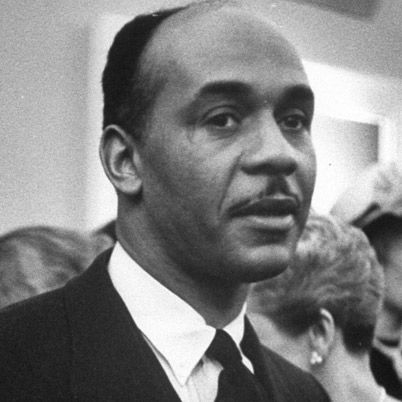
Ralph Ellison studied music before moving to New York City and working as a writer. He published his bestselling, acclaimed first novel Invisible Man in 1952; it would be seen as a seminal work on marginalization from an African American protagonist's perspective. Ellison's unfinished novel Juneteenth was published posthumously in 1999.
Childhood and Education
Ralph Waldo Ellison was born on March 1, 1914, in Oklahoma City, Oklahoma, and named after journalist and poet Ralph Waldo Emerson. Ellison's doting father, Lewis, who loved children and read books voraciously, worked as an ice and coal deliverer. He died from a work-related accident when Ellison was only three years old. His mother Ida then raised Ellison and younger brother Herbert by herself, working a variety of jobs to make ends meet.
Tuskegee Institute
In his future book of essays Shadow and Act, Ellison described himself and several of his friends growing up as young Renaissance Men, people who looked to culture and intellectualism as a source of identity. A budding instrumentalist, Ellison took up the cornet at the age of eight and years later, as a trumpeter, attended Tuskegee Institute in Alabama, where he studied music with his eye on becoming a symphony composer.
In 1936, Ellison went to New York over the summer with the intent of earning enough money to pay for his college expenses, but ended up relocating. He started to work as a researcher and writer for the New York Federal Writers Program, and was befriended by writers Richard Wright, Langston Hughes and Alain Locke, who all mentored the fledgling scribe. During this period, Ellison began to publish some of his essays and short stories, and worked as managing editor for The Negro Quarterly.
Ellison later enlisted as a Merchant Marine cook during World War II. Married briefly before, in 1946 he wed Fanny McConnell, and the two would remain together for the rest of Ellison's life.
Books
'Invisible Man'
Ellison started writing what would become The Invisible Man while at a friend's farm in Vermont. The existential novel, published in 1952, focused on an African American civil rights worker from the South who, upon his move to New York, becomes increasingly alienated due to the racism he encounters. Upon its release, Invisible Man became a runaway hit, remaining on bestseller lists for weeks and winning the National Book Award the following year. With millions of copies eventually printed, the novel would be regarded as a groundbreaking meditation on race and marginalized communities in America, influencing future generations of writers and thinkers.
'Shadow and Act,' 'Going to the Territory' Essays
Ellison traveled throughout Europe in the mid-1950s, and lived in Rome for two years after becoming an American Academy fellow. He continued writing — publishing a collection of essays in 1964, Shadow and Act — and taught at colleges and universities, including Bard College and New York University. He published his second collection of essays, Going to the Territory, in 1986, yet was stalled over the decades from completing his second novel, which he envisioned as a great American saga.
'Juneteenth'
Ellison died from pancreatic cancer in New York City on April 16, 1994. The novel that he had been working on prior to his death was released posthumously in 1999 and titled Juneteenth, with final shaping done by his literary executor, John Callahan, at the behest of his wife Fanny. Three Days Before the Shooting, released in 2010, offered a more comprehensive look at how the novel was shaped along with a look at Ellison's full manuscript.
Legacy
Ellison's literary legacy continues to be highly pronounced. A massive collection of his essays was released in the fall of 1995 and Flying Home, a collection of short stories, was released in the fall of 1996. Years later, scholar Arnold Rampersad wrote a well-received, critical biography on Ellison that was published in 2007.
Invisible Man continues to be held up as one of the most highly regarded works in the American literary canon.
Related Videos
QUICK FACTS
- Birth Year: 1914
- Birth date: March 1, 1914
- Birth State: Oklahoma
- Birth City: Oklahoma City
- Birth Country: United States
- Gender: Male
- Best Known For: Ralph Ellison was a 20th century African American writer and scholar best known for his renowned, award-winning novel 'Invisible Man.'
- Industries
- World War II
- Fiction and Poetry
- Astrological Sign: Pisces
- Schools
- Tuskegee University
- Death Year: 1994
- Death date: April 16, 1994
- Death State: New York
- Death City: New York
- Death Country: United States
Fact Check
We strive for accuracy and fairness.If you see something that doesn't look right,contact us!
CITATION INFORMATION
- Article Title: Ralph Ellison Biography
- Author: Biography.com Editors
- Website Name: The Biography.com website
- Url: https://www.biography.com/authors-writers/ralph-ellison
- Access Date:
- Publisher: A&E; Television Networks
- Last Updated: August 18, 2020
- Original Published Date: April 2, 2014
QUOTES
- If the Negro, or any other writer, is going to do what is expected of him, he's lost the battle before he takes the field. I suspect that all the agony that goes into writing is borne precisely because the writer longs for acceptance—but it must be acceptance on his own terms.
- Anything and everything was to be found in the chaos of Oklahoma; thus the concept of the Renaissance Man has lurked long within the shadow of my past, and I shared it with at least a half dozen of my Negro friends.
- So on a farm in Vermont, where I was reading The Hero by Lord Raglan and speculating on the nature of Negro leadership in the U.S., I wrote the first paragraph of Invisible Man, and was soon involved in the struggle of creating the novel.
- Looked at historically, there is no question but that this society started out with a divided mind, if not with a divided conscience. Its founders asserted the noble idea of creating a free, open society while retaining slavery, a system in direct contradiction to their rhetorically inclusive concept of freedom.