(1881-1973)
Who Was Pablo Picasso?
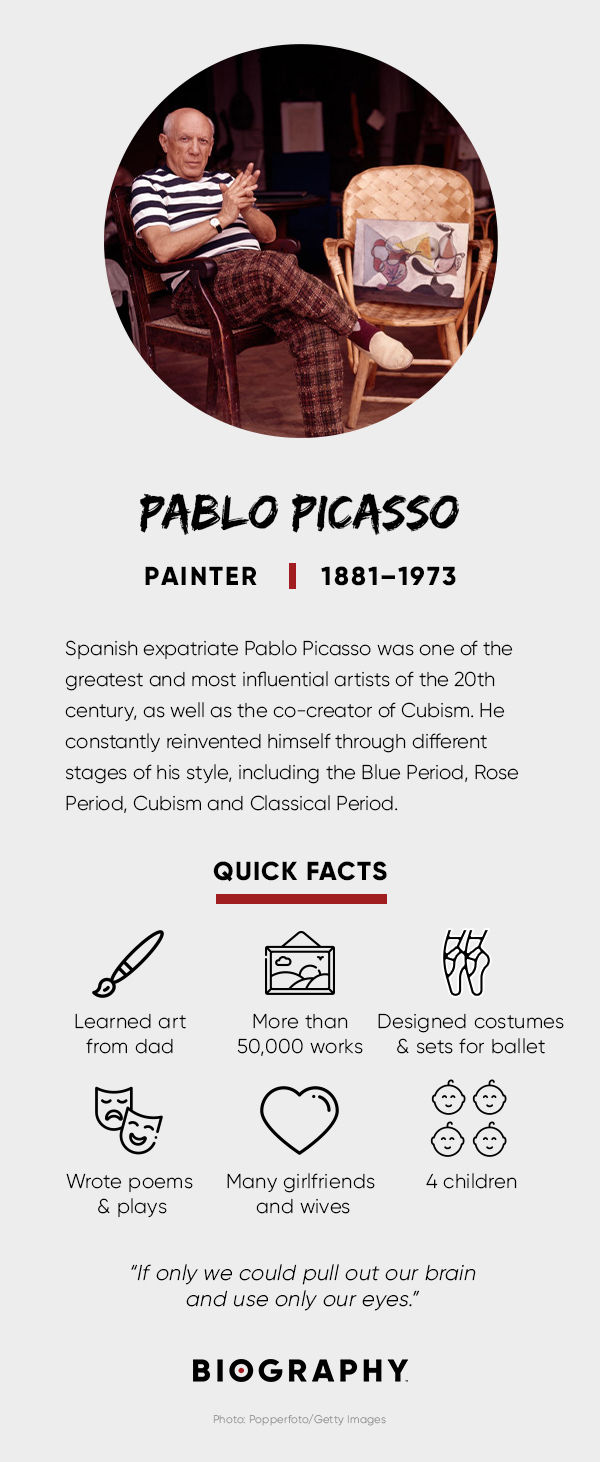
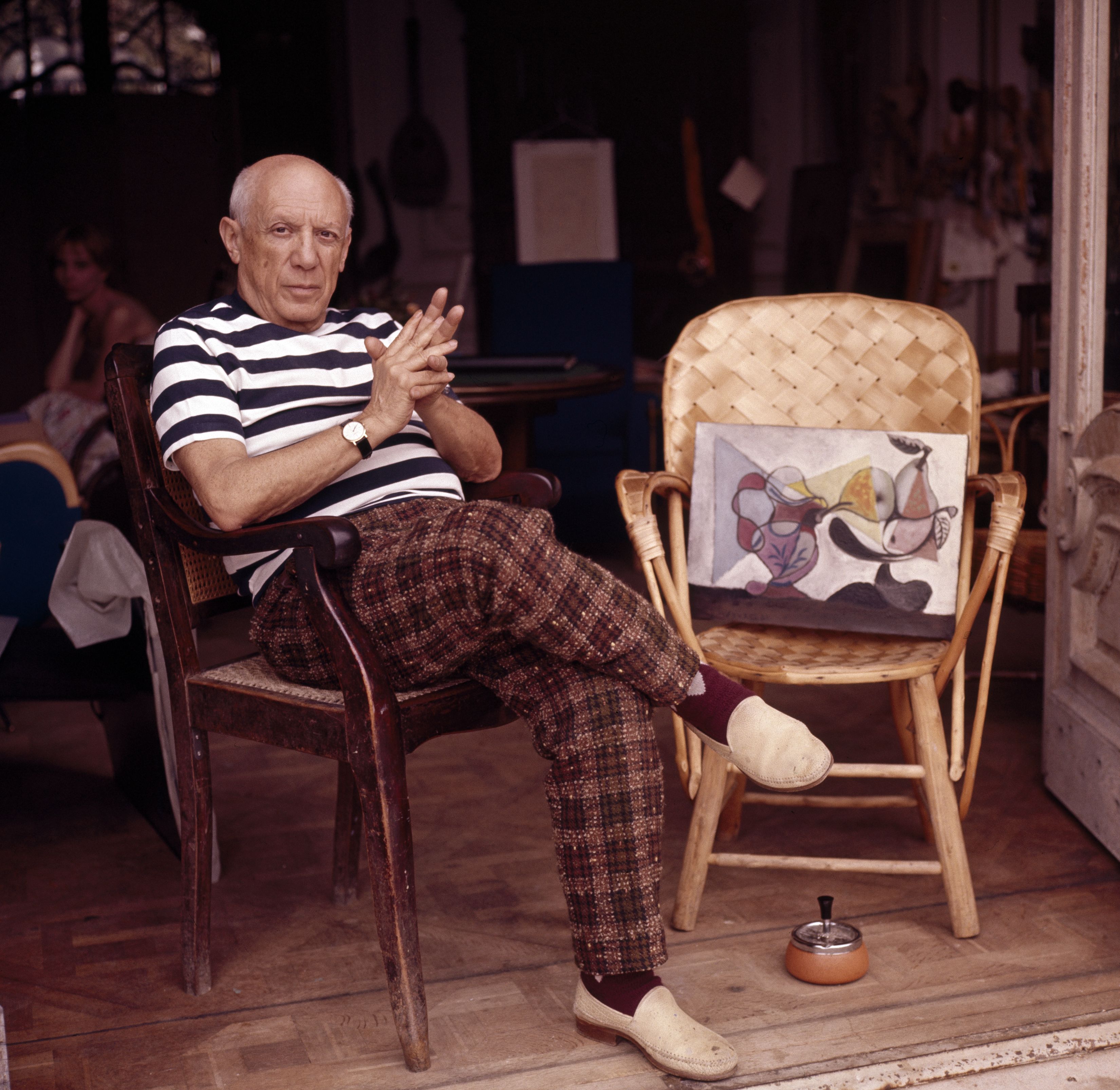
Pablo Picasso was a Spanish painter, sculptor, printmaker, ceramicist and stage designer considered one of the greatest and most influential artists of the 20th century. Picasso is credited, along with Georges Braque, with the creation of Cubism.
Early Life
Pablo Picasso was born in Málaga, Spain, on October 25, 1881. Picasso's mother was Doña Maria Picasso y Lopez. His father was Don José Ruiz Blasco, a painter and art teacher.
His gargantuan full name, which honors a variety of relatives and saints, is Pablo Diego José Francisco de Paula Juan Nepomuceno María de los Remedios Cipriano de la Santísima Trinidad Martyr Patricio Clito Ruíz y Picasso.
A serious and prematurely world-weary child, the young Picasso possessed a pair of piercing, watchful black eyes that seemed to mark him destined for greatness.
"When I was a child, my mother said to me, 'If you become a soldier, you'll be a general. If you become a monk you'll end up as the pope,'" he later recalled. "Instead, I became a painter and wound up as Picasso."
Though he was a relatively poor student, Picasso displayed a prodigious talent for drawing at a very young age. According to legend, his first words were "piz, piz," his childish attempt at saying "lápiz," the Spanish word for pencil.
Education
Picasso's father began teaching him to draw and paint when he was a child, and by the time he was 13 years old, his skill level had surpassed his father's. Soon, Picasso lost all desire to do any schoolwork, choosing to spend the school days doodling in his notebook instead.
"For being a bad student, I was banished to the 'calaboose,' a bare cell with whitewashed walls and a bench to sit on," he later remembered. "I liked it there, because I took along a sketch pad and drew incessantly ... I could have stayed there forever, drawing without stopping."
In 1895, when Picasso was 14 years old, his family moved to Barcelona, Spain, where he quickly applied to the city's prestigious School of Fine Arts. Although the school typically only accepted students several years his senior, Picasso's entrance exam was so extraordinary that he was granted an exception and admitted.
Nevertheless, Picasso chafed at the School of Fine Arts' strict rules and formalities, and began skipping class so that he could roam the streets of Barcelona, sketching the city scenes he observed.
In 1897, a 16-year-old Picasso moved to Madrid to attend the Royal Academy of San Fernando. However, he again became frustrated with his school's singular focus on classical subjects and techniques.
During this time, he wrote to a friend: "They just go on and on about the same old stuff: Velázquez for painting, Michelangelo for sculpture." Once again, Picasso began skipping class to wander the city and paint what he observed: gypsies, beggars and prostitutes, among other things.
In 1899, Picasso moved back to Barcelona and fell in with a crowd of artists and intellectuals who made their headquarters at a café called El Quatre Gats ("The Four Cats").
Inspired by the anarchists and radicals he met there, Picasso made his decisive break from the classical methods in which he had been trained, and began what would become a lifelong process of experimentation and innovation.
Paintings
Picasso remains renowned for endlessly reinventing himself, switching between styles so radically different that his life's work seems to be the product of five or six great artists rather than just one.
Of his penchant for style diversity, Picasso insisted that his varied work was not indicative of radical shifts throughout his career, but, rather, of his dedication to objectively evaluating for each piece the form and technique best suited to achieve his desired effect.
"Whenever I wanted to say something, I said it the way I believed I should," he explained. "Different themes inevitably require different methods of expression. This does not imply either evolution or progress; it is a matter of following the idea one wants to express and the way in which one wants to express it."
Blue Period
Art critics and historians typically break Picasso's adult career into distinct periods, the first of which lasted from 1901 to 1904 and is called his "Blue Period," after the color that dominated nearly all of his paintings over these years.
At the turn of the 20th century, Picasso moved to Paris, France — the center of European art — to open his own studio. Lonely and deeply depressed over the death of his close friend, Carlos Casagemas, he painted scenes of poverty, isolation and anguish, almost exclusively in shades of blue and green.
'Blue Nude’ and ‘The Old Guitarist’
Picasso's most famous paintings from the Blue Period include "Blue Nude," "La Vie" and "The Old Guitarist," all three of which were completed in 1903.
In contemplation of Picasso and his Blue Period, writer and critic Charles Morice once asked, "Is this frighteningly precocious child not fated to bestow the consecration of a masterpiece on the negative sense of living, the illness from which he more than anyone else seems to be suffering?"
Rose Period: 'Gertrude Stein' and 'Two Nudes'
By 1905, Picasso had largely overcome the depression that had previously debilitated him, and the artistic manifestation of Picasso's improved spirits was the introduction of warmer colors—including beiges, pinks and reds—in what is known as his "Rose Period" (1904-06).
Not only was he madly in love with a beautiful model, Fernande Olivier, he was newly prosperous thanks to the generous patronage of art dealer Ambroise Vollard. His most famous paintings from these years include "Family at Saltimbanques" (1905), "Gertrude Stein" (1905-06) and "Two Nudes" (1906).
Cubism
Cubism was an artistic style pioneered by Picasso and his friend and fellow painter Georges Braque.
In Cubist paintings, objects are broken apart and reassembled in an abstracted form, highlighting their composite geometric shapes and depicting them from multiple, simultaneous viewpoints in order to create physics-defying, collage-like effects. At once destructive and creative, Cubism shocked, appalled and fascinated the art world.
‘Les Desmoiselles d’Avignon’
In 1907, Picasso produced a painting that today is considered the precursor and inspiration of Cubism: "Les Demoiselles d'Avignon."
A chilling depiction of five nude prostitutes, abstracted and distorted with sharp geometric features and stark blotches of blues, greens and grays, the work was unlike anything he or anyone else had ever painted before and would profoundly influence the direction of art in the 20th century.
"It made me feel as if someone was drinking gasoline and spitting fire," Braque said, explaining that he was shocked when he first viewed Picasso's "Les Demoiselles." Braque quickly became intrigued with Cubism, seeing the new style as a revolutionary movement.
French writer and critic Max Jacob, a good friend of both Picasso and painter Juan Gris, called Cubism "the 'Harbinger Comet' of the new century," stating, "Cubism is ... a picture for its own sake. Literary Cubism does the same thing in literature, using reality merely as a means and not as an end."
Picasso's early Cubist paintings, known as his "Analytic Cubist" works, include "Three Women" (1907), "Bread and Fruit Dish on a Table" (1909) and "Girl with Mandolin" (1910).
His later Cubist works are distinguished as "Synthetic Cubism" for moving even further away from artistic typicalities of the time, creating vast collages out of a great number of tiny, individual fragments. These paintings include "Still Life with Chair Caning" (1912), "Card Player" (1913-14) and "Three Musicians" (1921).
Classical Period: ‘Three Women at the Spring’
Picasso’s works between 1918 and 1927 are categorized as part of his "Classical Period," a brief return to Realism in a career otherwise dominated by experimentation. The outbreak of World War I ushered in the next great change in Picasso's art.
He grew more somber and, once again, preoccupied with the depiction of reality. His most interesting and important works from this period include "Three Women at the Spring" (1921), "Two Women Running on the Beach/The Race" (1922) and "The Pipes of Pan" (1923).
‘Guernica’
From 1927 onward, Picasso became caught up in a new philosophical and cultural movement known as Surrealism, the artistic manifestation of which was a product of his own Cubism.
Picasso's most well-known Surrealist painting, deemed one of the greatest paintings of all time, was completed in 1937, during the Spanish Civil War: "Guernica." After Nazi German bombers supporting Francisco Franco's Nationalist forces carried out a devastating aerial attack on the Basque town of Guernica on April 26, 1937, Picasso, outraged by the bombing and the inhumanity of war, painted this work of art.
In black, white and grays, the painting is a Surrealist testament to the horrors of war, and features a minotaur and several human-like figures in various states of anguish and terror. "Guernica" remains one of the most moving and powerful anti-war paintings in history.
Later Works: 'Self Portrait Facing Death'
In contrast to the dazzling complexity of Synthetic Cubism, Picasso's later paintings display simple, childlike imagery and crude technique. Touching on the artistic validity of these later works, Picasso once remarked upon passing a group of school kids in his old age, "When I was as old as these children, I could draw like Raphael, but it took me a lifetime to learn to draw like them."
In the aftermath of World War II, Picasso became more overtly political, joining the Communist Party. He was twice honored with the International Lenin Peace Prize, first in 1950 and again in 1961.
By this point in his life, he was also an international celebrity, the world's most famous living artist. While paparazzi chronicled his every move, however, few paid attention to his art during this time. Picasso continued to create art and maintain an ambitious schedule in his later years, superstitiously believing that work would keep him alive.
Picasso created the epitome of his later work, "Self Portrait Facing Death," using pencil and crayon, a year before his death. The autobiographical subject, drawn with crude technique, appears as something between a human and an ape, with a green face and pink hair. Yet the expression in his eyes, capturing a lifetime of wisdom, fear and uncertainty, is the unmistakable work of a master at the height of his powers.
Women
A lifelong womanizer, Picasso had countless relationships with girlfriends, mistresses, muses and prostitutes, marrying only twice.
He wed a ballerina named Olga Khokhlova in 1918, and they remained together for nine years, parting ways in 1927. They had a son together, Paulo. In 1961, at the age of 79, he married his second wife, Jacqueline Roque.
While married to Khokhlova, he began a long-term relationship with Marie-Thérèse Walter. They had a daughter, Maya, together. Walter committed suicide after Picasso died.
Between marriages, in 1935, Picasso met Dora Maar, a fellow artist, on the set of Jean Renoir's film Le Crime de Monsieur Lange (released in 1936). The two soon embarked upon a partnership that was both romantic and professional.
Their relationship lasted more than a decade, during and after which time Maar struggled with depression; they parted ways in 1946, three years after Picasso began having an affair with a woman named Françoise Gilot, with whom he had two children, son Claude and daughter Paloma. They went separate ways in 1953. (Gilot would later marry scientist Jonas Salk, the inventor of the polio vaccine.)
Children
Picasso fathered four children: Paulo (Paul), Maya, Claude and Paloma Picasso. His daughter Paloma - featured in several of her father's paintings - would become a famous designer, crafting jewelry and other items for Tiffany & Co.
Death
Picasso died on April 8, 1973, at the age of 91, in Mougins, France. He died of heart failure, reportedly while he and his wife Jacqueline were entertaining friends for dinner.
Legacy
Considered radical in his work, Picasso continues to garner reverence for his technical mastery, visionary creativity and profound empathy. Together, these qualities have distinguished the "disquieting" Spaniard with the "piercing" eyes as a revolutionary artist.
For nearly 80 of his 91 years, Picasso devoted himself to an artistic production that he superstitiously believed would keep him alive, contributing significantly to — and paralleling the entire development of — modern art in the 20th century.
"],["
"],["
"],["
"]]" tml-render-layout="inline">
QUICK FACTS
- Name: Pablo Picasso
- Birth Year: 1881
- Birth date: October 25, 1881
- Birth City: Málaga
- Birth Country: Spain
- Gender: Male
- Best Known For: Pablo Picasso was one of the greatest artists of the 20th century, famous for paintings like ‘Guernica’ and for the art movement known as Cubism.
- Industries
- Art
- World War II
- Astrological Sign: Scorpio
- Schools
- La Llotja (Reial Acadèmia Catalana de Belles Arts de Sant Jordi)
- Royal Academy of San Fernando
- School of Fine Arts (Barcelona, Spain)
- Nacionalities
- Spanish
- Interesting Facts
- Picasso devoted himself to an artistic production that he superstitiously believed would keep him alive.
- Pablo Picasso's full name was: Pablo Diego José Francisco de Paula Juan Nepomuceno María de los Remedios Cipriano de la Santísima Trinidad Martyr Patricio Clito Ruíz y Picasso.
- Death Year: 1973
- Death date: April 8, 1973
- Death City: Mougins
- Death Country: France
Fact Check
We strive for accuracy and fairness.If you see something that doesn't look right,contact us!
CITATION INFORMATION
- Article Title: Pablo Picasso Biography
- Author: Biography.com Editors
- Website Name: The Biography.com website
- Url: https://www.biography.com/artists/pablo-picasso
- Access Date:
- Publisher: A&E; Television Networks
- Last Updated: August 28, 2019
- Original Published Date: April 3, 2014
QUOTES
- Whenever I wanted to say something, I said it the way I believed I should. Different themes inevitably require different methods of expression. This does not imply either evolution or progress; it is a matter of following the idea one wants to express and the way in which one wants to express it.
- If only we could pull out our brain and use only our eyes.
- When I was as old as these children, I could draw like Raphael, but it took me a lifetime to learn to draw like them.
- Everything you can imagine is real.
- Art is a lie that makes us realize truth.
- For being a bad student, I was banished to the 'calaboose,' a bare cell with whitewashed walls and a bench to sit on. I liked it there, because I took along a sketch pad and drew incessantly ... I could have stayed there forever, drawing without stopping.
- When I was a child, my mother said to me, 'If you become a soldier, you'll be a general. If you become a monk, you'll end up as the pope.' Instead, I became a painter and wound up as Picasso.
- Is this frighteningly precocious child not fated to bestow the consecration of a masterpiece on the negative sense of living, the illness from which he more than anyone else seems to be suffering?
- If you don't know what color to take, take black.
- Accidents, try to change them - it's impossible. The accidental reveals man.
- God is really only another artist. He invented the giraffe, the elephant and the cat. He has no real style. He just keeps on trying other things.
- It's not what the artist does that counts. But what he is.
- Everyone wants to understand art. Why not try to understand the songs of a bird?
- Of course, you can paint pictures by matching up different parts of them so that they go nicely together, but they'll lack any kind of drama.
- It has often been said that an artist should work for himself, for the love of art, and scorn success. It's a false idea. An artist needs success. Not only in order to live, but primarily so that he can realize his work.
- Nothing can be done without solitude.
- In my case a picture is a sum of destructions. I do a picture, then I destroy it. But in the long run nothing is lost; the red that I took away from one place turns up somewhere else.
- I want to get to the stage where nobody can tell how a picture of mine is done. What's the point of that? Simply that I want nothing but emotion given off by it.
- People who try to explain pictures are usually barking up the wrong tree.