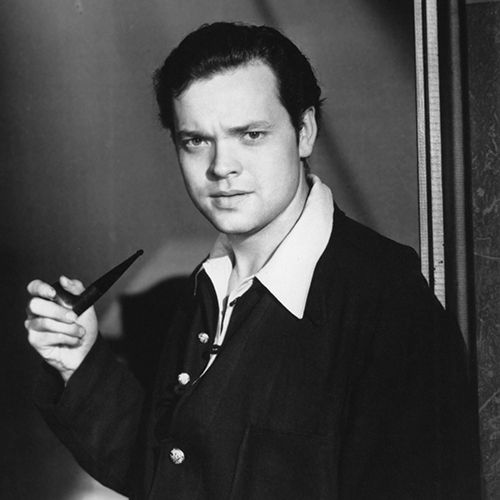
(1915-1985)
Who Was Orson Welles?
Orson Welles began his career as a stage actor before going on to radio, creating his unforgettable version of H.G. Wells' War of the Worlds. In Hollywood, he left his artistically indelible mark with such works as Citizen Kane and The Magnificent Ambersons. He died of a heart attack in Los Angeles, California, on October 10, 1985.
Early Years
Welles was born on May 6, 1915, in Kenosha, Wisconsin. His parents, Richard and Beatrice, were both incredibly bright people who introduced their son to worlds that went far beyond his Wisconsin roots.
Through his father, an inventor who'd made a fortune inventing a carbide lamp for bicycles, Welles met actors and sportsmen. His mother was a concert pianist who taught Welles how to play the piano and the violin.
But his childhood was far from easy. Welles' parents separated when he was four, and Beatrice died from jaundice when he was nine. When his father's successful business began to falter, he turned to the bottle. He died when Orson was 13.
Stability was found in the care of Maurice Bernstein, who took Welles in and became his official guardian when he was 15. Bernstein saw Welles' creative talents and enrolled him in the Todd School in Woodstock, Illinois, where Orson discovered his passion for the theater.
Following the Todd School, Welles left for Dublin, Ireland, paying his way with a small inheritance he'd received. There, he captivated audiences in a production of Jew Suss at the Gate Theatre.
Welles had announced his arrival in Dublin by declaring himself a Broadway star. By the age of 19, the brash and confident young actor made his Broadway debut with his role as Tybalt in Romeo and Juliet. His performance caught the attention of director John Houseman, who cast Welles in his Federal Theatre Project.
'War of the Worlds'
The Houseman-Welles partnership proved to be an important one. In 1937, the 21-year-old Welles, fresh off directing an all-Black cast in a version of Macbeth, teamed up with Houseman to form the Mercury Theatre. Its first production, an adaption of Julius Caesar in contemporary dress and with tones of Fascist Italy, was a huge success. Several more acclaimed stage productions followed before the Mercury moved into radio and began producing a weekly program, "The Mercury Theatre on the Air," which ran on CBS from 1938 to 1940, and again in 1946.
Critical praise was heaped upon the series soon after the program launched, but ratings were low. All that changed on October 30, 1938, when Welles aired his adaptation of H.G. Wells' novel The War of the Worlds.
The program simulated a news broadcast, and Welles, as its narrator, described in breathless detail the alien invasion and attack on New Jersey. The program included news reports and eyewitness accounts and sounded so real that listeners panicked over what they perceived to be a real event. When the truth came out, duped believers were outraged.
Movies: 'Citizen Kane'
Even while drawing the ire of some of his listeners, the broadcast cemented Welles's status as a genius, and his talents quickly became a fascination for Hollywood. In 1940, Welles signed a $225,000 contract with RKO to write, direct and produce two films. The deal gave the young filmmaker total creative control, as well as a percentage of the profits, and at the time was the most lucrative deal ever made with an unproven filmmaker. Welles was just 24 years old.
Success wasn't immediate. Welles started and then stopped an attempt at adapting Joseph Conrad's Heart of Darkness for the big screen. The daring behind that project paled in comparison to what became Welles' actual debut film: Citizen Kane (1941).
Modeled after the life and work of publishing magnate William Randolph Hearst, the film told the story of newspaperman Charles Foster Kane (played by Welles), tracing his rise to power and his eventual corruption from that power. The film outraged Hearst, who refused to allow mention of the movie in any of his newspapers and helped drive down the film's disappointing box-office numbers.
But Citizen Kane was a revolutionary work of art. In the film, which was nominated for a total of nine Academy Awards (earning a win for best screenplay), Welles deployed a number of pioneering techniques, including the use of deep-focus cinematography to present all objects in a shot in sharp detail. Welles also anchored the film's look with low-angle shots and told its story with multiple points of view.
It was only a matter of time before the genius of Citizen Kane would be lauded. It's now considered one of the greatest films ever made.
Welles' second film for RKO, The Magnificent Ambersons (1942), was a far more straightforward project and one that helped send Welles running from Hollywood. Toward the end of its filming, Welles made a quick trip to Rio de Janeiro to do a documentary. When he returned he discovered that RKO had made its own edit of the film's ending.
Welles, who disowned the movie, raged. A bitter public relations spat between the filmmaker and RKO ensued, and Welles, successfully cast by RKO as difficult to work with and with no appreciation for budgets, never truly recovered.
Later Years: 'The Stranger' and 'Macbeth'
For several years Welles stuck around Hollywood. He married "love goddess" Rita Hayworth in 1943, and starred in an adaptation of Jane Eyre that debuted in the United States the following February. Welles then directed The Stranger (1946) and Macbeth (1948), but he wasn't long for California; the same year he made Macbeth, he divorced Hayworth and began what amounted to a 10-year self-imposed exile from Hollywood.
He later appeared in films like The Third Man (1949) and directed other projects, including Othello (1952) and Mr. Arkadin (1955). He returned to Hollywood in 1958 to direct Touch of Evil, which registered low box-office numbers and took a further hit with an adaptation of Franz Kafka's The Trial (1962).
Hard times plagued Welles throughout much of the 1970s. Health issues dominated his life, many of them brought on by his growing obesity -- the filmmaker topped 400 pounds at one point.
The last decade of his life saw Welles continuing to stay busy. Among his many projects, he served as the spokesman for Paul Masson wine, appeared on the TV series Moonlighting and made a documentary called Filming Othello (1979), about the making of his 1952 film.
Toward the end of his life, Welles and Hollywood seemed to have made up. In 1975, he received the Lifetime Achievement Award of the American Film Institute, and in 1985, he was awarded the Directors Guild of America's D.W. Griffith Award, the organization's highest honor.
Death
He did his last interview on October 10, 1985, just two hours before his death, when he appeared on The Merv Griffin Show. Not long after returning to his Los Angeles home, he suffered a heart attack and died.
QUICK FACTS
- Name: Orson Welles
- Birth Year: 1915
- Birth date: May 6, 1915
- Birth State: Wisconsin
- Birth City: Kenosha
- Birth Country: United States
- Gender: Male
- Best Known For: Orson Welles wrote, directed and starred in the film 'Citizen Kane,' among others, which remains one of the most influential films ever made.
- Industries
- Radio
- Film
- Astrological Sign: Taurus
- Schools
- Todd School for Boys
- Art Institute of Chicago
- Death Year: 1985
- Death date: October 10, 1985
- Death State: California
- Death City: Los Angeles
- Death Country: United States
Fact Check
We strive for accuracy and fairness.If you see something that doesn't look right,contact us!
CITATION INFORMATION
- Article Title: Orson Welles Biography
- Author: Biography.com Editors
- Website Name: The Biography.com website
- Url: https://www.biography.com/movies-tv/orson-welles
- Access Date:
- Publisher: A&E; Television Networks
- Last Updated: April 15, 2021
- Original Published Date: April 2, 2014
QUOTES
- Movie directing is a perfect refuge for the mediocre.