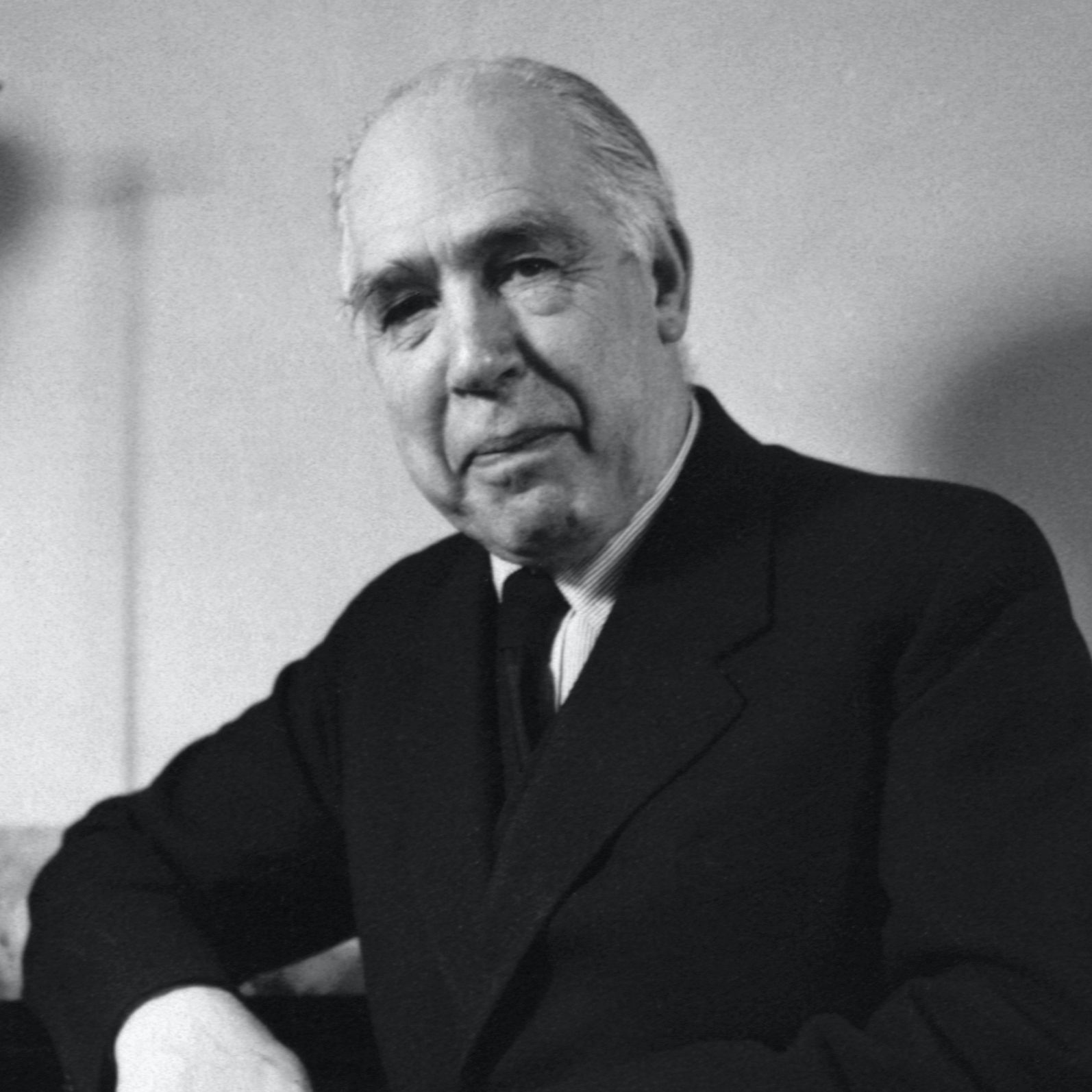
(1885-1962)
Who Was Niels Bohr?
Niels Bohr was an accomplished physicist who came up with a revolutionary theory on atomic structures and radiation emission. He won the 1922 Nobel Prize in physics for his ideas and years later, after working on the Manhattan Project in the United States, called for responsible and peaceful applications of atomic energy across the world.
Early Life
Niels Bohr was born on October 7, 1885, in Copenhagen, Denmark, to mother Ellen Adler, who was part of a successful Jewish banking clan, and father Christian Bohr, a celebrated physiology academic. The young Bohr eventually attended Copenhagen University, where he received his master's and doctorate in physics by 1911. During the fall of the same year, Bohr traveled to Cambridge, England, where he was able to follow the Cavendish Laboratory work of scientist J.J. Thomson.
In 1912, Bohr wed Margrethe Nørlund. The couple would have six children; four survived to adulthood and one, Aage, would become a well-known physics scientist as well.
Bohr’s own research led him to theorize in a series of articles that atoms give off electromagnetic radiation as a result of electrons jumping to different orbit levels, departing from a previously held model espoused by Ernest Rutherford. Though Bohr's discovery would eventually be tweaked by other scientists, his ideas formed the basis of future atomic research.
After teaching at Manchester’s Victoria University, Bohr settled again at Copenhagen University in 1916 with a professorship position. Then, in 1920, he founded the university’s Institute of Theoretical Physics, which he would head for the rest of his life.
Wins Nobel Prize
Bohr received the 1922 Nobel Prize in Physics for his work on atomic structures, and he would continue to come up with revolutionary theories. He worked with Werner Heisenberg and other scientists on a new quantum mechanics principle connected to Bohr's concept of complementarity, which was initially presented at an Italian conference in 1927. The concept asserted that physical properties on an atomic level would be viewed differently depending on experimental parameters, hence explaining why light could be seen as both a particle and a wave, though never both at the same time. Bohr would come to apply this idea philosophically as well, with the belief that evolving concepts of physics deeply affected human perspectives. Another physicist, by the name of Albert Einstein, didn’t fully see eye to eye with all of Bohr's assertions, and their talks became renowned in scientific communities.
Bohr went on to work with the group of scientists who were at the forefront of research on nuclear fission during the late 1930s, to which he contributed the liquid droplet theory. Outside of his pioneering ideas, Bohr was known for his wit and warmth, and his humanitarian ethics would inform his later work.
Fleeing Europe
With Adolf Hitler's rise in power, Bohr was able to offer German Jewish physicists refuge at his institute in Copenhagen, which in turn led to travel to the United States for many. Once Denmark became occupied by Nazi forces, the Bohr family escaped to Sweden, with Bohr and his son Aage eventually making their way to the United States. Bohr then worked with the Manhattan Project in Los Alamos, New Mexico, where the first atomic bomb was being created. Because he had concerns about how the bomb could be used, he called for future international arms control and active communication about the weapon between nations — an idea met with resistance by Winston Churchill and Franklin D. Roosevelt.
Atoms for Peace
After the end of the war, Bohr returned to Europe and continued to call for peaceful applications of atomic energy. In his "Open Letter to the United Nations," dated June 9, 1950, Bohr envisioned an "open world" mode of existence between countries that abandoned isolationism for true cultural exchange.
He helped to establish CERN, a Europe-based particle physics research facility, in 1954 and put together the Atoms for Peace Conference of 1955. In 1957, Bohr received the Atoms for Peace Award for his trailblazing theories and efforts to use atomic energy responsibly.
Death
Bohr was a prolific writer with more than 100 publications to his name. After having a stroke, he died on November 18, 1962, in Copenhagen. Bohr’s son Aage shared with two others the 1975 Nobel Prize in Physics for his research on motion in atomic nuclei.
QUICK FACTS
- Name: Niels Bohr
- Birth Year: 1885
- Birth date: October 7, 1885
- Birth City: Copenhagen
- Birth Country: Denmark
- Gender: Male
- Best Known For: Niels Bohr was a Nobel Prize-winning physicist and humanitarian whose revolutionary theories on atomic structures helped shape research worldwide.
- Industries
- Science and Medicine
- Astrological Sign: Libra
- Schools
- Copenhagen University
- Nacionalities
- Danish (Denmark)
- Death Year: 1962
- Death date: November 18, 1962
- Death City: Copenhagen
- Death Country: Denmark
Fact Check
We strive for accuracy and fairness.If you see something that doesn't look right,contact us!
CITATION INFORMATION
- Article Title: Niels Bohr Biography
- Author: Biography.com Editors
- Website Name: The Biography.com website
- Url: https://www.biography.com/scientists/niels-bohr
- Access Date:
- Publisher: A&E; Television Networks
- Last Updated: May 20, 2021
- Original Published Date: April 2, 2014
QUOTES
- Every great and deep difficulty bears in itself its own solution. It forces us to change our thinking in order to find it.
- An expert is a man who has made all the mistakes which can be made, in a very narrow field.
- Never express yourself more clearly than you are able to think.