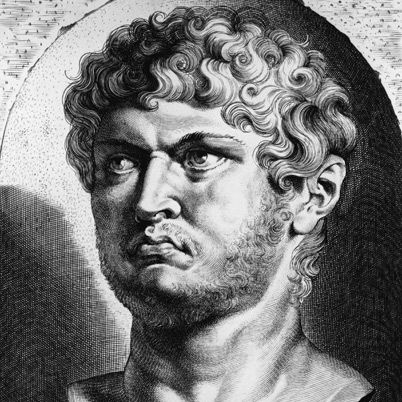
(37-68)
Who Was Nero?
Nero was born in 37 A.D., the nephew of the emperor. After his father’s death, his mother married his great uncle, Claudius, and persuaded him to name Nero his successor. Nero took the throne at 17, rebuffed his mother’s attempts to control him, and had her killed. He spent lavishly and behaved inappropriately. He began executing opponents and Christians. In 68, he committed suicide when the empire revolted.
Early Life and Ascent to the Throne
Nero was born as Lucius Domitius Ahenobarbus, the son of Gnaeus Domitius Ahenobarbus and Agrippina, who was the great-granddaughter of the emperor Augustus. He was educated in the classical tradition by the philosopher Seneca and studied Greek, philosophy and rhetoric.
After Ahenobarbus died in 48 A.D., Agrippina married her uncle, the emperor Claudius. She persuaded him to name Nero as his successor rather than his own son, Britannicus, and to offer his daughter, Octavia, as Nero’s wife, which he did in 50 A.D.
Claudius died in 54 A.D., and it is widely suspected that Agrippina had him poisoned. Nero presented himself to the Senate to deliver a eulogy in Claudius’s honor and was named Emperor of Rome. He took the name Nero Claudius Caesar Augustus Germanicus, and ascended to the throne at the age of 17.
Agrippina’s Influence
Agrippina was domineering and attempted to influence her son’s rule. She was angered by the more moderate advice of Nero’s advisors, his former tutor Seneca and the commander of the Praetorian Guard, Burrus.
Agrippina also tried to assert her authority in Nero’s private life. When Nero began an affair with Claudia Acte, a former enslaved person, and threatened to divorce Octavia, Agrippina advocated for Octavia and demanded that her son dismiss Acte. Although he and Octavia remained married, Nero began living openly with Acte as his wife in spite of his mother’s protests.
After Nero spurned his mother’s influence in both public and private affairs, she was infuriated. She began championing Britannicus, then still a minor, as emperor. However, Britannicus died suddenly in 55, the day before he was to be proclaimed an adult. It is widely assumed that Nero poisoned Britannicus, although Nero claimed that he died from a seizure. Even after Britannicus had died, Agrippina tried to agitate the public against Nero, and Nero banished her from the family palace.
By 58, Nero had dismissed Acte and fallen for Poppaea Sabina, a noblewoman who was married to a member of the Roman aristocracy. He wanted to marry her, but public opinion did not look favorably upon a divorce from Octavia and his mother staunchly opposed it. Fed up with his mother’s interference and no longer content with her removal from the palace, Nero took matters into his own hands. Agrippina was murdered in 59 at Nero’s command.
Nero’s Reign
Until the year 59, Nero was described as a generous and reasonable leader. He eliminated capital punishment, lowered taxes and allowed enslaved people to bring complaints against their masters. He supported the arts and athletics above gladiator entertainment and gave aid to other cities in crisis. Although he was known for his nighttime frolicking, his actions were good-natured, if irresponsible and self-indulgent.
But after Agrippina’s murder, Nero descended into a hedonic lifestyle that was marked not just by lavish self-indulgence but also tyranny. He spent exorbitant amounts of money on artistic pursuits and around 59 A.D., began to give public performances as a poet and lyre player, a significant breach of etiquette for a member of the ruling class.
When Burrus died and Seneca retired in the year 62, Nero divorced Octavia and had her killed, then married Poppaea. Around this time accusations of treason against Nero and the Senate began to surface, and Nero began to react harshly to any form of perceived disloyalty or criticism. One army commander was executed for badmouthing him at a party; another politician was exiled for writing a book that made negative remarks about the Senate. Other rivals were executed in the ensuing years, allowing Nero to reduce opposition and consolidate his power.
The Great Fire
By 64, the scandalous nature of Nero’s artistic antics may have begun to cause controversy, but the public’s attention was diverted by the Great Fire. The blaze began in stores at the southeastern end of the Circus Maximus and ravaged Rome for 10 days, decimating 75 percent of the city. Although accidental fires were common at the time, many Romans believed Nero started the fire to make room for his planned villa, the Domus Aurea. Whether or not Nero started the fire, he determined that a guilty party must be found, and he pointed the finger at the Christians, still a new and underground religion. With this accusation, persecution and torture of the Christians began in Rome.
Political Demise and Death
After the Great Fire, Nero resumed plans for the Domus Aurea. In order to finance this project, Nero needed money and set about to get it however he pleased. He sold positions in public office to the highest bidder, increased taxes and took money from the temples. He devalued currency and reinstituted policies to confiscate property in cases of suspected treason.
These new policies resulted in the Pisonian conspiracy, a plot formed in 65 by Gaius Calpurnius Piso, an aristocrat, along with knights, senators, poets and Nero's former mentor, Seneca. They planned to assassinate Nero and crown Piso the ruler of Rome. The plan was discovered, however, and the leading conspirators, as well as many other wealthy Romans, were executed.
Just three years later, in March, 68, the governor Gaius Julius Vindex rebelled against Nero's tax policies. He recruited another governor, Servius Sulpicius Galba, to join him and to declare himself emperor. While these forces were defeated and Galba was declared a public enemy, support for him increased, despite his categorization as a public enemy. Even Nero’s own bodyguards defected in support of Galba.
Fearing that his demise was imminent, Nero fled. He planned to head east, where many provinces were still loyal to him, but had to abandon the plan after his officers refused to obey him. He returned to his palace, but his guards and friends had left. He ultimately received word that the Senate had condemned him to death by beating and so he decided to commit suicide. Unable to carry out the deed by himself, however, his secretary, Epaphroditos, assisted him. As he died, Nero was said to have exclaimed, ‘What an artist dies in me!' He was the last of the Julio-Claudian emperors.
QUICK FACTS
- Name: Nero
- Birth Year: 37
- Birth date: December 15, 37
- Birth City: Antium
- Birth Country: Italy
- Gender: Male
- Best Known For: As Roman emperor, Nero’s reign was lavish and tyrannical. He killed his mother, persecuted Christians and is said to have "fiddled while Rome burned."
- Industries
- World Politics
- Music
- Theater and Dance
- Astrological Sign: Sagittarius
- Nacionalities
- Italian
- Death Year: 68
- Death date: June 9, 68
- Death City: Rome
- Death Country: Italy
Fact Check
We strive for accuracy and fairness.If you see something that doesn't look right,contact us!
CITATION INFORMATION
- Article Title: Nero Biography
- Author: Biography.com Editors
- Website Name: The Biography.com website
- Url: https://www.biography.com/political-figures/nero
- Access Date:
- Publisher: A&E; Television Networks
- Last Updated: September 24, 2020
- Original Published Date: April 2, 2014