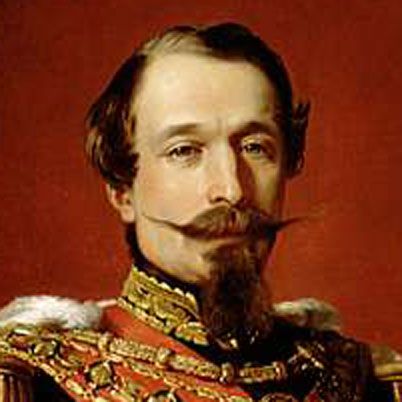
(1808-1873)
Who Was Napoleon III?
Napoleon III, the nephew of Napoleon I, grew up in exile — the year 1815 marked the end of Napoleon I's reign. However, Napoleon III was determined to regain the French throne. He began his quest in 1832, writing various political and military tracts in an effort to make himself and his ideas known. After a failed coup attempt in 1836, he was exiled again. After the Revolution of 1848, in 1850, Napoleon III was elected president of the Second Republic. He served in that position until 1852, when he was made emperor—a position he held until 1870, when the disastrous Franco-Prussian War led to his capture. He was deposed and sent to England, where he died in 1873.
Early Years
Born on April 20, 1808, in Paris, France, Charles-Louis-Napoleon Bonaparte was the third son of Napoleon I's brother, Louis Bonaparte, and his wife, Hortense de Beauharnais Bonaparte. Louis Bonaparte served as king of Holland from 1806 to 1810, and Hortense de Beauharnais Bonaparte was the stepdaughter of Napoleon I. Louis-Napoleon's parents had been made king and queen of French-controlled Holland by Napoleon I, but after Napoleon I's deposition in 1815, all members of the Bonaparte dynasty were forced into exile.
Louis-Napoleon grew up in Switzerland, living with his mother, who instilled in him a longing for France and an abiding admiration of the genius of Napoleon I.
When he was a young man, Louis-Napoleon settled in Italy, where he became interested in history and ideas of national liberty, with thoughts of regaining the Napoleonic Empire beginning to burn in the back of his mind. He and his elder brother, Napoleon Louis, began espousing liberal politics and joined the Carbonari, a revolutionist group fighting papal and Austrian control over Northern Italy. The brothers fled in March 1831, when troops began cracking down on revolutionary activity. Suffering from measles, Napoleon Louis died in his brother's arms during their escape; Louis-Napoleon was saved from the troops only by his mother's intervention.
The Failed Coups
After the death in 1832 of his cousin, the Duke of Reichstadt (Napoleon I's only son), Louis-Napoleon considered himself, following the law of succession established by Napoleon I when he was emperor, next in line for the French throne, and he completed his military training and studied economic and social issues in preparation. In 1832, he published the first of his own writings on political and military subjects, asserting in his tract "Rveries politiques" that only an emperor could give France the glory and liberty it deserved. The pamphlet was the start of Louis-Napoleon's effort to get his name widely known, spread his ideas and recruit followers.
Louis-Napoleon returned to France in October 1836 with an attempt to imitate Napoleon I's Hundred Days, in which Napoleon I escaped his Elba exile and briefly retook France from Louis XVIII. For Louis-Napoleon's effort, he initiated a Bonapartist coup at Strasbourg, calling on the local garrison to help him restore the Napoleonic Empire. Instead of joining him, the local troops arrested him. King Louis-Philippe exiled Louis-Napoleon to the United States, but he was recalled to Switzerland in early 1837 due to his mother's final illness. Expelled from Switzerland the following year, he settled in England.
In 1839, Louis-Napoleon published the booklet "Des idées napoléoniennes," in which he tried to transform Bonapartism, to this point essentially an object of reminiscence or romantic legend, into a political ideology. In his booklet, the Napoleonic ideal was put forth as a "social and industrial one, humanitarian and encouraging trade" that would "reconcile order and freedom, the rights of the people and the principles of authority." Louis-Napoleon saw it as his mission to return France to its earlier, Napoleonic, state with his ideals as its new backbone.
With this in mind, Louis-Napoleon again (secretly) returned to France in August 1840, sailing with 50 hired soldiers to Boulogne-Sur-Mer, and attempted yet another coup. The town's garrison, yet again, did not join Louis-Napoleon's efforts, and he was arrested. This time, however, Louis-Napoleon was not exiled, but was brought to trial and sentenced to "permanent confinement in a fortress." Confined in the town of Ham (in a castle), he again embarked on studying to prepare himself for his eventual imperial role. He also corresponded with members of the brewing French opposition and published articles in opposition newspapers, writing several more brochures.
In May 1846, Louis-Napoleon finally escaped and fled to England, where he waited for another chance to seize power. Just two months later, in July 1846, his father died, officially making Louis-Napoleon the clear heir to the Bonaparte legacy in France.
The Revolution of 1848
Louis-Napoleon lived in the United Kingdom until the Revolution began, in February 1848, and a new republic was established. He was then free to return to France, which he did immediately, but was sent right back to England by the provisional government because he was seen by many as a distraction to the settlement of a new government. Some of Louis-Napoleon's supporters, however, organized a small Bonapartist party and nominated him as their candidate for the Constituent Assembly, which was being brought together to draft a new constitution.
Louis-Napoleon won a seat and, in mid-1848, yet again returned to France, where he quickly began hatching a plan to run for the presidency. Because the Bonaparte name carried obvious weight in France, Louis-Napoleon captivated the voters as he evoked Napoleonic memories of national glory, promising to bring back those days with his administration. He also managed to succeed in promoting himself to literally every group of the population by promising to ensure the advancement of their particular interests, depicting himself as "all things to all men."
When the constitution of the Second Republic was finalized and elections for the presidency were held in December 1848, Louis-Napoleon won a surprising landslide victory, taking nearly 75 percent of the vote.
The Presidency
According to the new constitution of 1848, Louis-Napoleon's term would end in May 1852. The constitution also prohibited elected officials from running for a second term. Thusly, Louis-Napoleon, in the third year of his four-year mandate, sought an amendment to allow him to serve a second term as president, arguing that one term was not enough to implement his political and economic programs.
Despite his convictions, the National Assembly, fearful that longer terms would lead to abuse of the presidential office and power, refused to consider amending the constitution. Louis-Napoleon subsequently began touring the country in an attempt to garner popular appeal for himself, his policies, and the idea that his presidential term should be extended beyond four years. Despite his widespread appeal, the Assembly's opinion would not be swayed, so, on December 2, 1851, Louis-Napoleon seized dictatorial powers, claiming the right to do so as a referendum on his universal popularity.
Louis-Napoleon then dissolved the Assembly and declared a new constitution, which was soon approved by a plebiscite. He held another plebiscite in November 1852 and was confirmed as emperor, becoming Napoleon III, and thereby officially ending the Second Republic and ushering in the Second French Empire.
Napoleon III: Domestic Policies
Although one of Napoleon III's points of strategy was to always be ahead of public opinion, and he took great pains to study and influence it by means of propaganda, he also did, in fact, implement plans to appeal to virtually every segment of the populace. Napoleon III vowed "to take the initiative to do everything useful for the prosperity and the greatness of France," a vague goal to be sure, but he promoted public works, the construction of railroads, and other means of furthering industry and agriculture. He also took a personal interest in the rebuilding of modern Paris and was a ardent supporter of French inventors. Additionally, he ensured a lower price for bread, promoted the construction of sanitary housing for workers, and established boards of arbitration.
Foreign Policy
As he did on the domestic front, Napoleon III hit the ground running on foreign affairs, and he ended up dabbling in policy that would touch every corner of the globe. His overarching goal was to make France a great power once again by breaking up the European system created by the Congress of Vienna of 1815, which had also humiliated the French a great deal. Stating that the "successes of armies were only temporary" and that it was, as he had always contended, "public opinion which always gained the final victory," he planned to effect change in the region with "noble ideas," the principle of nationality being of utmost importance.
The Crimean War (1854-56) offered Napoleon III a chance to form a long-sought alliance with Great Britain, culminating with a successful effort in stopping Russian expansion toward the Mediterranean. More important in the end, the defeat of Russia and the alliance with England gave France increased influence in Europe, and the Paris Peace Conference of 1856 represented a high-water mark for the emperor in foreign affairs, as the ideas he set out in "Des idées napoléoniennes" came to fruition.
Internally, however, a deterioration in the economy caused unrest among the middle and working classes, who joined the Catholics to become a steadily growing oppositional force. Napoleon III put forth many concessions (freedom of coalition, freedom of assembly, liberalization of the press laws), but they were hampered by too many reservations and came too late, and by the 1869 elections, he realized that change in France, at his expense, was inevitable.
The Franco-Prussian War & End of Reign
Napoleon III saw France's dominance in Europe eroded by Prussia's decisive victory over Austria in the Austro-Prussian War during the summer of 1866, and in 1870, when goaded by the actions of Prussian prime minister Otto von Bismarck, Napoleon III began the Franco-Prussian War (also called the Franco-German War).
The war was an unmitigated disaster for France and for Napoleon III personally, and it was instrumental in the creation of the German Empire, which would replace France as the major land power on the European continent until the end of World War I. During the Battle of Sedan in September 1870, Napoleon III was captured by the Germans. He was deposed two days later, and the Third Republic of France was declared.
Death
Released by the Germans in 1871, Napoleon III moved to England, where he would spend his final years. He continued to write, and even thought of returning to France to regain his throne. Less than three years after his release by Germany, Napoleon III underwent an operation to extract bladder stones. He died shortly thereafter, on January 9, 1873, in Chislehurst, London, England.
QUICK FACTS
- Name: Napoleon III
- Birth Year: 1808
- Birth date: April 20, 1808
- Birth City: Paris
- Birth Country: France
- Gender: Male
- Best Known For: Napoleon III, the nephew of Napoleon I, was emperor of France from 1852 to 1870. His downfall came during the Franco-Prussian War, when his efforts to defeat Otto Von Bismarck ended in his capture.
- Industries
- War and Militaries
- World Politics
- Astrological Sign: Taurus
- Nacionalities
- French
- Death Year: 1873
- Death date: January 9, 1873
- Death City: Chislehurst, London, England
- Death Country: United Kingdom
Fact Check
We strive for accuracy and fairness.If you see something that doesn't look right,contact us!
CITATION INFORMATION
- Article Title: Napoleon III Biography
- Author: Biography.com Editors
- Website Name: The Biography.com website
- Url: https://www.biography.com/political-figures/napoleon-iii
- Access Date:
- Publisher: A&E; Television Networks
- Last Updated: January 22, 2021
- Original Published Date: April 2, 2014
QUOTES
- The Empress is Legitimist, my cousin is Republican, Morny is Orleanist, I am a socialist; the only Bonapartist is Persigny, and he is mad.
- If other countries gain anything, France must gain something also.
- Napoleon III wanted to turn Paris into Rome with Versailles piled on top, and it was done. His architects gave him the Paris Opera, an addition to the Louvre, and miles of new boulevards.