(1717-1780)
Who Was Maria Theresa?
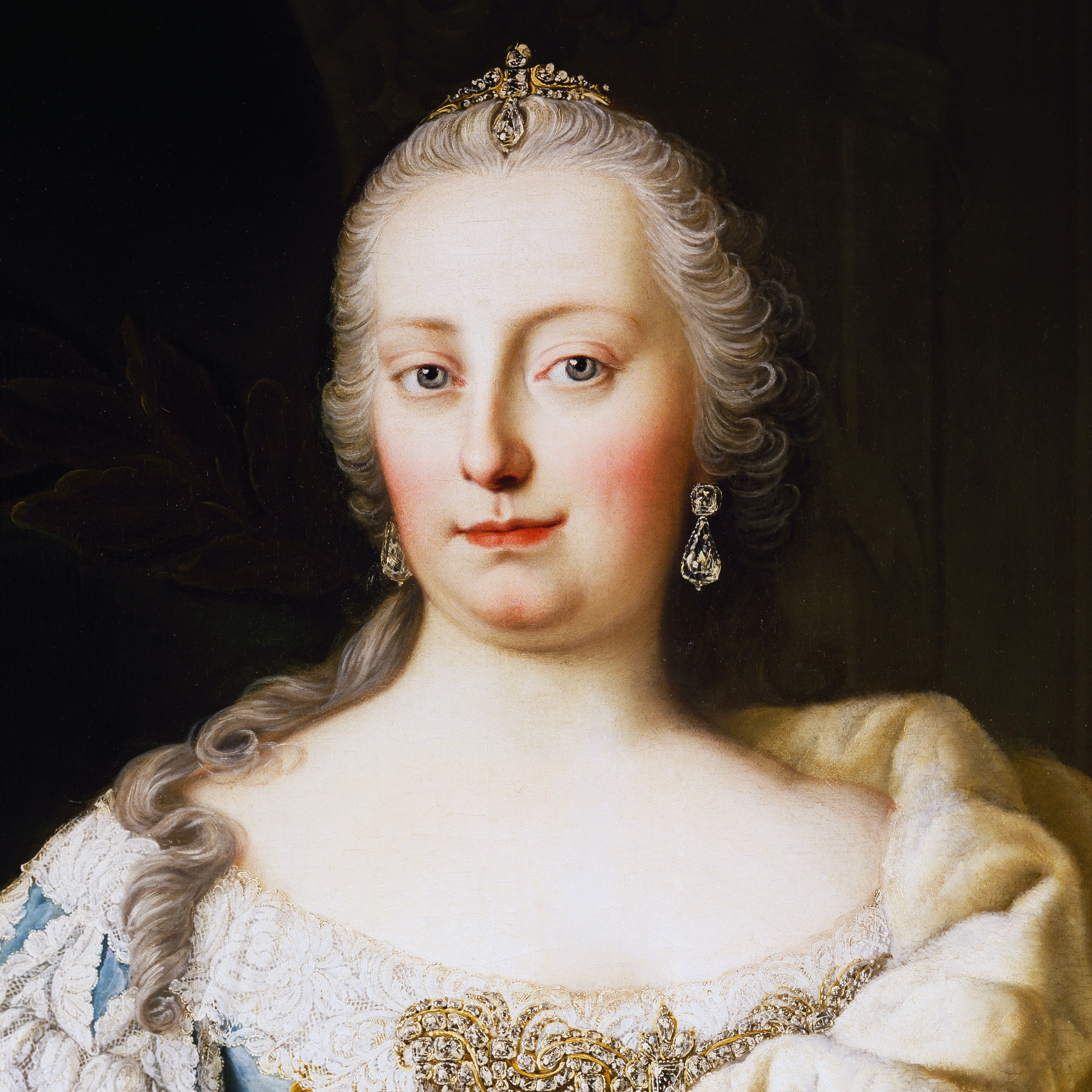
In 1740, Maria Theresa succeeded the Habsburg throne. In resistance, Frederick II’s army invaded and claimed Silesia. The war ended in 1748, after which she reformed her government and military. In 1756 Frederick II waged the Seven Years' War against her. In 1765 she appointed her son her co-regent. She died on November 29, 1780, in Vienna, Austria.
Early Life
Holy Roman Emperor Charles VI and his wife, Elisabeth Christine of Brunswick-Wolfenbüttel, welcomed their first daughter, Maria Theresa, into the world on May 13, 1717. She was born at the Hofburg Palace in Vienna, Austria.
Maria Theresa’s father was the last remaining male heir to the Habsburg throne, so before she was born, fearing that he might not produce a son, Charles VI reformed the Salic Law, which prevented any female heir from succeeding her father. In 1713 he issued the Pragmatic Sanction to ensure his eldest daughter’s right to take over the throne when he died, provided he never had a son. In 1720 Charles worked tirelessly to earn support for the sanction from his crown lands and several of the great European powers. Over time, they begrudgingly agreed to honor the sanction.
Maria Theresa’s education and upbringing were typical of princesses at the time. Her studies focused on frivolous skills thought to befit a young noblewoman. Despite the fact that Maria Theresa, who indeed still did not have a brother, was increasingly likely to inherit the Habsburg throne, she was ill-acquainted with affairs of state.
Marriage and Children
Charles VI had been encouraged by his trusted adviser, Prince Eugene of Savoy, to marry Maria Theresa off to a powerful prince. Instead, Charles VI allowed his daughter to marry for love. In 1736 Maria Theresa and her beloved Duke Francis Stephen of Lorraine, France, were wed. Since Lorraine could potentially be incorporated into the Habsburg Empire, Duke Francis appeased France by conceding to trade his province for Tuscany, which was of considerably lesser value.
Over the course of her marriage, Maria Theresa would give birth to a sizable brood. Her 16 children consisted of 5 sons and 11 daughters, including the future queen of France, Marie Antoinette.
Succession and Resistance
In October of 1740, Charles VI died. It was time for Maria Theresa, then 23 years old, to succeed to the Habsburg throne. Subjects of her crown lands — the Austrian duchies and Netherlands, and Bohemia and Hungary — were quick to accept Maria Theresa as their empress. But Maria Theresa immediately faced resistance to her succession from European powers who had previously agreed to her father’s Pragmatic Sanction. Under the leadership of Frederick II, King of Prussia, those powers formed a coalition against Maria Theresa.
By December of that year, Frederick II’s army invaded Silesia, an Austrian province, and claimed it for his kingdom. Bavaria and France followed suit with their own invasion of Habsburg territories, resulting in an eight-year conflict dubbed the War of the Austrian Succession. The war ended in 1748 when Austria was forced to let Prussia keep Silesia and to accept the loss of three of its Italian territories to France.
Reforming Domestic Policy
During the War of the Austrian Succession, Maria Theresa had never found an adequate general. She also to struggled to find capable men to align themselves with the Habsburg Empire, with the exception of a few administrators she had managed to appoint.
Once the war had ended, Maria Theresa set about further reforming the Habsburg government, with Silesian exile Count Frederick William Haugwitz heading up the effort. Haugwitz’s reform effort focused mainly on the centralization of the empire’s power. He assigned Bohemia and Austria to a joint ministry and took power away from the Provincial Estates. As a result, the affected territories lent Austria’s weakened army significantly more military power. Austria also benefited from the wealth produced by those provinces’ industries.
Maria Theresa also allowed Haugwitz to do away with yearly resource negotiations with the empire’s estates in favor of meeting to negotiate only once a decade. Over the course of that decade, the estates would pay the central government yearly taxes. Additionally, Maria Theresa reorganized several government functions, combining them in a centralized General Directory.
Foreign Relations
The increased revenue and cost savings of Maria Theresa and Haugwitz’s domestic reforms further served to strengthen the Habsburg Empire’s army. Although it was peacetime, Maria Theresa saw the need to prepare for an impending second war with Fredrick II, as he sought to defend Prussia against Austria’s newly formed alliance with its former enemy, France.
In 1756 Fredrick II once again waged war against Maria Theresa’s empire. His attack culminated in the Seven Years' War, during which Maria Theresa tried to reclaim Silesia. In 1762, when Empress Elisabeth died, Russia, one of Austria’s greatest allies in the war, withdrew. Because it was clear that the Habsburg Dynasty couldn’t win the war without its allies, in 1763 Maria Theresa and Fredrick II agreed to a peace treaty on the condition that Prussia would get to keep Silesia.
Late Reign and Death
In 1765 Maria Theresa’s husband, Francis Stephen, died. Upon his death, Maria Theresa appointed her eldest son, Joseph II, as emperor and co-regent. The two frequently clashed in their beliefs. After considering her own abdication and ultimately rejecting the idea, Maria Theresa allowed Joseph to take control of army reforms and join Wenzel Anton, Prince of Kaunitz-Rietberg, in determining the empire’s foreign policy.
Although Maria Theresa craved peace and promoted diplomacy, during the mother and son’s co-regency the War of the Bavarian Succession broke out, lasting from 1778 to 1779.
Maria Theresa died on November 29, 1780, at Hofburg Palace in Vienna, Austria—where she had reigned for four decades—leaving behind a solid basis for future generations of the family empire. With her death, Joseph II assumed full responsibility as Holy Roman Emperor.
QUICK FACTS
- Name: Maria Theresa
- Birth Year: 1717
- Birth date: May 13, 1717
- Birth City: Vienna
- Birth Country: Austria
- Gender: Female
- Best Known For: Maria Theresa was an Austrian archduchess and Holy Roman Empress of the Habsburg Dynasty from 1740 to 1780. She was also Marie Antoinette’s mother.
- Industries
- Politics and Government
- Astrological Sign: Taurus
- Nacionalities
- Hungarian
- Austrian
- Death Year: 1780
- Death date: November 29, 1780
- Death City: Vienna
- Death Country: Austria
Fact Check
We strive for accuracy and fairness.If you see something that doesn't look right,contact us!
CITATION INFORMATION
- Article Title: Maria Theresa Biography
- Author: Biography.com Editors
- Website Name: The Biography.com website
- Url: https://www.biography.com/royalty/maria-theresa
- Access Date:
- Publisher: A&E; Television Networks
- Last Updated: October 27, 2021
- Original Published Date: April 2, 2014
QUOTES
- I found myself without money, without credit, without army, without experience and knowledge of my own and finally, also without any counsel because each one of them at first wanted to wait and see how things would develop.
- I can never have enough children; in this I am insatiable.