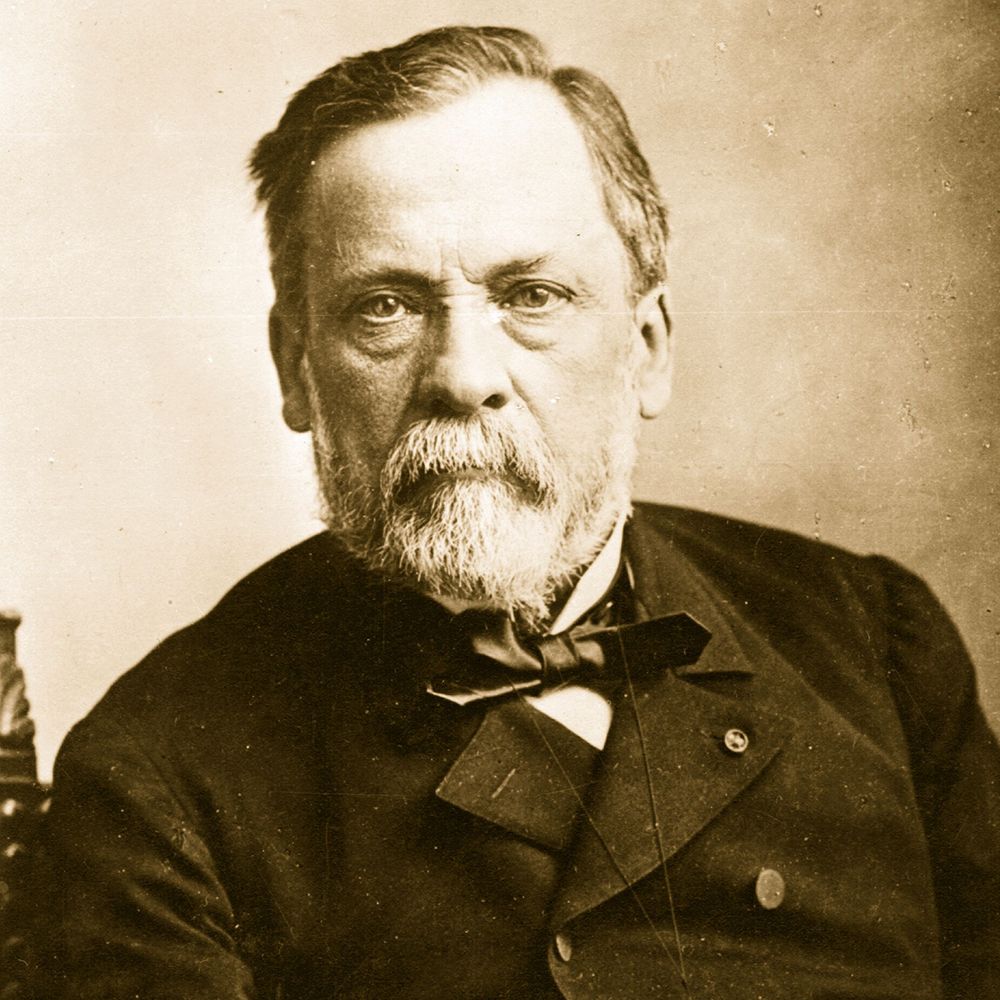
(1822-1895)
Who Was Louis Pasteur?
Louis Pasteur discovered that microbes were responsible for souring alcohol and came up with the process of pasteurization, where bacteria are destroyed by heating beverages and then allowing them to cool. His work in germ theory also led him and his team to create vaccinations for anthrax and rabies.
Early Life
Louis Pasteur was born on December 27, 1822, in Dole, located in the Jura region of France. He grew up in the town of Arbois, and his father, Jean-Joseph Pasteur, was a tanner and a sergeant major decorated with the Legion of Honor during the Napoleonic Wars. An average student, Pasteur was skilled at drawing and painting. He earned his bachelor of arts degree (1840) and a bachelor of science degree (1842) at the Royal College of Besançon and a doctorate (1847) from the École Normale in Paris.
Pasteur then spent several years researching and teaching at Dijon Lycée. In 1848, he became a professor of chemistry at the University of Strasbourg, where he met Marie Laurent, the daughter of the university's rector. They wed on May 29, 1849, and had five children, though only two survived childhood.
First Major Contribution in Chemistry
In 1849, Pasteur was attempting to resolve a problem concerning the nature of tartaric acid — a chemical found in the sediments of fermenting wine. Scientists were using the rotation of polarized light as a means for studying crystals. When polarized light is passed through a solution of dissolved tartaric acid, the angle of the plane of light is rotated. Pasteur observed that another compound called paratartaric acid, also found in wine sediments, had the same composition as tartaric acid. Most scientists assumed the two compounds were identical. However, Pasteur observed that paratartaric acid did not rotate plane-polarized light. He deduced that although the two compounds had the same chemical composition, they must somehow have different structures.
Looking at the paratartaric acid under a microscope, Pasteur observed there were two different types of tiny crystals. Though they looked almost identical, the two were actually mirror images of each other. He separated the two types of crystals into two piles and made solutions of each. When polarized light was passed through each, he discovered that both solutions rotated, but in opposite directions. When the two crystals were together in the solution the effect of polarized light was canceled. This experiment established that just studying the composition is not enough to understand how a chemical behaves. The structure and shape is also important and led to the field of stereochemistry.
Commercial Achievements
In 1854, Pasteur was appointed professor of chemistry and dean of the science faculty at the University of Lille. There, he worked on finding solutions to the problems with the manufacture of alcoholic drinks. Working with the germ theory, which Pasteur did not invent but further developed through experiments and eventually convinced most of Europe of its truth, he demonstrated that organisms such as bacteria were responsible for souring wine, beer and even milk. He then invented a process where bacteria could be removed by boiling and then cooling liquid. He completed the first test on April 20, 1862. Today the process is known as pasteurization.
Shifting focus, in 1865, Pasteur helped save the silk industry. He proved that microbes were attacking healthy silkworm eggs, causing an unknown disease and that the disease would be eliminated if the microbes were eliminated. He eventually developed a method to prevent their contamination and it was soon used by silk producers throughout the world.
Pasteur's first vaccine discovery was in 1879, with a disease called chicken cholera. After accidentally exposing chickens to the attenuated form of a culture, he demonstrated that they became resistant to the actual virus. Pasteur went on to extend his germ theory to develop causes and vaccinations for diseases such as anthrax, cholera, TB and smallpox.
In 1873, Pasteur was elected as an associate member of the Académie de Médecine. In 1882, the year of his acceptance into the Académie Française, he decided to focus his efforts on the problem of rabies. On July 6, 1885, Pasteur vaccinated Joseph Meister, a 9-year-old boy who had been bitten by a rabid dog. The success of Pasteur's vaccine brought him immediate fame. This began an international fundraising campaign to build the Pasteur Institute in Paris, which was inaugurated on November 14, 1888.
Personal Life
Pasteur had been partially paralyzed since 1868, due to a severe brain stroke, but he was able to continue his research. He celebrated his 70th birthday at the Sorbonne, which was attended by several prominent scientists, including British surgeon Joseph Lister. At that time, his paralysis worsened, and he died on September 28, 1895. Pasteur's remains were transferred to a Neo-Byzantine crypt at the Pasteur Institute in 1896.
QUICK FACTS
- Name: Louis Pasteur
- Birth Year: 1822
- Birth date: December 27, 1822
- Birth City: Dole
- Birth Country: France
- Gender: Male
- Best Known For: Scientist Louis Pasteur came up with the food preparation process known as pasteurization; he also developed vaccinations for anthrax and rabies.
- Industries
- Science and Medicine
- Astrological Sign: Capricorn
- Nacionalities
- French
- Death Year: 1895
- Death date: September 28, 1895
- Death City: Marnes-la-Coquette
- Death Country: France
Fact Check
We strive for accuracy and fairness.If you see something that doesn't look right,contact us!
CITATION INFORMATION
- Article Title: Louis Pasteur Biography
- Author: Biography.com Editors
- Website Name: The Biography.com website
- Url: https://www.biography.com/scientists/louis-pasteur
- Access Date:
- Publisher: A&E; Television Networks
- Last Updated: May 26, 2021
- Original Published Date: April 2, 2014
QUOTES
- Chance only favors the prepared mind.
- The role of the infinitely small appeared to me to be infinitely great.
- I still have hope, and if my life is spared, I believe that by analogy and experiment, I will attain to the discovery of a remedy.
- The universe is an asymmetrical entity. I am inclined to believe that life as it is manifested to us must be a function of [that] asymmetry.
- There is no such thing as a special category of science called applied science. There is science and there are its applications, which are related to one another as the fruit is related to the tree that has borne it.
- After death, life reappears in a different form and with different laws.
- One must not assume that an understanding of science is present in those who borrow its language.
- Life is the germ, and the germ is life.
- A known enemy is already half disarmed.
- If one boasts of having done 250 experiments, it means that one has done them badly more than 249 times.
- The thought that my name might some day awaken in a child's soul the first stirrings of patriotism makes my heart beat faster.
- The universe is asymmetric and I am persuaded that life, as it is known to us, is a direct result of the asymmetry of the universe or of its indirect consequences.