(1941-2011)
Who Was Kim Jong Il?
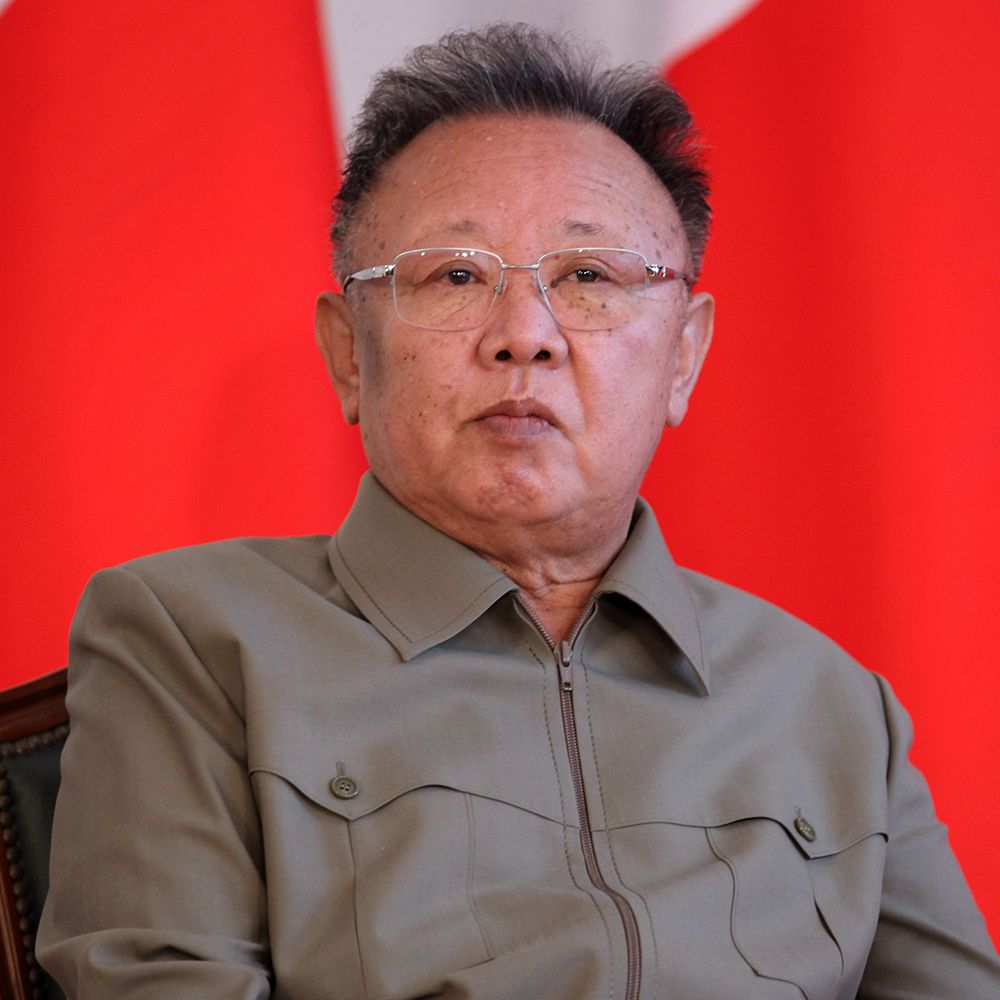
Much of Kim Jong Il's persona is based on a cult of personality, meaning that legend and official North Korean government accounts describe his life, character and actions in ways that promote and legitimize his leadership, including his birth. Over the years, Kim's dominating personality and complete concentration of power has come to define the country North Korea.
Early Life
Kim Jong Il was born on February 16, 1941, though official accounts place his birth a year later. Some mystery surrounds when and where Kim Jong Il was born. Official North Korean biographies state that his birth occurred on February 16, 1942, in a secret camp on Mount Paekdu along the Chinese border, in Samjiyon County, Ryanggang Province, in the Democratic People's Republic of Korea (North Korea). Other reports indicate he was born a year later in Vyatskoye in the former Soviet Union.
During World War II, his father commanded the 1st Battalion of the Soviet 88th Brigade, composed of Chinese and Korean exiles battling the Japanese Army. Kim Jong Il's mother was Kim Jong Suk, his father's first wife. Official accounts indicate that Kim Jong Il comes from a family of nationalists who actively resisted imperialism from the Japanese in the early 20th century.
His official government biography claims Kim Jong Il completed his general education between September 1950 and August 1960 in Pyongyang, the current capital city of North Korea. But scholars point out that the first few years of this period were during the Korean War and contend his early education took place in the People's Republic of China, where it was safer to live. Official accounts claim that throughout his schooling, Kim was involved in politics. While attending the Namsan Higher Middle School in Pyongyang, he was active in the Children's Union—a youth organization that promotes the concept of Juche, or the spirit of self-reliance—and the Democratic Youth League (DYL), taking part in the study of Marxist political theory. During his youth, Kim Jong Il showed an interest in a wide range of subjects including agriculture, music, and mechanics. In high school, he took classes in automotive repair and participated in trips to farms and factories. Official accounts of his early schooling also point out his leadership capabilities: as vice chairman of his school's DYL branch, he encouraged younger classmates to pursue greater ideological education and organized academic competitions and seminars as well as field trips.
Kim Jong Il graduated from Namsan Higher Middle School in 1960 and enrolled the same year at Kim Il Sung University. He majored in Marxist political economy and minored in philosophy and military science. While at the university, Kim trained as an apprentice in a textile machine factory and took classes in building TV broadcast equipment. During this time, he also accompanied his father on tours of field guidance in several of North Korea's provinces.
Rise to Power
Kim Jong Il joined the Workers' Party, the official ruling party of North Korea, in July 1961. Most political experts believe the party follows the traditions of Stalinist politics even though North Korea began distancing itself from Soviet domination in 1956. The Workers' Party claims to have its own ideology, steeped in the philosophy of Juche. However, in the late 1960s, the party instituted a policy of "burning loyalty" to the "Great Leader" (Kim Il Sung). This practice of personality cult is reminiscent of Stalinist Russia but was taken to new heights with Kim Il Sung and would continue with Kim Jong Il.
Soon after his 1964 graduation from the university, Kim Jong Il began his rise through the ranks of the Korean Workers' Party. The 1960s were a time of high tension between many Communist countries. China and the Soviet Union were clashing over ideological differences that resulted in several border skirmishes, Soviet satellite nations in Eastern Europe were simmering with dissention, and North Korea was pulling away from both Soviet and Chinese influence. Within North Korea, internal forces were attempting to revise the party's revolutionary message. Kim Jong Il was appointed to the Workers' Party Central Committee to lead the offensive against the revisionists and ensure the party did not deviate from the ideological line set by his father. He also led efforts to expose dissidents and deviant policies to ensure strict enforcement of the party's ideological system. In addition, he took on major military reform to strengthen the party's control of the military and expelled disloyal officers.
Kim Jong Il oversaw the Propaganda and Agitation department, the government agency responsible for media control and censorship. Kim gave firm instructions that the party's monolithic ideological message be communicated constantly by writers, artists, and officials in the media. According to official accounts, he revolutionized Korean fine arts by encouraging the production of new works in new media. This included the art of film and cinema. Mixing history, political ideology, and movie-making, Kim encouraged the production of several epic films, which glorified works written by his father. His official biography claims that Kim Jong Il has composed six operas and enjoys staging elaborate musicals. Kim is reported to be an avid film buff who owns more than 20,000 movies, including the entire series of James Bond films, for his personal enjoyment.
Kim Il Sung began preparing his son to lead North Korea in the early 1970s. Between 1971 and 1980, Kim Jong Il was appointed to increasingly important positions in the Korean Workers' Party. During this time, he instituted policies to bring party officials closer to the people by forcing bureaucrats to work among subordinates for one month a year. He launched the Three-Revolution Team Movement, in which teams of political, technical, and scientific technicians traveled around the country to provide training. He was also involved in economic planning to develop certain sectors of the economy.
By the 1980s, preparations were being made for Kim to succeed his father as the leader of North Korea. At this time, the government began building a personality cult around Kim Jong Il patterned after that of his father. Just as Kim Il Sung was known as the "Great Leader," Kim Jong Il was hailed in the North Korean media as the "fearless leader" and "the great successor to the revolutionary cause." His portraits appeared in public buildings along with his father's. He also initiated a series of drop-in inspections of businesses, factories, and government offices. At the Sixth Party Congress in 1980, Kim Jong Il was given senior posts in the Politburo (the policy committee of the Korean Workers' Party), the Military Commission, and the Secretariat (the executive department charged with carrying out policy). Thus, Kim was positioned to control all aspects of the government.
The one area of leadership in which Kim Jong Il might have had a perceived weakness was the military. The army was the foundation of power in North Korea, and Kim had no military service experience. With the assistance of allies in the military, Kim was able to gain acceptance by the army officials as the next leader of North Korea. By 1991, he was designated as the supreme commander of the Korean People's Army, thus giving him the tool he needed to maintain complete control of the government once he took power.
Following the death of Kim Il Sung in July 1994, Kim Jong Il took total control of the country. This transition of power from father to son had never been seen before in a communist regime. In deference to his father, the office of president was abolished, and Kim Jong Il took the titles of general secretary of the Workers' Party and chairman of the National Defense Commission, which was declared the highest office of the state.
Foreign Aid and Nuclear Testing
It is important to understand that much of Kim Jong Il's persona is based on a cult of personality, meaning that legend and official North Korean government accounts describe his life, character, and actions in ways that promote and legitimize his leadership. Examples include his family's nationalist revolutionary roots and claims that his birth was foretold by a swallow, the appearance of a double rainbow over Mount Paekdu, and a new star in the heavens. He is known to personally manage the country's affairs and sets operational guidelines for individual industries. He is said to be arrogant and self-centered in policy decisions, openly rejecting criticism or opinions that differ from his. He is suspicious of nearly all of those who surround him and volatile in his emotions. There are many stories of his eccentricities, his playboy lifestyle, the lifts in his shoes and pompadour hairstyle that make him appear taller, and his fear of flying. Some stories can be verified while others are most likely exaggerated, possibly circulated by foreign operatives from hostile countries.
In the 1990s, North Korea went through a series of devastating and debilitating economic episodes. With the collapse of the Soviet Union in 1991, North Korea lost its main trading partner. Strained relations with China following China's normalization with South Korea in 1992 further limited North Korea's trade options. Record-breaking floods in 1995 and 1996 followed by drought in 1997 crippled North Korea's food production. With only 18 percent of its land suitable for farming in the best of times, North Korea began experiencing a devastating famine. Worried about his position in power, Kim Jong Il instituted the Military First policy, which prioritized national resources to the military. Thus, the military would be pacified and remain in his control. Kim could defend himself from threats domestic and foreign, while economic conditions worsened. The policy did produce some economic growth and along with some socialist-type market practices—characterized as a "flirtation with capitalism"—North Korea has been able to remain operational despite being heavily dependent on foreign aid for food.
In 1994, the Clinton administration and North Korea agreed to a framework designed to freeze and eventually dismantle North Korea's nuclear weapons program. In exchange, the United States would provide assistance in producing two power-generating nuclear reactors and supplying fuel oil and other economic aid. In 2000, the presidents of North Korea and South Korea met for diplomatic talks and agreed to promote reconciliation and economic cooperation between the two countries. The agreement allowed families from both countries to reunite and signaled a move toward increased trade and investment. For a time, it appeared that North Korea was reentering the international community.
Then in 2002, U.S. intelligence agencies suspected North Korea was enriching uranium or building the facilities to do so, presumably for making nuclear weapons. In his 2002 State of the Union address, President George W. Bush identified North Korea as one of the countries in the "axis of evil" (along with Iraq and Iran). The Bush administration soon revoked the 1994 treaty designed to eliminate North Korea's nuclear weapons program. Finally, in 2003, Kim Jong Il's government admitted to having produced nuclear weapons for security purposes, citing tensions with President Bush. Late in 2003, the Central Intelligence Agency issued a report that North Korea possessed one and possibly two nuclear bombs. The Chinese government stepped in to try to mediate a settlement, but President Bush refused to meet with Kim Jong Il one-on-one and instead insisted on multilateral negotiations. China was able to gather Russia, Japan, South Korea, and the United States for negotiations with North Korea. Talks were held in 2003, 2004, and twice in 2005. All through the meetings, the Bush administration demanded North Korea eliminate its nuclear weapons program. It adamantly maintained any normalcy of relations between North Korea and the United States would come about only if North Korea changed its human rights policies, eliminated all chemical and biological weapons programs, and ended missile technology proliferation. North Korea continually rejected the proposal. In 2006, North Korea's Central News Agency announced North Korea had successfully conducted an underground nuclear bomb test.
Failing Health
There have been many reports and claims regarding Kim Jong Il's health and physical condition. In August 2008, a Japanese publication claimed Kim had died in 2003 and had been replaced with a stand-in for public appearances. It was also noted that Kim hadn't made a public appearance for the Olympic torch ceremony in Pyongyang in April 2008. After Kim failed to show up for a military parade celebrating North Korea's 60th anniversary, U.S. intelligence agencies believed Kim to be gravely ill after possibly suffering a stroke. During the fall of 2008, numerous news sources gave conflicting reports on his condition. The North Korean news agency reported Kim participated in national elections in March 2009 and was unanimously elected to a seat in the Supreme People's Assembly, the North Korean parliament. The assembly will vote later to confirm him as chairman of the National Defense Commission. In the report, it was said Kim cast his ballot at the Kim Il Sung University and later toured the facility and talked to a small group of people.
Kim's health was watched closely by other countries because of his volatile nature, the country's possession of nuclear weapons, and its precarious economic condition. Kim also had no apparent successors to his regime, as did his father. His three sons spent most of their lives outside the country and none seemed to be in the favor of the "Dear Leader" to ascend to the top spot. Many international experts believed that when Kim died, there would be mayhem because there seemed to be no apparent method for a transfer of power. But due to the North Korean government's predilection for secrecy, this was too hard to know.
In 2009, however, news reports revealed that Kim planned to name his son, Kim Jong Un as his successor. Very little was known about Kim's heir apparent; until 2010, only one officially confirmed photo of Jong Un existed, and not even his official birthdate had been revealed. The twenty-something was officially confirmed in September 2010.
Final Days and Death
Kim Jon-Il died December 17, 2011, of a heart attack while traveling on a train. Media reports say the leader was on a work trip for official duties. Upon news of The Dear Leader's death, North Koreans marched on the capital, weeping and mourning.
Kim is said to be survived by three wives, three sons and three daughters. Other reports claim he has fathered 70 children, most of whom are housed in villas throughout North Korea.
His son, Kim Jong Un, is reported to take up leadership, and the military pledged to support Jong Un's succession.
QUICK FACTS
- Name: Kim
- Birth Year: 1941
- Birth date: February 16, 1941
- Gender: Male
- Best Known For: Kim Jong Il's dominating personality and complete concentration of power have come to define the country North Korea.
- Astrological Sign: Aquarius
- Schools
- Namsan Higher Middle School
- Kim Il Sung University
- Death Year: 2011
- Death date: December 17, 2011
Fact Check
We strive for accuracy and fairness.If you see something that doesn't look right,contact us!
CITATION INFORMATION
- Article Title: Kim Jong Il Biography
- Author: Biography.com Editors
- Website Name: The Biography.com website
- Url: https://www.biography.com/political-figures/kim-jong-il
- Access Date:
- Publisher: A&E; Television Networks
- Last Updated: April 20, 2021
- Original Published Date: April 2, 2014