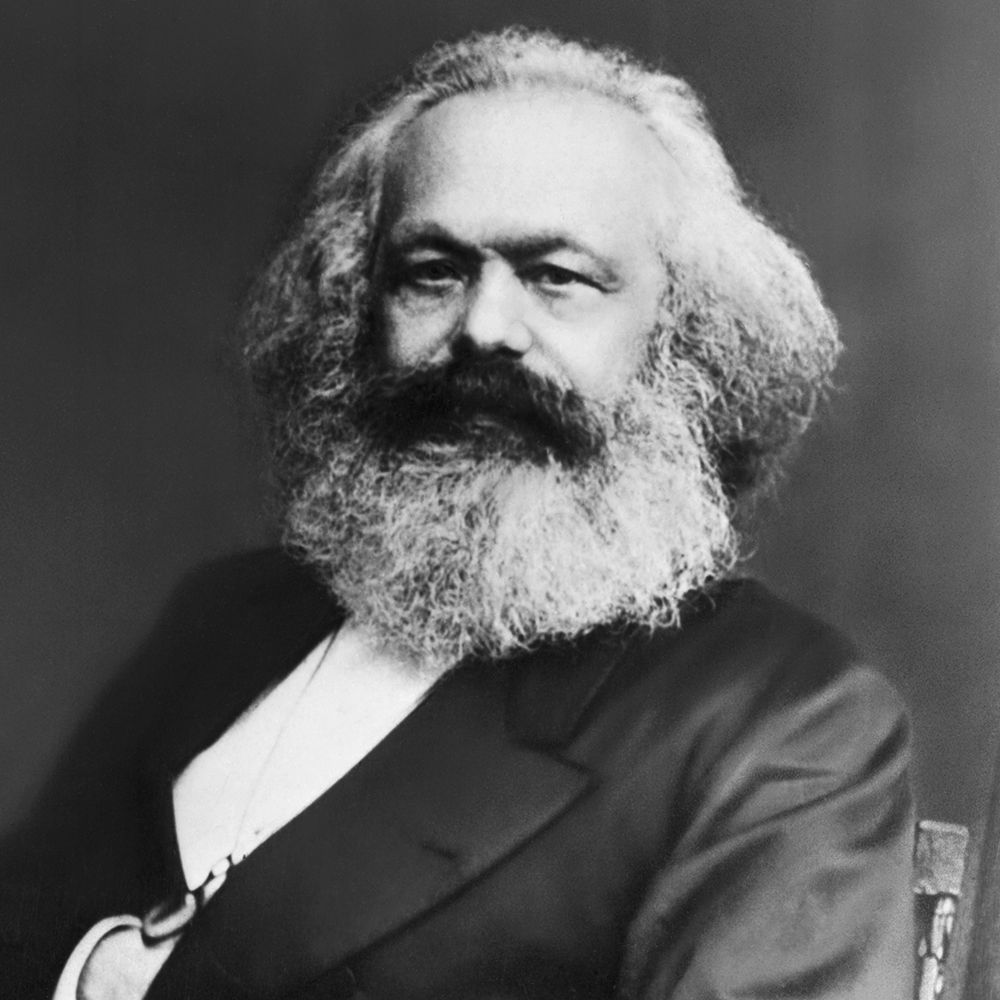
(1818-1883)
Who Was Karl Marx?
Karl Marx began exploring sociopolitical theories at university among the Young Hegelians. He became a journalist, and his socialist writings would get him expelled from Germany and France. In 1848, he published The Communist Manifesto with Friedrich Engels and was exiled to London, where he wrote the first volume of Das Kapital and lived the remainder of his life.
Early Life
Karl Heinrich Marx was one of nine children born to Heinrich and Henrietta Marx in Trier, Prussia. His father was a successful lawyer who revered Kant and Voltaire, and was a passionate activist for Prussian reform. Although both parents were Jewish with rabbinical ancestry, Karl’s father converted to Christianity in 1816 at the age of 35.
This was likely a professional concession in response to an 1815 law banning Jews from high society. He was baptized a Lutheran, rather than a Catholic, which was the predominant faith in Trier, because he “equated Protestantism with intellectual freedom.” When he was 6, Karl was baptized along with the other children, but his mother waited until 1825, after her father died.
Marx was an average student. He was educated at home until he was 12 and spent five years, from 1830 to 1835, at the Jesuit high school in Trier, at that time known as the Friedrich-Wilhelm Gymnasium. The school’s principal, a friend of Marx’s father, was a liberal and a Kantian and was respected by the people of Rhineland but suspect to authorities. The school was under surveillance and was raided in 1832.
Education
In October of 1835, Marx began studying at the University of Bonn. It had a lively and rebellious culture, and Marx enthusiastically took part in student life. In his two semesters there, he was imprisoned for drunkenness and disturbing the peace, incurred debts and participated in a duel. At the end of the year, Marx’s father insisted he enroll in the more serious University of Berlin.
In Berlin, he studied law and philosophy and was introduced to the philosophy of G.W.F. Hegel, who had been a professor at Berlin until his death in 1831. Marx was not initially enamored with Hegel, but he soon became involved with the Young Hegelians, a radical group of students including Bruno Bauer and Ludwig Feuerbach, who criticized the political and religious establishments of the day.
In 1836, as he was becoming more politically zealous, Marx was secretly engaged to Jenny von Westphalen, a sought-after woman from a respected family in Trier who was four years his senior. This, along with his increasing radicalism, caused his father angst. In a series of letters, Marx’s father expressed concerns about what he saw as his son’s “demons,” and admonished him for not taking the responsibilities of marriage seriously enough, particularly when his wife-to-be came from a higher class.
Marx did not settle down. He received his doctorate from the University of Jena in 1841, but his radical politics prevented him from procuring a teaching position. He began to work as a journalist, and in 1842, he became the editor of Rheinische Zeitung, a liberal newspaper in Cologne. Just one year later, the government ordered the newspaper’s suppression, effective April 1, 1843. Marx resigned on March 18th. Three months later, in June, he finally married Jenny von Westphalen, and in October, they moved to Paris.
Paris
Paris was the political heart of Europe in 1843. There, along with Arnold Ruge, Marx founded a political journal titled Deutsch-Französische Jahrbücher (German-French Annals). Only a single issue was published before philosophical differences between Marx and Ruge resulted in its demise, but in August of 1844, the journal brought Marx together with a contributor, Friedrich Engels, who would become his collaborator and lifelong friend. Together, the two began writing a criticism of the philosophy of Bruno Bauer, a Young Hegelian and former friend of Marx’s. The result of Marx and Engels’s first collaboration was published in 1845 as The Holy Family.
Later that year, Marx moved to Belgium after being expelled from France while writing for another radical newspaper, Vorwärts!, which had strong ties to an organization that would later become the Communist League.
Brussels
In Brussels, Marx was introduced to socialism by Moses Hess, and finally broke off from the philosophy of the Young Hegelians completely. While there, he wrote The German Ideology, in which he first developed his theory on historical materialism. Marx couldn’t find a willing publisher, however, and The German Ideology -- along with Theses on Feuerbach, which was also written during this time -- were not published until after his death.
At the beginning of 1846, Marx founded a Communist Correspondence Committee in an attempt to link socialists from around Europe. Inspired by his ideas, socialists in England held a conference and formed the Communist League, and in 1847 at a Central Committee meeting in London, the organization asked Marx and Engels to write Manifest der Kommunistischen Partei (Manifesto of the Communist Party).
The Communist Manifesto, as this work is commonly known, was published in 1848, and shortly after, in 1849, Marx was expelled from Belgium. He went to France, anticipating a socialist revolution, but was deported from there as well. Prussia refused to renaturalize him, so Marx moved to London. Although Britain denied him citizenship, he remained in London until his death.
London
In London, Marx helped found the German Workers’ Educational Society, as well as a new headquarters for the Communist League. He continued to work as a journalist, including a 10-year stint as a correspondent for the New York Daily Tribune from 1852 to 1862, but he never earned a living wage and was largely supported by Engels.
Marx became increasingly focused on capitalism and economic theory, and in 1867, he published the first volume of Das Kapital. The rest of his life was spent writing and revising manuscripts for additional volumes, which he did not complete. The remaining two volumes were assembled and published posthumously by Engels.
Death
Marx died of pleurisy in London on March 14, 1883. While his original grave had only a nondescript stone, the Communist Party of Great Britain erected a large tombstone, including a bust of Marx, in 1954. The stone is etched with the last line of The Communist Manifesto (“Workers of all lands unite”), as well as a quote from the Theses on Feuerbach.
QUICK FACTS
- Name: Karl Heinrich Marx
- Birth Year: 1818
- Birth date: May 5, 1818
- Birth City: Trier
- Birth Country: Germany
- Gender: Male
- Best Known For: German philosopher and revolutionary socialist Karl Marx published 'The Communist Manifesto' and 'Das Kapital,' anticapitalist works that form the basis of Marxism.
- Industries
- Business and Industry
- Education and Academia
- Astrological Sign: Taurus
- Schools
- University of Berlin
- University of Bonn
- Nationalities
- German
- Death Year: 1883
- Death date: March 14, 1883
- Death City: London
- Death Country: England
Fact Check
We strive for accuracy and fairness. If you see something that doesn't look right, contact us!