(1667-1745)
Who Was Jonathan Swift?
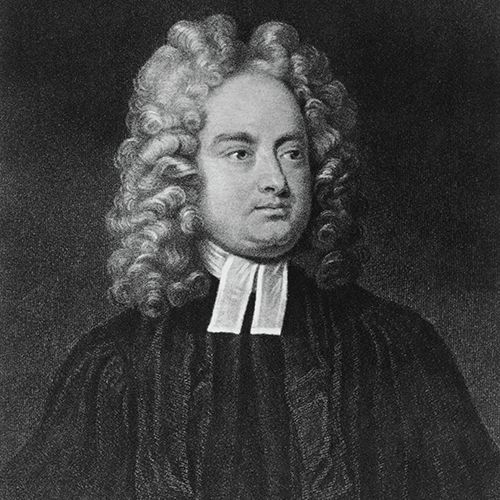
Irish author, clergyman and satirist Jonathan Swift grew up fatherless. Under the care of his uncle, he received a bachelor's degree from Trinity College and then worked as a statesman's assistant. Eventually, he became dean of St. Patrick's Cathedral in Dublin. Most of his writings were published under pseudonyms. He best remembered for his 1726 book Gulliver's Travels.
Early Life and Education
Irish author and satirist Swift was born in Dublin, Ireland on November 30, 1667. His father, an attorney, also named Jonathan Swift, died just two months before he arrived. Without steady income, his mother struggled to provide for her newborn. Moreover, Swift was a sickly child. It was later discovered that he suffered from Meniere's Disease, a condition of the inner ear that leaves the afflicted nauseous and hard of hearing. In an effort to give her son the best upbringing possible, Swift's mother gave him over to Godwin Swift, her late husband's brother and a member of the respected professional attorney and judges group Gray's Inn. Godwin Swift enrolled his nephew in the Kilkenny Grammar School (1674–1682), which was perhaps the best school in Ireland at the time. Swift's transition from a life of poverty to a rigorous private school setting proved challenging. He did, however, make a fast friend in William Congreve, the future poet and playwright.
At age 14, Swift commenced his undergraduate studies at Trinity College in Dublin. In 1686, he received a Bachelor of Arts degree and went on to pursue a master's. Not long into his research, huge unrest broke out in Ireland. The king of Ireland, England and Scotland was soon to be overthrown. What became known as the Glorious Revolution of 1688 spurred Swift to move to England and start anew. His mother found a secretary position for him under the revered English statesman, Sir William Temple. For 10 years, Swift worked in Surrey's Moor Park and acted as an assistant to Temple, helping him with political errands, and also in the researching and publishing of his own essays and memoirs. Temple was impressed by Swift's abilities and after a time, entrusted him with sensitive and important tasks.
During his Moor Park years, Swift met the daughter of Temple's housekeeper, a girl just 8 years old named Esther Johnson. When they first met, she was 15 years Swift's junior, but despite the age gap, they would become lovers for the rest of their lives. When she was a child, he acted as her mentor and tutor, and gave her the nickname "Stella." When she was of age, they maintained a close but ambiguous relationship, which lasted until Johnson's death. It was rumored that they married in 1716, and that Swift kept of lock of Johnson's hair in his possession at all times.
Writings
During his decade of work for Temple, Swift returned to Ireland twice. On a trip in 1695, he took all necessary requirements to become an ordained priest in the Anglican tradition. Under Temple's influence, he also began to write, first short essays and then a manuscript for a later book. In 1699, Temple died. Swift completed the task of editing and publishing his memoirs—not without disputes by several of Temple's family members—and then, grudgingly, accepted a less prominent post as secretary and chaplain to the Earl of Berkeley. After making the long journey to the Earl's estate, Swift was informed the position had been filled. Discouraged but resourceful, he leaned on his priestly qualifications and found work ministering to a pea-sized congregation just 20 miles outside of Dublin. For the next 10 years, he gardened, preached and worked on the house provided to him by the church. He also returned to writing. His first political pamphlet was titled A Discourse on the Contests and Dissentions in Athens and Rome.
In 1704, Swift anonymously released A Tale of a Tub and The Battle of the Books. Tub, although widely popular with the masses, was harshly disapproved of by the Church of England. Ostensibly, it criticized religion, but Swift meant it as a parody of pride. Nonetheless, his writings earned him a reputation in London, and when the Tories came into power in 1710, they asked him to become editor of the Examiner, their official paper. After a time, he became fully immersed in the political landscape and began writing some of the most cutting and well-known political pamphlets of the day, including The Conduct of the Allies, an attack on the Whigs. Privy to the inner circle of Tory government, Swift laid out his private thoughts and feelings in a stream of letters to his beloved Stella. They would later be published as The Journal to Stella.
'Gulliver's Travels' and Later Years
When he saw that the Tories would soon fall from power, Swift returned to Ireland. In 1713, he took the post of dean at St. Patrick's Cathedral in Dublin. Although he was still in contact with Esther Johnson, it is documented that he engaged in a romantic relationship with Esther Vanhomrigh (whom he called Vanessa). His courtship with her inspired his long and storied poem, "Cadenus and Vanessa." He is also rumored to have had a relationship with the celebrated beauty Anne Long.
While leading his congregation at St. Patrick's, Swift began to write what would become his best-known work. In 1726, at last finished with the manuscript, he traveled to London and benefited from the help of several friends, who anonymously published it as Travels into Several Remote Nations of the World, in Four Parts. By Lemuel Gulliver, First a Surgeon, and then a Captain of Several Ships — also known, more simply, as Gulliver's Travels. The book was an immediate success and hasn't been out of print since its first run. Interestingly, much of the storyline points to historical events that Swift had lived through years prior during intense political turmoil.
Not long after the celebration of this work, Swift's longtime love, Esther Johnson, fell ill. She died in January 1728. Her life's end moved Swift to write The Death of Mrs. Johnson. Shortly after her death, a stream of Swift's other friends also died, including John Gay and John Arbuthnot. Swift, always bolstered by the people around him, was now quite troubled.
Death
In 1742, Swift suffered from a stroke and lost the ability to speak. On October 19, 1745, Swift died. He was laid to rest next to Esther Johnson inside Dublin's St. Patrick's Cathedral.
QUICK FACTS
- Name: Jonathan Swift
- Birth Year: 1667
- Birth date: November 30, 1667
- Birth City: Dublin
- Birth Country: Ireland
- Gender: Male
- Best Known For: Jonathan Swift was an Irish author and satirist. Best known for writing 'Gulliver's Travels,' he was dean of St. Patrick's Cathedral in Dublin.
- Industries
- Writing and Publishing
- Astrological Sign: Sagittarius
- Schools
- University of Oxford
- Trinity College
- Kilkenny School
- Nacionalities
- Irish
- Death Year: 1745
- Death date: October 19, 1745
- Death City: Dublin
- Death Country: Ireland
Fact Check
We strive for accuracy and fairness.If you see something that doesn't look right,contact us!
CITATION INFORMATION
- Article Title: Jonathan Swift Biography
- Author: Biography.com Editors
- Website Name: The Biography.com website
- Url: https://www.biography.com/authors-writers/jonathan-swift
- Access Date:
- Publisher: A&E; Television Networks
- Last Updated: April 13, 2021
- Original Published Date: April 2, 2014
QUOTES
- A wise person should have money in their head, but not in their heart.