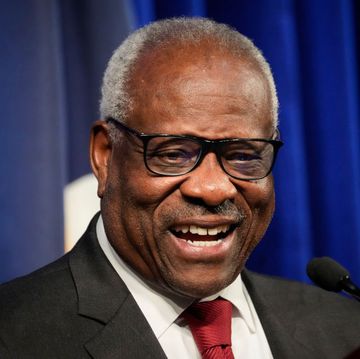
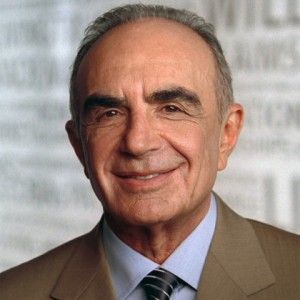
(1955-)
Who Is John Roberts?
U.S. Supreme Court Chief Justice John Roberts grew up in Long Beach, Indiana, and attended Harvard Law School. He served on the U.S. Court of Appeals for two years before being confirmed as Chief Justice of the United States in 2005. In June 2015, Roberts ruled on two landmark legislative cases: He reaffirmed the legality of Obamacare, by siding with the liberal wing of the Court, along with swing vote Justice Anthony Kennedy. However, he held to his conservative views on the issue of gay marriage and voted against the Court's decision that made same-sex marriage legal in all 50 states.
Early Life and Education
John Glover Roberts Jr., the only son of John G. "Jack" Roberts Sr. and Rosemary Podrasky Roberts, was born in Buffalo, New York, on January 27, 1955. In 1959, the family moved to Long Beach, Indiana, where Roberts grew up with his three sisters, Kathy, Peggy and Barbara.
He attended Notre Dame Elementary School in Long Beach and then La Lumiere boarding school in La Porte, Indiana. Along with being an excellent student, Roberts participated in several extracurricular activities including choir, drama and student council. Though not an exceptionally gifted athlete, he was named the captain of the high school football team because of his leadership skills and excelled as a wrestler, becoming Regional Champion while at La Lumiere.
Roberts entered Harvard College with aspirations of becoming a history professor. During the summers, he worked in a steel mill in Indiana to help pay his tuition. After graduating summa cum laude in three years, Roberts attended Harvard Law School, where he discovered his love for the law. He was managing editor of the Harvard Law Review and graduated magna cum laude with a J.D. in 1979.
Due to his high honors at Harvard Law, Roberts was recruited to clerk for Judge Henry Friendly of the U.S. Court of Appeals, Second Circuit. In 1980, he clerked for then-Associate Justice William Rehnquist on the U.S. Supreme Court. Legal analysts believe that working for both Friendly and Rehnquist influenced Roberts's conservative approach to the law, including his skepticism of federal power over the states and his support of broad executive branch powers in foreign and military affairs.
Attorney and Judge
In 1982, Roberts served as an aide to U.S. Attorney General William French Smith and later as an aide to White House counsel Fred Fielding under President Ronald Reagan. During these years, Roberts earned the reputation of being a political pragmatist, tackling some of the administration’s toughest issues (such as school busing) and matching wits with legal scholars and members of Congress.
After working as an associate at the Washington, D.C. law firm of Hogan & Hartson from 1987 to 1989, Roberts returned to the Justice Department under President George H.W. Bush as Principal Deputy Solicitor General from 1989 to 1993. In 1992, President Bush nominated Roberts to serve on the U.S. Court of Appeals for the D.C. District, but no Senate vote was held and his nomination expired when Bush left office.
During President Bill Clinton's administration, Roberts returned to Hogan & Hartson as a partner and became head of the appellate division arguing cases before the U.S. Supreme Court. During this time, Roberts argued in favor of a government regulation that banned abortion-related counseling by federally funded family-planning programs. In 1990, he wrote a brief that stated Roe v. Wade was wrongly decided and should be overturned and he co-authored a brief that argued in favor of clergy-led prayer at public school graduations.
In November 2000, Roberts traveled to Florida to advise then-Governor Jeb Bush on the recount of ballots during the 2000 presidential election between Al Gore and Bush's brother, George W. Bush.
U.S. Court of Appeals and Supreme Court Nomination
In January 2003, President George W. Bush nominated Roberts for a position on the U.S. Court of Appeals. He was confirmed in May by voice vote with little opposition. During his two-year tenure on the court, Roberts wrote 49 opinions of which only two were not unanimous and he dissented in three others. He ruled on several controversial cases including Hedgepeth v. Washington Metro Transit Authority, upholding the arrest of a 12-year-old girl for violating the “no eating food” policy at a Washington, D.C. Metro station.
Roberts was also part of the unanimous ruling in Hamdan v. Rumsfeld, upholding military tribunals’ trying terrorism suspects known as "enemy combatants." This decision was overturned in a 5-3 decision by the U.S. Supreme Court in 2006 (Chief Justice Roberts excused himself from this case).
On July 19, 2005, following the retirement of Associate Supreme Court Justice Sandra Day O'Connor, President Bush nominated Roberts to fill her vacancy. However, on September 3, 2005, Chief Justice William H. Rehnquist died following a long illness. On September 6, President Bush withdrew Roberts' nomination as O'Connor's successor and nominated him for the position of Chief Justice.
During his confirmation hearings, Roberts dazzled both the Senate Judiciary Committee and a nationwide audience watching on CSPAN with his encyclopedic knowledge of Supreme Court precedent, which he discussed in detail without notes. While he gave no indication of how he would rule on any particular case, he did state that the issues he argued for while deputy solicitor general were the views of the administration he was representing at the time and not necessarily his own.
Roberts was confirmed by the full Senate on September 29, 2005, as the 17th Chief Justice of the United States by a margin of 78-22, more than any other nominee for Chief Justice in American history. At age 50, Roberts became the youngest person confirmed as Chief Justice since John Marshall in 1801.
Before his confirmation, Roberts' brief stint on the U.S. Court of Appeals didn't provide an extensive case history to determine his judicial philosophy. Roberts has denied he has any comprehensive jurisprudential philosophy and believes not having one is the best way to faithfully construe the Constitution. Some Supreme Court observers believe Roberts puts this attitude into practice, noting that he is a master at building consensus for his judicial opinions by citing the opinions of his fellow justices. Others have observed this shrewd tactic has allowed Roberts to incrementally move the court's decisions to the right by tailoring his arguments and decisions so as to cultivate the support of more moderate justices.
Chief Justice of the United States
During his tenure on the Court, Chief Justice Roberts has ruled that in certain circumstances local governments can be exempt from some procedural requirements of the Voting Rights Act of 1965. He has ruled that the exclusionary rule needn't be so broad and that some evidence can be admissible even if obtained through police negligence. Roberts wrote the majority opinion against using race as a criterion in voluntary desegregation policies, a ruling which dissenting justices said stood Brown v. Board of Education on its head.
'Citizens United'
One of his more controversial decisions came in 2010 when Chief Justice Roberts concurred with Justice Anthony Kennedy in Citizens United v. Federal Election Commission, which declared that corporations have the same rights as average citizens engaging in political speech. Critics alleged that the decision ignored the vast discrepancy between a corporation's finances and those of the average citizen and destroyed years of reform efforts to limit the power of special interest groups to influence the voters. Supporters hailed the decision as a boost for the First Amendment because campaign finance reform's efforts to force equality of free speech were contrary to those protecting speech from government restraint.
The ruling moved President Barack Obama to criticize the court's ruling during his 2010 State of the Union address and that, in turn, prompted Roberts to characterize Obama's choice of venue to criticize the court as "very troubling."
Obamacare and Same-Sex Marriage
Roberts made headlines again in June 2012, when he voted to uphold a mandate in President Obama's Patient Protection and Affordable Care Act (initiated in 2010), allowing other important pieces of the law to stay intact, including free health screenings for certain citizens, restrictions to stringent insurance company policies and permission for citizens under age 26 to be insured under parental plans.
Roberts and four other justices voted to uphold the mandate, under which citizens are required to purchase health insurance or pay a tax, a main provision of Obama's health-care law, stating that while the mandate is unconstitutional, according to the Constitution's commerce clause, it falls within Congress' constitutional power to tax. Four justices voted against the mandate.
In June 2015, Roberts ruled on two landmark legislative cases. Siding with the liberal wing of the Court and its swing vote Justice Kennedy in a 6-3 decision, Roberts reaffirmed the legality of Obamacare by supporting the law's subsidy programs in King v. Burwell. However, Roberts upheld his conservative views on the issue of gay marriage and voted against the Court's decision that made same-sex marriage legal in all 50 states.
Of the Court's 5-4 ruling to legalize gay marriage, Roberts was bold in his protest, claiming it undermines the country's democratic process. "If you are among the many Americans — of whatever sexual orientation — who favor expanding same-sex marriage, by all means celebrate today's decision," he wrote in his 29-page dissent, which was released on the day of the historical announcement on June 26, 2015. "Celebrate the achievement of a desired goal. Celebrate the opportunity for a new expression of commitment to a partner. Celebrate the availability of new benefits. But do not celebrate the Constitution. It had nothing to do with it."
President Trump's Travel Ban
The onset of the Donald Trump administration in 2017 brought new legal challenges, with the court agreeing to review a case regarding the president's attempt to restrict entry to the United States by citizens of several Muslim-majority nations. Authoring the June 2018 majority opinion in Trump v. Hawaii, which ruled in favor of the administration, Roberts determined the president to have a "sufficient national security justification" and emphasized his "broad discretion to suspend the entry of aliens into the United States."
Roberts also took the opportunity to formally repudiate the 1944 ruling of Korematsu v. United States, which forced the internment of Japanese-Americans during World War II, calling it "objectively unlawful" and "gravely wrong the day it was decided."
Early 2020 saw Roberts undertake a lesser-known responsibility in his role as Chief Justice, as he presided over the Senate impeachment trial of President Trump. Seeking to stay above the partisan tug of war, Roberts made it clear that he would not break a tie in the event of a deadlocked Senate vote, and admonished both sides for not adhering to civil discourse. Following Trump's acquittal in February, Senate Majority Leader Mitch McConnell praised Roberts for presiding with a "clear head" and a "steady hand."
QUICK FACTS
- Name: John Roberts
- Birth Year: 1955
- Birth date: January 27, 1955
- Birth State: New York
- Birth City: Buffalo
- Birth Country: United States
- Gender: Male
- Best Known For: John Roberts became Chief Justice of the United States after he was nominated by President George W. Bush in 2005.
- Industries
- U.S. Politics
- Astrological Sign: Aquarius
- Schools
- Harvard College
- Harvard Law School
Fact Check
We strive for accuracy and fairness.If you see something that doesn't look right,contact us!
CITATION INFORMATION
- Article Title: John Roberts Biography
- Author: Biography.com Editors
- Website Name: The Biography.com website
- Url: https://www.biography.com/law-figure/john-roberts
- Access Date:
- Publisher: A&E; Television Networks
- Last Updated: April 1, 2021
- Original Published Date: April 2, 2014