(1920-2005)
Who Was Pope John Paul II?
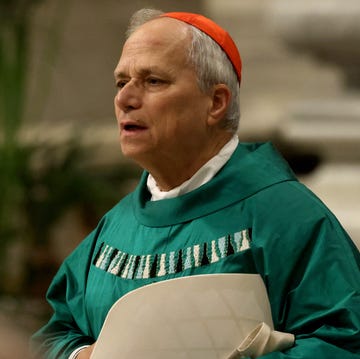
Pope John Paul II was ordained in 1946, became the bishop of Ombi in 1958, and became the archbishop of Krakow in 1964. He was made a cardinal by Pope Paul VI in 1967, and in 1978 became the first non-Italian pope in more than 400 years. He was a vocal advocate for human rights and used his influence to effect political change. He died in Italy in 2005. It was announced in July 2013 that he would be declared a saint in April of the following year.
Early Life
Born Karol Józef Wojtyla on May 18, 1920, in Wadowice, Poland, Pope John Paul II's early life was marked by great loss. His mother died when he was nine years old, and his older brother Edmund died when he was 12.
Growing up, John Paul was athletic and enjoyed skiing and swimming. He went to Krakow's Jagiellonian University in 1938 where he showed an interest in theater and poetry. The school was closed the next year by Nazi troops during the German occupation of Poland. Wanting to become a priest, John Paul began studying at a secret seminary run by the archbishop of Krakow. After World War II ended, he finished his religious studies at a Krakow seminary and was ordained in 1946.
Rise Within the Church
John Paul spent two years in Rome where he finished his doctorate in theology. He returned to his native Poland in 1948 and served in several parishes in and around Krakow. John Paul became the bishop of Ombi in 1958 and then the archbishop of Krakow six years later. Considered one of the Catholic Church's leading thinkers, he participated in the Second Vatican Council—sometimes called Vatican II. The council began reviewing church doctrine in 1962, holding several sessions over the course of the next few years. As a member of the council, John Paul helped the church to examine its position in the world. Well regarded for his contributions to the church, John Paul was made a cardinal in 1967 by Pope Paul VI.
Becoming Pope
In 1978, John Paul made history by becoming the first non-Italian pope in more than four hundred years. As the leader of the Catholic Church, he traveled the world, visiting more than 100 countries to spread his message of faith and peace. But he was close to home when he faced the greatest threat to his life. In 1981, an assassin shot John Paul twice in St. Peter's Square in Vatican City. Fortunately, he was able to recover from his injuries and later forgave his attacker.
Legacy
A vocal advocate for human rights, John Paul often spoke out about suffering in the world. He held strong positions on many topics, including his opposition to capital punishment. A charismatic figure, John Paul used his influence to bring about political change and is credited with the fall of communism in his native Poland. He was not without critics, however. Some have stated that he could be harsh with those who disagreed with him and that he would not compromise his hard-line stance on certain issues, such as contraception.
In his later years, John Paul's health appeared to be failing. At public appearances, he moved slowly and seemed unsteady on his feet. He also visibly trembled at times. One of his doctors also disclosed that John Paul had Parkinson's disease, a brain disorder often characterized by shaking, in 2001. But there was never any official announcement about his illness from the Vatican.
Pope John Paul II died on April 2, 2005, at the age of 84, at his Vatican City residence. More than 3 million people waited in line to say good-bye to their beloved religious leader at St. Peter's Basilica before his funeral on April 8.
On July 5, 2013, waving the usual five-year waiting period, the Vatican announced that the Roman Catholic Church would declare Pope John Paul II a saint and that the canonization ceremony would likely take place within the next 16 months. The Vatican also stated that Pope John XXIII, who headed the Catholic Church from 1958 until his death in 1963 and convened the Vatican II council, would also be declared a saint.
On September 30, 2013, Pope Francis announced that the canonizations of Pope John Paul II and Pope John XXIII would occur on April 27, 2014. The announcement of Pope John Paul II's canonization came after the Vatican revealed that two miracles were attributed to the late pope. After a dying French nun, Sister Marie Simon-Pierre Normand, prayed to Pope John Paul II for during her battle with Parkinson's disease—the same illness that killed the pope—she was cured. The second miracle involved a 50-year-old woman, who claimed that she was cured of a brain aneurysm after a photograph of Pope John Paul II spoke to her.
The official sainthood ceremony, held on April 27, 2014, brought together four popes. Pope Francis led the event to elevate Pope John Paul II and Pope John XXIII to sainthood, which was also attended by Francis's predecessor Emeritus Pope Benedict.
QUICK FACTS
- Name: Paul
- Birth Year: 1920
- Birth date: May 18, 1920
- Birth City: Wadowice
- Birth Country: Poland
- Gender: Male
- Best Known For: Pope John Paul II made history in 1978 by becoming the first non-Italian pope in more than 400 years.
- Industries
- Christianity
- Astrological Sign: Taurus
- Schools
- Krakow seminary
- Jagiellonian University
- Nacionalities
- Polish
- Interesting Facts
- Pope John Paul II was the first non-Italian pope in more than 400 years.
- Death Year: 2005
- Death date: April 2, 2005
- Death City: Vatican City
- Death Country: Italy
Fact Check
We strive for accuracy and fairness.If you see something that doesn't look right,contact us!
CITATION INFORMATION
- Article Title: John Paul II Biography
- Author: Biography.com Editors
- Website Name: The Biography.com website
- Url: https://www.biography.com/religious-figure/john-paul-ii
- Access Date:
- Publisher: A&E Television Networks
- Last Updated: April 9, 2021
- Original Published Date: April 2, 2014
QUOTES
- As the family goes, so goes the nation, and so goes the whole world in which we live.
- The great danger for family life, in the midst of any society whose idols are pleasure, comfort and independence, lies in the fact that people close their hearts and become selfish.
- Never again war! Never again hatred and intolerance! This is the lesson taught by this century and this millennium which are now drawing to a close.
- When the light fades or vanishes altogether, we no longer see things as they really are.
- People are made for happiness.
- True joy is a victory, something which cannot be obtained without a long and difficult struggle.
- The world you are inheriting is a world which desperately needs a new sense of brotherhood and human solidarity.
- Even a tiny flame lifts the heavy lid of night.
- Although I have lived through much darkness, under harsh totalitarian regimes, I have seen enough evidence to be unshakably convinced that no difficulty, no fear is so great that it can completely suffocate the hope that springs eternal in the hearts of the young.
- Man cannot live without love. He remains a being that is incomprehensible for himself, his life is senseless, if love is not revealed to him, if he does not encounter love, if he does not experience it and make it his own, if he does not participate intimately in it.