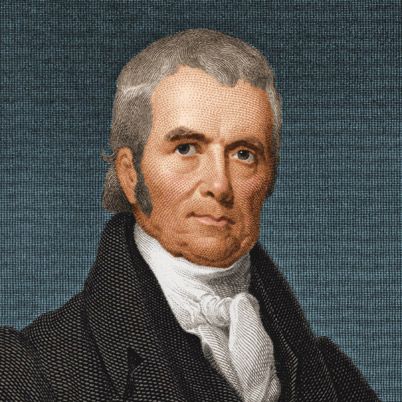
(1755-1835)
Who Was John Marshall?
In 1780, John Marshall started his own law practice, defending clients against pre-war British creditors. From 1782 to 1795, he held various political offices, including the position of secretary of state in 1800. In 1801, he became chief justice of the U.S. Supreme Court, serving until his death, on July 6, 1835, in Philadelphia, Pennsylvania.
Early Life
Marshall was born on September 24, 1755, in rural Fauquier County, near Germantown on the Virginia frontier. He was the first of 15 children born to Thomas Marshall and Mary Randolph Keith. His father was a land surveyor for Lord Fairfax, and made a tidy income; his cousin was Humphrey Marshall, who would later become a U.S. senator for Kentucky. Marshall and his father were descendants of colonist William Randolph, who had helped establish the Commonwealth of Virginia.
As a child, Marshall was mainly home-schooled by his father. He did, however, spend one year at Campbell Academy (founded by Reverend Archibald Campbell) in Westmoreland County, with future U.S. President James Monroe as his classmate.
Serving in the Revolutionary War
A major influence on Marshall during his teen years was General George Washington, a friend of Marshall's father. Marshall admired Washington; when the American Revolutionary War broke out, Washington inspired Marshall, then 20 years old, to join the military so that he could take part in forming the new nation. Marshall was appointed lieutenant with a state militia called the Culpeper Minuteman, which was later absorbed by the Continental Army's 11th Regiment of Virginia. The Patriot militia achieved victory against the British Royal Army at the Battle of Great Bridge, freeing Virginia from British rule.
Following the militia's victory, Marshall became an officer with the Continental Army's 3rd Regiment of Virginia, serving under Colonel Morgan. Marshall proved his bravery and fortitude during the Battle of Brandywine, where he fought relentlessly from dawn to dusk. At the Battle of Germantown, he was wounded in the hand while leading a charge. At Valley Forge, George Washington appointed Marshall his chief legal officer.
In 1780, while stationed at Oak Hill, Marshall took leave on furlough, and went to visit his father who was stationed in Yorktown. In Yorktown, Marshall met his future wife, Mary Willis Ambler, daughter of the Virginia treasurer. Marshall left the military in 1780 to study law.
Law Practice
In 1780, Marshall studied law by attending a series of Judge George Wythe's lectures at the College of William & Mary in Williamsburg, Virginia — the only formal legal education that Marshall would receive — and soon obtained a firm grasp on English common law. That same year, he was admitted to the Virginia bar and began his own legal practice. He built his law practice's success by defending clients against British creditors who attempted to collect debts incurred during British colonial rule, prior to the American Revolution.
Government Roles
Marshall began his career in government by representing Fauquier County in the General Assembly for a single term. In 1782, he joined the Virginia House of Delegates, representing Henrico County. He would return to the position in 1787, and again in 1795.
Marshall ran for city council in 1785, but came in second and was made city recorder instead. One of his duties as city recorder was to act as magistrate on the Richmond Hustings Court, where he presided over small criminal and civil court cases. Through this position, Marshall established a reputation for being a fair and modest man who communicated clearly and based his decisions on the common good.
In 1788, Marshall became a delegate to the state convention that had been formed to ratify the United States' Constitution. He was a powerful advocate for replacing the Articles of Confederation with the Constitution.
In 1798, Marshall was invited to join the U.S. Supreme Court. Still thriving and content with his private practice at the time, however, he turned down the position, but agreed to participate in a 1797 diplomatic mission that was dubbed the "XYZ Affair." Serving as one of three envoys to France, Marshall was sent there to help improve relations between the United States and France (the commission's main goal was to stop French attacks on American ships). In France, Marshall's commission was turned away by French officials, who demanded they be bribed. Marshall staunchly refused. Following his refusal, he became known and liked for the slogan, "Millions for defense, but not one cent for tribute," though the line had actually been uttered by Marshall's fellow convoy, Charles Cotesworth Pinckney.
In 1799, Marshall was elected to a seat in the U.S. House of Representatives, a position he would hold only briefly, as he was appointed secretary of state under President John Adams in 1800. (Marshall had previously received many job offers under Washington's and Adams's administrations, but, until 1800, had always declined the opportunities.)
Later in life, from 1829 to 1830, Marshall also served as a delegate to the Virginia Constitutional Convention, along with his former Campbell classmate, Monroe.
'Marbury v. Madison'
One of Marshall's first landmark cases was Marbury v. Madison, which established the basis of judicial review. The case went to the Supreme Court in 1803, following a hostile history: Toward the end of John Adams' term (while Marshall was serving as secretary of state), Adams had made William Marbury justice of the peace for the District of Columbia. Instead of handing over the commission to Marbury himself, Marshall left the document for his successor as secretary of state, James Madison, to deliver. However, once Thomas Jefferson, Adams'spolitical adversary, took office as president, Jefferson forbade Madison to deliver the commission because it had been drawn up by Adams' supporters. Marbury responded by filing a lawsuit, requesting that the Supreme Court issue a court order forcing Madison to give the commission to Marbury.
Marshall ruled that the Supreme Court lacked the power to make Madison hand over the commission, although he thought that Marbury had the right to have it. In the process, Marshall determined that Section 13 of the Judiciary Act of 1789 — authorizing the Supreme Court to issue writs to government officials — was unconstitutional. Additionally, he concluded that all laws conflicting with the Constitution should be from then on rendered "null and void." In so doing, Marshall instituted the process of judicial review and, subsequently, positioned the judicial branch as equal to its partners in the American government: the legislative and executive branches.
In 1807, Marshall was involved in another high-profile case when President Jefferson charged Vice President Aaron Burr with treason. To Jefferson's chagrin, Marshall ruled that the prosecution lacked sufficient evidence to prove treason, and charged Burr with a high misdemeanor instead. Marshall set Burr's bail at $10,000. The high misdemeanor case was later sent to a jury, who, based on new evidence, found Burr not guilty.
'McCulloch v. Maryland'
McCulloch v. Maryland, in 1819, was another of Marshall's notable cases. State banks resented the competition of a new national bank that President Madison had opened in 1816. The State of Maryland imposed a tax on the national bank, which the bank refused to pay. Maryland claimed that nothing in the Constitution gave the federal government the right to open a national bank. However, Marshall ruled in the bank's favor, stating that although the Constitution did not explicitly grant the federal government the right to open the bank, the Necessary and Proper Clause of the Constitution did. The bank was spared, and Maryland was not permitted to charge a tax.
'Cohens v. Virginia'
In 1821, Marshall presided over Cohens v. Virginia, in which the Cohen brothers, who sold Washington, D.C. lottery tickets in Virginia, appealed their conviction of having violated Virginia law. The Cohens argued that starting a lottery was a right under federal law; the Virginia state court ruled that when a decision came down to state versus federal law, state law overruled. Marshall supported Virginia's conviction, permitting the state to fine the Cohens. He ultimately decided that the Supreme Court was entitled to review state cases, and that it was the Supreme Court's responsibility to handle all cases posing questions about the Constitution. Considered a historically pivotal case, Cohens v. Virginia helped establish parameters for conflicting local and state laws.
Death and Legacy
Marshall proudly served on the Supreme Court until his death, on July 6, 1835, at age 79, in Philadelphia, Pennsylvania. The Liberty Bell was rung during his funeral procession. Legend says that this was when the bell cracked, never to be rung again, although newspapers never reported the event and it has never been verified. Marshall was buried at the Shockoe Cemetery in Richmond, Virginia, next to his wife, Mary Willis Ambler. The nation mourned his passing.
Over the course of his 34-year term as chief justice, Marshall delivered more than 1,000 decisions and penned more than 500 opinions. He played a pivotal role in determining the Supreme Court's role in federal government, establishing it as the ultimate authority in interpreting the Constitution.
QUICK FACTS
- Name: John Marshall
- Birth Year: 1755
- Birth date: September 24, 1755
- Birth State: Virginia
- Birth City: Fauquier County (near Germantown)
- Birth Country: United States
- Gender: Male
- Best Known For: John Marshall became the fourth chief justice of the U.S. Supreme Court in 1801. He is largely responsible for establishing the Supreme Court's role in federal government.
- Industries
- U.S. Politics
- Law
- Astrological Sign: Libra
- Schools
- College of William & Mary
- Campbell Academy
- Death Year: 1835
- Death date: July 6, 1835
- Death State: Pennsylvania
- Death City: Philadelphia
- Death Country: United States
Fact Check
We strive for accuracy and fairness.If you see something that doesn't look right,contact us!
CITATION INFORMATION
- Article Title: John Marshall Biography
- Author: Biography.com Editors
- Website Name: The Biography.com website
- Url: https://www.biography.com/legal-figures/john-marshall
- Access Date:
- Publisher: A&E; Television Networks
- Last Updated: July 27, 2020
- Original Published Date: April 2, 2014
QUOTES
- Congress has a right to punish murder in a fort, or other place within its exclusive jurisdiction; but no general right to punish murder committed within any of the States.
- There, Story; that is the law of this case; now go and find the authorities.