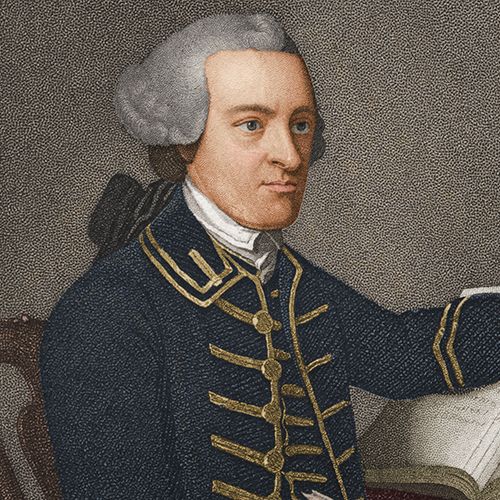
(1737-1793)
Who Was John Hancock?
Born on January 23, 1737, in Braintree (present day city of Quincy) Massachusetts, John Hancock inherited a thriving trading business in Boston and would, with Samuel Adams, become a major figure in colonial agitation against British rule. He was the first to sign the Declaration of Independence and would later be elected the first governor of Massachusetts. He also faced accusations of financial mismanagement.
Early Life
Hancock was born on January 23, 1737, in Braintree (present day city of Quincy), Massachusetts, to Mary Hawke and the senior John Hancock, who was a clergyman. The elder Hancock died when John was a child, and his mother took him and his siblings to live with in-laws in Lexington. She later sent John to live with Lydia and Thomas Hancock, his aunt and uncle. The couple had no children and hence adopted the boy.
Thomas was a wealthy merchant who owned a highly successful shipping business. John went on to attend Harvard College, his father's alma mater, graduating in 1754 and subsequently working with his uncle. In 1759, John ventured to London and lived there for a spell, returning to the colonies in 1761. His uncle's health was failing and upon Thomas's death in 1764, John inherited the family business and estate.
Unrest in the Colonies
Hancock — who reputedly maintained a lavish lifestyle and often faced staunch criticism for his exorbitance — would become a major figure in the American Revolution. In the mid-1760s, he won two consecutive political positions, first managing affairs on a local level in Boston and then moving to the colonial legislature. He entered politics at a time when American colonialists were becoming increasingly agitated by British parliamentary tax regulations and restrictions, with Hancock becoming inextricably involved due to his importing-exporting affairs.
Protesting financial regulations like the Stamp Act and Townshend duties, Hancock commandeered public acts of protest. To avoid British taxation, Hancock had also allegedly taken to smuggling goods aboard his vessels. In 1768, Hancock's ship the Liberty was taken ahold of by British authorities who stated the merchant hadn't paid the required fees on his imports. Hancock was given a huge fine and taken to court. These actions in turn prompted mob violence on Boston streets and eventually led to British authorities sending in military forces.
In 1770, after the Boston Massacre, where British troops fired into a crowd with no matching weaponry, Hancock chaired the committee that demanded the removal of British forces. After a period of improved transatlantic relations, Boston became a volatile site once again with the Tea Act of 1773, with Hancock helping to organize protests. He, along with fellow New England agitator and legislator Samuel Adams, was increasingly seen as a major rabble rouser by the British government.
Signs Declaration of Independence
In 1774, Hancock was made leader of the Massachusetts delegate to the second Continental Congress, which would convene the following year in Philadelphia. Yet Hancock and Adams were hunted by British general Thomas Gage. The two were warned by Paul Revere during his famous April 18, 1775 night ride shouting out that British forces were on their way. Hancock and Adams fled Lexington, where they were staying, and eventually made their way to Philadelphia.
The Congress met in May 1775. George Washington was appointed leader of the Continental Army while Hancock was appointed congress president. Hancock would give the coming American war effort financial support while his presidential role was more of a figurehead position, with congressional decisions generally achieved through committee. In August of the same year, he wed Dorothy Quincy, who came from a merchant family as well. Hancock’s business fortune by this time had significantly dwindled.
Hancock became the first representative to sign the Declaration of Independence on July 4, 1776, a document which maintained that the thirteen American states were free of British rule. Hancock left a sizable signature with flourish; the idea of leaving one's "John Hancock" on paperwork has meaning to this day.
Becomes Massachusetts Governor
Hancock resigned as president of the Continental Congress in 1777, citing health issues, though he remained a member. During the same year, he also faced accusations from Harvard for mismanagement of institutional funds, as he had been serving as treasurer since 1773; Hancock was made to issue a significant repayment. Then in 1778, working with the French navy, he would lead an unsuccessful military campaign to recapture Newport, Rhode Island from the British.
In 1780, Hancock won the election to become the first governor of Massachusetts. He held office until 1785 when he resigned, citing poor health once again. Yet his resignation also coincided with the forthcoming Shay’s Rebellion, an uprising from debt-burdened citizens of the state who were protesting high government taxation and state regulations. Hancock was believed to have mishandled the Massachusetts economy, yet he was re-elected to the governorship in 1787.
The following year Hancock also won the presidency of his state’s convention, whose purpose was to ratify the U.S. Constitution. Hancock ultimately pushed for constitutional approval despite some initial reservations, and also presented amendments endorsed by the Federalist Party. Hancock’s name was in the candidate pool during the first U.S. presidential election, though he won a small share of electoral votes.
Death
Hancock died on October 8, 1793, while serving as governor. He was buried in Boston, Massachusetts.
QUICK FACTS
- Name: John Hancock
- Birth Year: 1737
- Birth date: January 23, 1737
- Birth State: Massachusetts
- Birth City: Quincy
- Birth Country: United States
- Gender: Male
- Best Known For: John Hancock was an 18th century U.S. merchant who was president of the Continental Congress and the first person to sign the Declaration of Independence.
- Industries
- U.S. Politics
- Astrological Sign: Aquarius
- Schools
- Harvard University
- Death Year: 1793
- Death date: October 8, 1793
- Death State: Massachusetts
- Death City: Quincy
- Death Country: United States
Fact Check
We strive for accuracy and fairness.If you see something that doesn't look right,contact us!
CITATION INFORMATION
- Article Title: John Hancock Biography
- Author: Biography.com Editors
- Website Name: The Biography.com website
- Url: https://www.biography.com/political-figure/john-hancock
- Access Date:
- Publisher: A&E; Television Networks
- Last Updated: April 9, 2021
- Original Published Date: April 2, 2014


