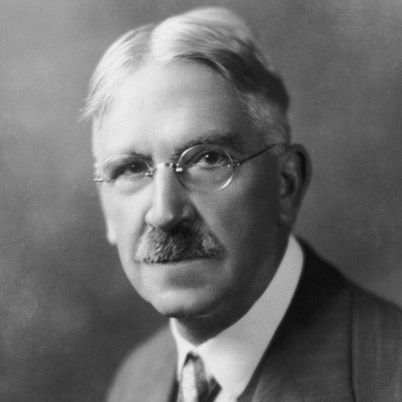
(1859-1952)
Who Was John Dewey?
John Dewey taught at universities from 1884 to 1930. An academic philosopher and proponent of educational reform, in 1894 Dewey started an experimental elementary school. In 1919 he co-founded The New School for Social Research. Dewey published over 1,000 pieces of writings during his lifetime.
Early Life
Dewey was born on October 20, 1859, to Archibald Dewey and Lucina Artemisia Rich in Burlington, Vermont. He was the third of the couple’s four sons, one of whom died as an infant. Dewey’s mother, the daughter of a wealthy farmer, was a devout Calvinist. His father, a merchant, left his grocery business to become a Union Army soldier in the Civil War. Dewey’s father was known to share his passion for British literature with his offspring. After the war, Archibald became the proprietor of a successful tobacco shop, affording the family a comfortable life and financial stability.
Growing up, Dewey attended Burlington public schools, excelling as a student. When he was just 15 years old, he enrolled at the University of Vermont, where he particularly enjoyed studying philosophy under the tutelage of H.A.P. Torrey. Four years later, Dewey graduated from the University of Vermont second in his class.
Teaching Career
The autumn after Dewey graduated, his cousin landed him a teaching job at a seminary in Oil City, Pennsylvania. Two years later, Dewey lost the position when his cousin resigned as principal of the seminary.
After being laid off, Dewey went back to Vermont and started teaching at a private school in Vermont. During his free time, he read philosophical treatises and discussed them with his former teacher, Torrey. As his fascination with the topic grew, Dewey decided to take a break from teaching in order to study philosophy and psychology at Johns Hopkins. George Sylvester Morris and G. Stanley Hall were among the teachers there who influenced Dewey most.
Upon receiving his doctorate from Johns Hopkins in 1884, Dewey was hired as an assistant professor at the University of Michigan. At Michigan he met Harriet Alice Chipman, and the two married in 1886. Over the course of their marriage, they would give birth to six children and adopt one child.
In 1888 Dewey and his family left Michigan for the University of Minnesota, where he was a professor of philosophy. However, within a year, they chose to return to the University of Michigan, where Dewey taught for the next five years.
By 1894 Dewey was made head of the philosophy department at the University of Chicago. He remained at the University of Chicago until 1904, also serving as director of its School of Education for two years.
Dewey left Chicago in 1904 to join the Ivy League, becoming a professor of philosophy at Columbia University while working at Teachers College on the side.
In 1930, Dewey left Columbia and retired from his teaching career with the title of professor emeritus. His wife, Harriet, had died three years earlier.
Philosophy
Dewey’s philosophical treatises were at first inspired by his reading of philosopher and psychologist William James’ writing. Dewey’s philosophy, known as experimentalism, or instrumentalism, largely centered on human experience. Rejecting the more rigid ideas of Transcendentalism to which Dewey had been exposed in academia, it viewed ideas as tools for experimenting, with the goal of improving the human experience.
Dewey’s philosophy also claimed than man behaved out of habit and that change often led to unexpected outcomes. As man struggled to understand the results of change, he was forced to think creatively in order to resume control of his shifting environment. For Dewey, thought was the means through which man came to understand and connect with the world around him. A universal education was the key to teaching people how to abandon their habits and think creatively.
Education Reform
Dewey was a strong proponent for progressive educational reform. He believed that education should be based on the principle of learning through doing.
In 1894 Dewey and his wife Harriet started their own experimental primary school, the University Elementary School, at the University of Chicago. His goal was to test his educational theories, but Dewey resigned when the university president fired Harriet.
In 1919, Dewey, along with his colleagues Charles Beard, Thorstein Veblen, James Harvey Robinson and Wesley Clair Mitchell, founded The New School for Social Research. The New School is a progressive, experimental school that emphasizes the free exchange of intellectual ideas in the arts and social sciences.
During the 1920s, Dewey lectured on educational reform at schools all over the world. He was particularly impressed by experiments in the Russian educational system and shared what he learned with his colleagues when he returned to the States: that education should focus mainly on students’ interactions with the present. Dewey did not, however, dismiss the value of also learning about the past.
In the 1930s, after he retired from teaching, Dewey became an active member of numerous educational organizations, including the New York Teachers Guild and the International League for Academic Freedom.
Writing
Dewey wrote his first two books, Psychology (1887) and Leibniz’s New Essays Concerning the Human Understanding (1888), when he was working at the University of Michigan. Over the course of his lifetime, Dewey published more than 1,000 works, including essays, articles and books. His writing covered a broad range of topics: psychology, philosophy, educational theory, culture, religion and politics. Through his articles in The New Republic, he established himself as one of the most highly regarded social commentators of his day. Dewey continued to write prolifically up until his death.
Politics
While Dewey thought that a democracy was the best type of government, he believed that America’s democracy was strained in the wake of the Industrial Revolution. Industrialization, he believed, had quickly created great wealth for only a few people, rather than benefiting society as a whole. Viewing the major political parties as servants of big business, Dewey became president of the People’s Lobby, an organization that often lobbied their own candidates—in lieu of affiliating themselves with big business — in accordance with everyday people’s social interests. In 1946, Dewey even attempted to help labor leaders establish a new political party, the People’s Party, for the 1948 presidential elections.
Later Life and Death
In 1946, Dewey, then 87, remarried to a widow named Roberta Grant. Following their marriage, the Deweys lived off of Roberta’s inheritance and Dewey’s book royalties. On June 1, 1952, Dewey, a lifelong supporter of educational reform and defender of rights for everyman, died of pneumonia at the age of 92 in the couple’s New York City apartment.
QUICK FACTS
- Name: John Dewey
- Birth Year: 1859
- Birth date: October 20, 1859
- Birth State: Vermont
- Birth City: Burlington
- Birth Country: United States
- Gender: Male
- Best Known For: Educator John Dewey originated the experimentalism philosophy. A proponent of social change and education reform, he founded The New School for Social Research.
- Industries
- Journalism and Nonfiction
- Education and Academia
- Astrological Sign: Libra
- Schools
- Johns Hopkins University
- University of Vermont
- Death Year: 1952
- Death date: June 1, 1952
- Death State: New York
- Death City: New York
- Death Country: United States
Fact Check
We strive for accuracy and fairness. If you see something that doesn't look right, contact us!
QUOTES
- If I were asked to name the most needed of all reforms in the spirit of education I should say: 'Cease conceiving of education as mere preparation for later life, and make of it the full meaning of the present life.'