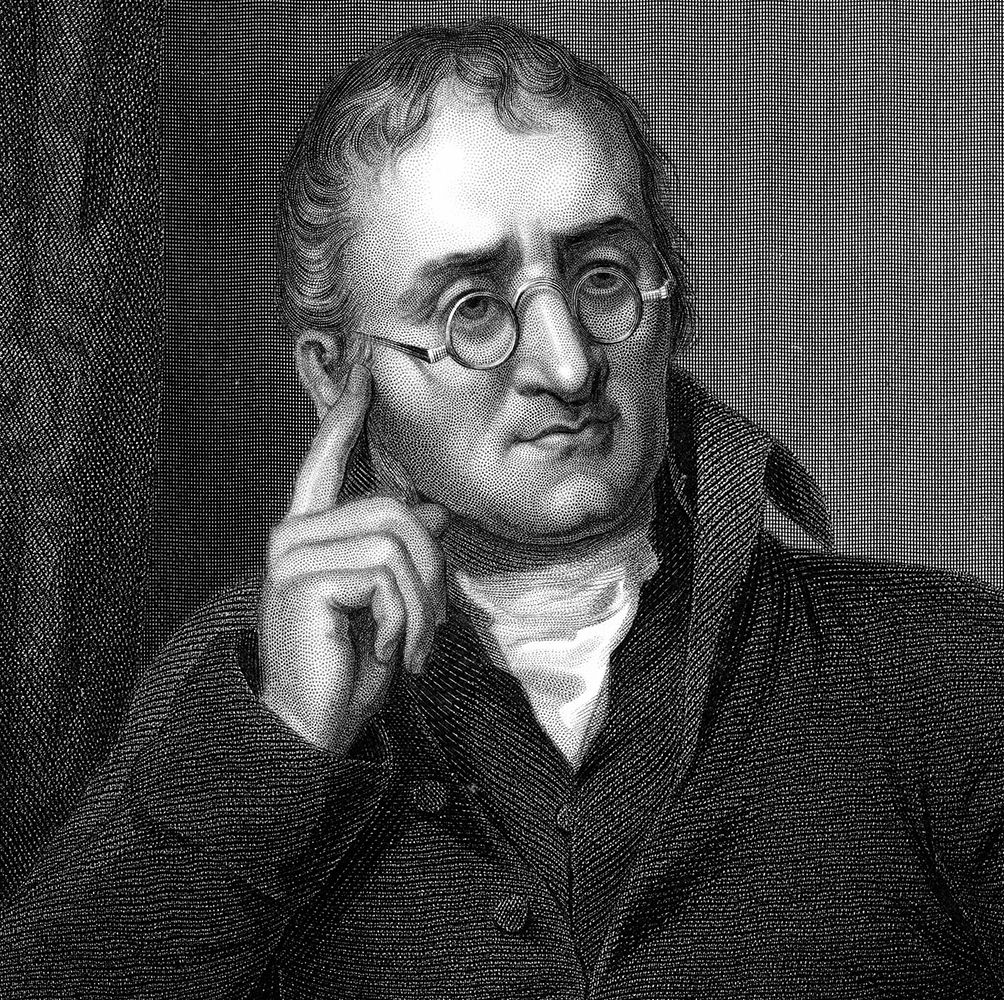
(1766-1844)
Who Was John Dalton?
During John Dalton's early career, he identified the hereditary nature of red-green color blindness. In 1803 he revealed the concept of Dalton’s Law of Partial Pressures. Also in the 1800s, he was the first scientist to explain the behavior of atoms in terms of the measurement of weight.
Early Life and Career
Dalton was born in Eaglesfield, England, on September 6, 1766, to a Quaker family. He had two surviving siblings. Both he and his brother were born color-blind. Dalton's father earned a modest income as a handloom weaver. As a child, Dalton longed for formal education, but his family was very poor. It was clear that he would need to help out with the family finances from a young age.
After attending a Quaker school in his village in Cumberland, when Dalton was just 12 years old he started teaching there. When he was 14, he spent a year working as a farmhand but decided to return to teaching — this time as an assistant at a Quaker boarding school in Kendal. Within four years, the shy young man was made principal of the school. He remained there until 1793, at which time he became a math and philosophy tutor at the New College in Manchester.
While at New College, Dalton joined the Manchester Literary and Philosophical Society. Membership granted Dalton access to laboratory facilities. For one of his first research projects, Dalton pursued his avid interest in meteorology. He started keeping daily logs of the weather, paying special attention to details such as wind velocity and barometric pressure—a habit Dalton would continue all of his life. His research findings on atmospheric pressure were published in his first book, Meteorological Findings, the year he arrived in Manchester.
During his early career as a scientist, Dalton also researched color blindness—a topic with which he was familiar through firsthand experience. Since the condition had affected both him and his brother since birth, Dalton theorized that it must be hereditary. He proved his theory to be true when genetic analysis of his own eye tissue revealed that he was missing the photoreceptor for perceiving the color green. As a result of his contributions to the understanding of red-green color blindness, the condition is still often referred to as "Daltonism."
Dalton's Law
Dalton's interest in atmospheric pressures eventually led him to a closer examination of gases. While studying the nature and chemical makeup of air in the early 1800s, Dalton learned that it was not a chemical solvent, as other scientists had believed. Instead, it was a mechanical system composed of small individual particles that used pressure applied by each gas independently.
Dalton's experiments on gases led to his discovery that the total pressure of a mixture of gases amounted to the sum of the partial pressures that each individual gas exerted while occupying the same space. In 1803 this scientific principle officially came to be known as Dalton's Law of Partial Pressures. Dalton's Law primarily applies to ideal gases rather than real gases, due to the elasticity and low particle volume of molecules in ideal gases. Chemist Humphry Davy was skeptical about Dalton's Law until Dalton explained that the repelling forces previously believed to create pressure only acted between atoms of the same sort and that the atoms within a mixture varied in weight and complexity.
The principle of Dalton's Law can be demonstrated using a simple experiment involving a glass bottle and large bowl of water. When the bottle is submerged under water, the water it contains is displaced, but the bottle isn't empty; it's filled with the invisible gas hydrogen instead. The amount of pressure exerted by the hydrogen can be identified using a chart that lists the pressure of water vapors at different temperatures, also thanks to Dalton's discoveries. This knowledge has many useful practical applications today. For instance, scuba divers use Dalton's principles to gauge how pressure levels at different depths of the ocean will affect the air and nitrogen in their tanks.
During the early 1800s, Dalton also postulated a law of thermal expansion that illustrated the heating and cooling reaction of gases to expansion and compression. He garnered international fame for his additional study using a crudely fashioned dew point hygrometer to determine how temperature impacts the level of atmospheric water vapor.
Atomic Theory
Dalton's fascination with gases gradually led him to formally assert that every form of matter (whether solid, liquid or gas) was also made up of small individual particles. He referred to the Greek philosopher Democritus of Abdera's more abstract theory of matter, which had centuries ago fallen out of fashion, and borrowed the term "atomos" or "atoms" to label the particles. In an article he wrote for the Manchester Literary and Philosophical Society in 1803, Dalton created the first chart of atomic weights.
Seeking to expand on his theory, he readdressed the subject of atomic weight in his book A New System of Chemical Philosophy, published in 1808. In A New System of Chemical Philosophy, Dalton introduced his belief that atoms of different elements could be universally distinguished based on their varying atomic weights. In so doing, he became the first scientist to explain the behavior of atoms in terms of the measurement of weight. He also uncovered the fact that atoms couldn't be created or destroyed.
Dalton's theory additionally examined the compositions of compounds, explaining that the tiny particles (atoms) in a compound were compound atoms. Twenty years later, chemist Amedeo Avogadro would further detail the difference between atoms and compound atoms.
In A New System of Chemical Philosophy, Dalton also wrote about his experiments proving that atoms consistently combine in simple ratios. What that meant was that the molecules of an element are always made up of the same proportions, with the exception of water molecules.
In 1810 Dalton published an appendix to A New System of Chemical Philosophy. In it he elaborated on some of the practical details of his theory: that the atoms within a given element are all exactly the same size and weight, while the atoms of different elements look—and are—different from one other. Dalton eventually composed a table listing the atomic weights of all known elements.
His atomic theories were quickly adopted by the scientific community at large with few objections. "Dalton made atoms scientifically useful," asserted Rajkumari Williamson Jones, a science historian at the University of Manchester Institute of Science and Technology. Nobel Laureate Professor Sir Harry Kroto, noted for co-discovering spherical carbon fullerenes, identified the revolutionary impact of Dalton's discoveries on the field of chemistry: "The crucial step was to write down elements in terms of their atoms...I don't know how they could do chemistry beforehand, it didn't make any sense."
Later Life
From 1817 to the day he died, Dalton served as president of the Manchester Literary and Philosophical Society, the organization that first granted him access to a laboratory. A practitioner of Quaker modesty, he resisted public recognition; in 1822 he turned down elected membership to the Royal Society. In 1832 he did, however, begrudgingly accept an honorary Doctorate of Science degree from the prestigious Oxford University. Ironically, his graduation gown was red, a color he could not see. Fortunately for him, his color blindness was a convenient excuse for him to override the Quaker rule forbidding its subscribers to wear red.
In 1833 the government granted him a pension, which was doubled in 1836. Dalton was offered another degree, this time a Doctorate of Laws, by Edinburgh University in 1834. As if those honors were insufficient tribute to the revolutionary chemist, in London, a statue was erected in Dalton's honor--also in 1834. "Dalton was very much an icon for Manchester," said Rajkumari Williams Jones. "He is probably the only scientist who got a statue in his lifetime."
In his later life, Dalton continued to teach and lecture at universities throughout the United Kingdom, although it is said that the scientist was an awkward lecturer with a gruff and jarring voice. Throughout his lifetime, Dalton managed to maintain his nearly impeccable reputation as a devout Quaker. He lived a humble, uncomplicated life focusing on his fascination with science, and never married.
In 1837 Dalton had a stroke. He had trouble with his speech for the next year.
Death and Legacy
After suffering a second stroke, Dalton died quietly on the evening of July 26, 1844, at his home in Manchester, England. He was provided a civic funeral and granted full honors. A reported 40,000 people attended the procession, honoring his contributions to science, manufacturing and the nation's commerce.
By finding a way to "weigh atoms," John Dalton's research not only changed the face of chemistry but also initiated its progression into a modern science. The splitting of the atom in the 20th century could most likely not have been accomplished without Dalton laying the foundation of knowledge about the atomic makeup of simple and complex molecules. Dalton's discoveries also allowed for the cost-efficient manufacturing of chemical compounds, since they essentially give manufacturers a recipe for determining the correct chemical proportions in a given compound.
The majority of conclusions that made up Dalton's atomic theory still stand today.
"Now with nanotechnology, atoms are the centerpiece," said Nottingham University Professor of Chemistry David Garner. "Atoms are manipulated directly to make new medicines, semiconductors and plastics." He went on to further explain, "He gave us the first understanding of the nature of materials. Now we can design molecules with a pretty good idea of their properties."
In 2003, on the bicentennial of Dalton's public announcement of his atomic theory, the Manchester Museum held a tribute to the man, his life and his groundbreaking scientific discoveries.
QUICK FACTS
- Name: John Dalton
- Birth Year: 1766
- Birth date: September 6, 1766
- Birth City: Eaglesfield
- Birth Country: United Kingdom
- Gender: Male
- Best Known For: Chemist John Dalton is credited with pioneering modern atomic theory. He was also the first to study color blindness.
- Industries
- Journalism and Nonfiction
- Science and Medicine
- Education and Academia
- Astrological Sign: Virgo
- Schools
- John Fletcher's Quaker grammar school
- Death Year: 1844
- Death date: July 26, 1844
- Death City: Manchester
- Death Country: United Kingdom
Fact Check
We strive for accuracy and fairness.If you see something that doesn't look right,contact us!
CITATION INFORMATION
- Article Title: John Dalton Biography
- Author: Biography.com Editors
- Website Name: The Biography.com website
- Url: https://www.biography.com/scientists/john-dalton
- Access Date:
- Publisher: A&E; Television Networks
- Last Updated: May 21, 2021
- Original Published Date: April 2, 2014
QUOTES
- Berzelius' symbols are horrifying. A young student in chemistry might as soon learn Hebrew as make himself acquainted with them.
- We might as well attempt to introduce a new planet into the solar system, or to annihilate one already in existence, as to create or destroy a particle of hydrogen.
- The principal failing in [Sir Humphrey Davy's] character as a philosopher is that he does not smoke.
- I can now enter the lecture room with as little emotion nearly as I can smoke a pipe with you on Sunday or Wednesday evenings.
- Matter, though divisible in an extreme degree, is nevertheless not infinitely divisible. That is, there must be some point beyond which we cannot go in the division of matter... I have chosen the word 'atom' to signify these ultimate particles.
- Will it not be thought remarkable that in 1836 the British chemists are ignorant whether attraction, repulsion or indifference is marked when a mixture of any proportions of azote and oxygen are made.
- In short, [London] is a most surprising place, and worth one's while to see once; but the most disagreeable place on earth for one of a contemplative turn to reside in constantly.
- To ascertain the exact quantity of water in a given quantity of air is, I presume, an object not yet fully attained.
- The cause of rain is now, I consider, no longer an object of doubt.