(1926-1967)
Who Was John Coltrane?
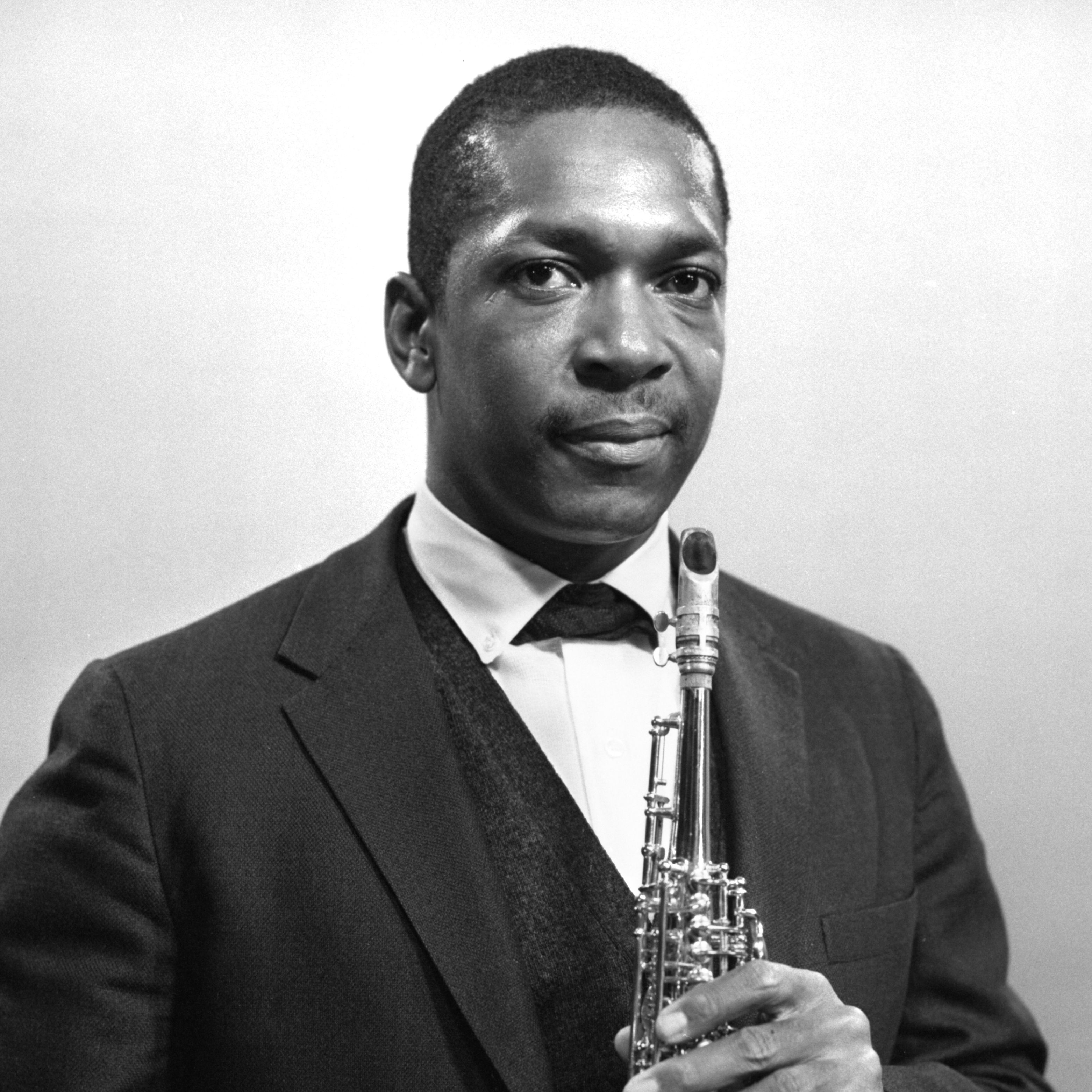
During the 1940s and '50s, John Coltrane developed his craft as a saxophonist and composer, working with famed musicians/bandleaders Dizzy Gillespie, Duke Ellington and Miles Davis. Coltrane turned the jazz world on its head with technically marvelous, innovative playing that was thrillingly dense and fluid in its understanding of the genre; his virtuosity and vision could be heard on the now revered albums Giant Steps, My Favorite Things and A Love Supreme, among others. He died from liver cancer at 40 years old on July 17, 1967, in Huntington, Long Island, New York.
Background and Early Years
A revolutionary and groundbreaking jazz saxophonist, John William Coltrane was born on September 23, 1926, in Hamlet, North Carolina, growing up in nearby High Point. Coltrane was surrounded by music as a child. His father John R. Coltrane worked as a tailor, but had a passion for music, playing several instruments. The younger Coltrane's early influences included jazz legends like Count Basie and Lester Young. By his teens, Coltrane had picked up the alto saxophone and displayed immediate talent. Family life took a tragic turn in 1939 with the passing of Coltrane's father, along with several other relatives. Financial struggles defined this period for Coltrane, and eventually his mother Alice and other family members moved to New Jersey in the hopes of having an improved life. Coltrane remained in North Carolina until he graduated from high school.
In 1943, he too moved north, specifically to Philadelphia, to make a go of it as a musician. For a short time Coltrane studied at the Ornstein School of Music. But with the country in the throes of war, he was called to duty and enlisted in the Navy. During his service, Coltrane was stationed in Hawaii and regularly performed and made his first recording with a quartet of fellow sailors.
Joining Dizzy Gillespie and Duke Ellington
Upon his return to civilian life in the summer of 1946, Coltrane landed back in Philadelphia, where he studied at the Granoff School of Music and proceeded to hook up with a number of jazz bands. One of the earliest was a group led by Eddie "Cleanhead" Vinson, for whom Coltrane switched over to tenor sax. He later joined Jimmy Heath's band, where Coltrane began to fully explore his experimental side. Then in the fall of 1949 he signed on with a big band led by famed trumpeter Gillespie, remaining with the group for the next year and a half. Coltrane had started to earn a name for himself. But during the 1950s, as was the case with other jazz performers, he began to use drugs, mainly heroin. His talent earned him gigs, but his addictions ended them prematurely. In 1954 Ellington brought Coltrane on to temporarily replace Johnny Hodges, but soon fired him because of his drug dependency.
Working With Miles Davis
Coltrane rebounded during the mid-'50s when Davis asked him to join his group, the Miles Davis Quintet. Davis encouraged Coltrane to push his creative boundaries while holding him accountable for his drug habits. With the group working under a new record contract from Columbia Records, the next several years proved fruitful and artistically rewarding with albums such as The New Miles Davis Quintet (1956) and 'Round About Midnight (1957). Coltrane also played on Davis' seminal masterpiece Kind of Blue (1959).
Albums and Songs
From 'Blue Train' to 'Giant Steps'
In 1957, after having previously fired and rehired his bandmate, Davis fired Coltrane again, after he failed to give up heroin. Whether that was the exact impetus for Coltrane finally getting sober isn't certain, but the saxophonist finally kicked his drug habit. He worked with pianist Thelonious Monk for several months while also developing as a bandleader and solo recording artist, heralded by the release of albums like Blue Train (1957) and Soultrane (1958). At the start of a new decade, Coltrane made his debut on Atlantic Records with the groundbreaking Giant Steps (1960), penning all of the material himself.
By this time, Coltrane had nurtured a distinctive sound defined in part by an ability to play several notes at once amid wondrous cascades of scales, dubbed in 1958 by critic Ira Gitler as a "sheets of sound" technique. Coltrane reportedly described it this way: "I start in the middle of a sentence and move both directions at once.”
'My Favorite Things'
In autumn 1960, Coltrane led a group that included pianist McCoy Tyner, bassist Steve Davis and drummer Elvin Jones to create My Favorite Things (1961). With its title track and additional standards "Ev'ry Time We Say Goodbye," "Summertime" and "But Not for Me," the enduring album was also heralded for Coltrane's performance on the soprano sax. The bandleader was catapulted to stardom. Over the next several years Coltrane was lauded — and, to a smaller degree, criticized — for his sound. His albums from this period included Duke Ellington and John Coltrane (1963), Impressions (1963) and Live at Birdland (1964).
'A Love Supreme'
A Love Supreme (1965) is arguably Coltrane's most globally acclaimed record. The succinct, four-suite album, a big seller that went gold decades later (along with My Favorite Things), is noted not only for Coltrane's astounding technical vision but for its nuanced spiritual explorations and ultimate transcendence. The work was nominated for two Grammys and is considered a hallmark album by jazz historians around the world.
Wives
Having been previously married to Juanita "Naima" Grubbs, Coltrane wed pianist and harpist Alice McLeod (or MacLeod, according to some sources) in the mid-1960s. Alice Coltrane would also play in her husband's band and establish her own unique jazz career noted for its Asian stylistic fusions and divine orientation.
Final Years and Death
Coltrane wrote and recorded a considerable amount of material over the final two years of his life in which his work was described as avant-garde, steeped in poignant spirituality for some while spurned by others. In 1966 he recorded the last two albums to be released while he was alive — Kulu Se Mama and Meditations. The album Expression was finalized just days before his death. He died at only 40 years old from liver cancer on July 17, 1967, in Huntington, Long Island, New York, survived by his second wife and four children.
'Both Directions at Once: The Lost Album'
In June 2018, Impulse! Records announced plans to release Both Directions at Once: The Lost Album, a collection of material lost to time until recently found by the family of his first wife.
Recorded over a single day in March 1963 with his "classic quartet" of Jimmy Garrison, Elvin Jones and McCoy Tyner, the album included a studio version of "Impressions," a concert favorite, as well as two original, untitled tracks believed to have been recorded solely for this collection.
Legacy
A voracious reader noted for his gentleness, Coltrane had an immense impact on the music world. He revolutionized jazz with his innovative, demanding techniques while showing a deep reverence for sounds from other locales that included Africa, Latin America, the Far East and South Asia. Having received a 1981 Grammy posthumously for the live recording Bye Bye Blackbird, in 1992 Coltrane was given the Grammy Lifetime Achievement Award as well, with an array of unearthed recordings and reissues released in the years since his death. In 2007, the Pulitzer Prize Board also awarded the musician a special posthumous citation. Coltrane's work continues to be an integral part of the sonic landscape and a major inspiration for newer generations of artists.
QUICK FACTS
- Name: John Coltrane
- Birth Year: 1926
- Birth date: September 23, 1926
- Birth State: North Carolina
- Birth City: Hamlet
- Birth Country: United States
- Gender: Male
- Best Known For: John Coltrane was an acclaimed American saxophonist, bandleader and composer, becoming an iconic figure of jazz in the 20th century with albums like 'Giant Steps,' 'My Favorite Things' and 'A Love Supreme.'
- Industries
- Jazz
- Music
- Astrological Sign: Libra
- Schools
- Ornstein School of Music
- Death Year: 1967
- Death date: July 17, 1967
- Death State: New York
- Death City: Huntington, Long Island
- Death Country: United States
Fact Check
We strive for accuracy and fairness.If you see something that doesn't look right,contact us!
CITATION INFORMATION
- Article Title: John Coltrane Biography
- Author: Biography.com Editors
- Website Name: The Biography.com website
- Url: https://www.biography.com/musicians/john-coltrane
- Access Date:
- Publisher: A&E; Television Networks
- Last Updated: April 27, 2021
- Original Published Date: April 2, 2014
QUOTES
- You can play a shoestring if you're sincere.
- I think that music, being an expression of the human heart, or of the human being itself, does express just what is happening–the whole of human experience at the particular time that it is being expressed.
- In any situation that we find in our lives, when there is something that we feel should be better, we must exert effort to try and make it better. So it's the same socially, musically, politically in any department of our lives. I think music is an instrument. It can create the initial thought patterns that can change the thinking of the people
- I want to be a force for real good. In other words, I know that there are bad forces, forces that bring suffering to others and misery to the world, but I want to be the opposite force. I want to be the force which is truly for good.