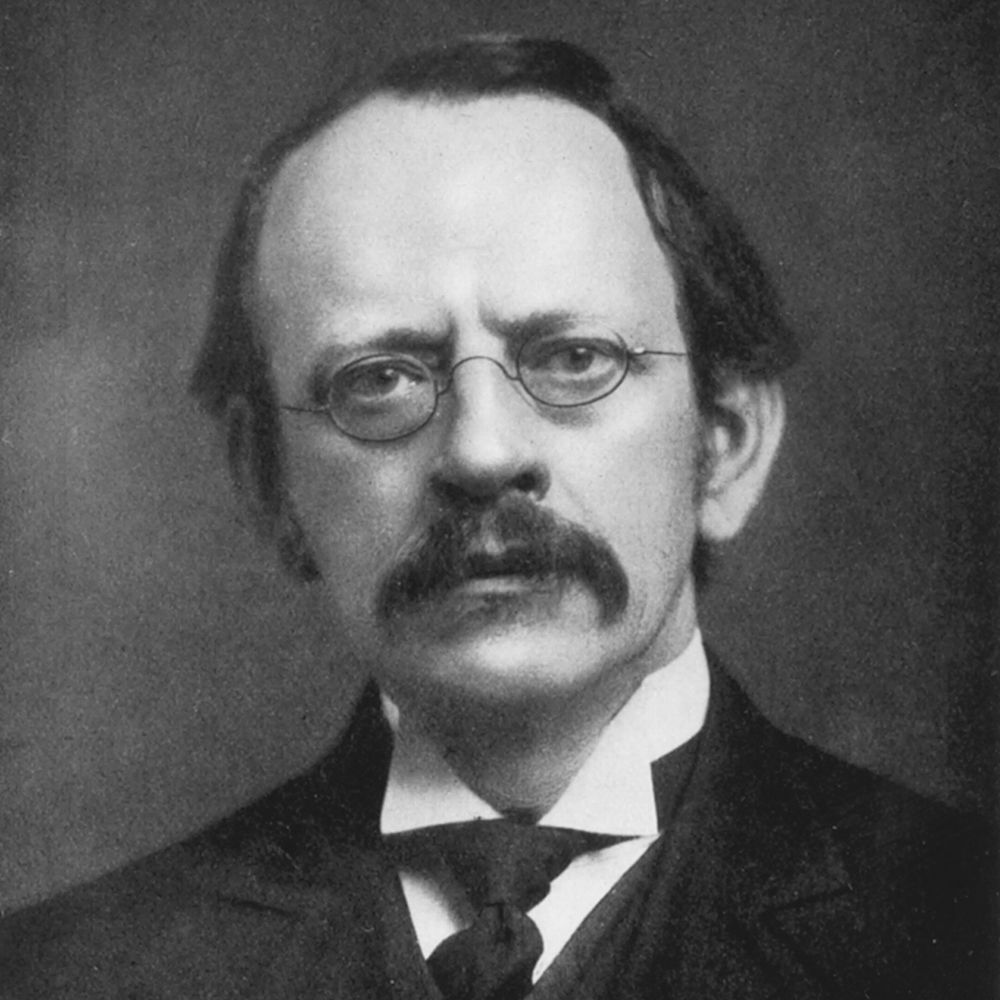
(1856-1940)
Who Was J.J. Thomson?
J.J. Thomson attended Trinity College at Cambridge, where he would come to head the Cavendish Laboratory. His research in cathode rays led to the discovery of the electron, and he pursued further innovations in atomic structure exploration. Thomson won the 1906 Nobel Prize in Physics, among many accolades.
Early Life and Education
Joseph John Thomson, who was always called J.J., was born in Cheetham Hill, England, near Manchester, in 1856. His father was a bookseller who planned for Thomson to be an engineer. When an apprenticeship at an engineering firm couldn't be found, Thomson was sent to bide his time at Owens College at the age of 14. In 1876, he received a small scholarship to attend Trinity College at Cambridge to study mathematics.
Thomson worked in the Cavendish Laboratory after graduation, under the tutelage of Lord Rayleigh. He quickly earned a membership in the prestigious Royal Society and was appointed Rayleigh’s successor as the Cavendish Professor of Physics at the age of 28. He was both respected and well-liked, and students came from around the world to study with him.
Research
In 1894, Thomson began studying cathode rays, which are glowing beams of light that follow an electrical discharge in a high-vacuum tube. It was a popular research topic among physicists at the time because the nature of cathode rays was unclear.
Thomson devised better equipment and methods than had been used before. When he passed the rays through the vacuum, he was able to measure the angle at which they were deflected and calculate the ratio of the electrical charge to the mass of the particles. He discovered that the ratio was the same regardless of what type of gas was used, which led him to conclude that the particles that made up the gases were universal.
Thomson determined that all matter is made up of tiny particles that are much smaller than atoms. He originally called these particles 'corpuscles,' although they are now called electrons. This discovery upended the prevailing theory that the atom was the smallest fundamental unit.
In 1906, Thomson began studying positively charged ions, or positive rays. This led to one of his other famous discoveries in 1912 when he channeled a stream of ionized neon through a magnetic and an electric field and used deflection techniques to measure the charge to mass ratio. In doing so, he discovered that neon was composed of two different kinds of atoms, and proved the existence of isotopes in a stable element. This was the first use of mass spectrometry.
Personal Life and Later Years
Thomson married Rose Paget, one of his students, in 1890. They had one daughter, Joan, and one son, George Paget Thomson, who went on to become a physicist and win a Nobel Prize of his own. J.J. Thomson published 13 books and more than 200 papers in his lifetime. In addition to being awarded the Nobel Prize in 1906, he was knighted in 1908 by King Edward VII. He left research in 1918 to become Master of Trinity College. He died in Cambridge on August 30, 1940, and is buried in Westminster Abbey near two other influential scientists: Isaac Newton and Charles Darwin.
QUICK FACTS
- Name: Joseph John Thomson
- Birth Year: 1856
- Birth date: December 18, 1856
- Birth City: Cheetham Hill, Manchester
- Birth Country: England
- Gender: Male
- Best Known For: J.J. Thomson was a Nobel Prize-winning physicist whose research led to the discovery of electrons.
- Industries
- Education and Academia
- Writing and Publishing
- Science and Medicine
- Astrological Sign: Sagittarius
- Schools
- Owens College
- Trinity College
- Death Year: 1940
- Death date: August 30, 1940
- Death City: Cambridge
- Death Country: England
Fact Check
We strive for accuracy and fairness.If you see something that doesn't look right,contact us!
CITATION INFORMATION
- Article Title: J.J. Thomson Biography
- Author: Biography.com Editors
- Website Name: The Biography.com website
- Url: https://www.biography.com/scientists/jj-thomson
- Access Date:
- Publisher: A&E; Television Networks
- Last Updated: May 26, 2021
- Original Published Date: April 2, 2014
QUOTES
- To the electron: may it never be of any use!