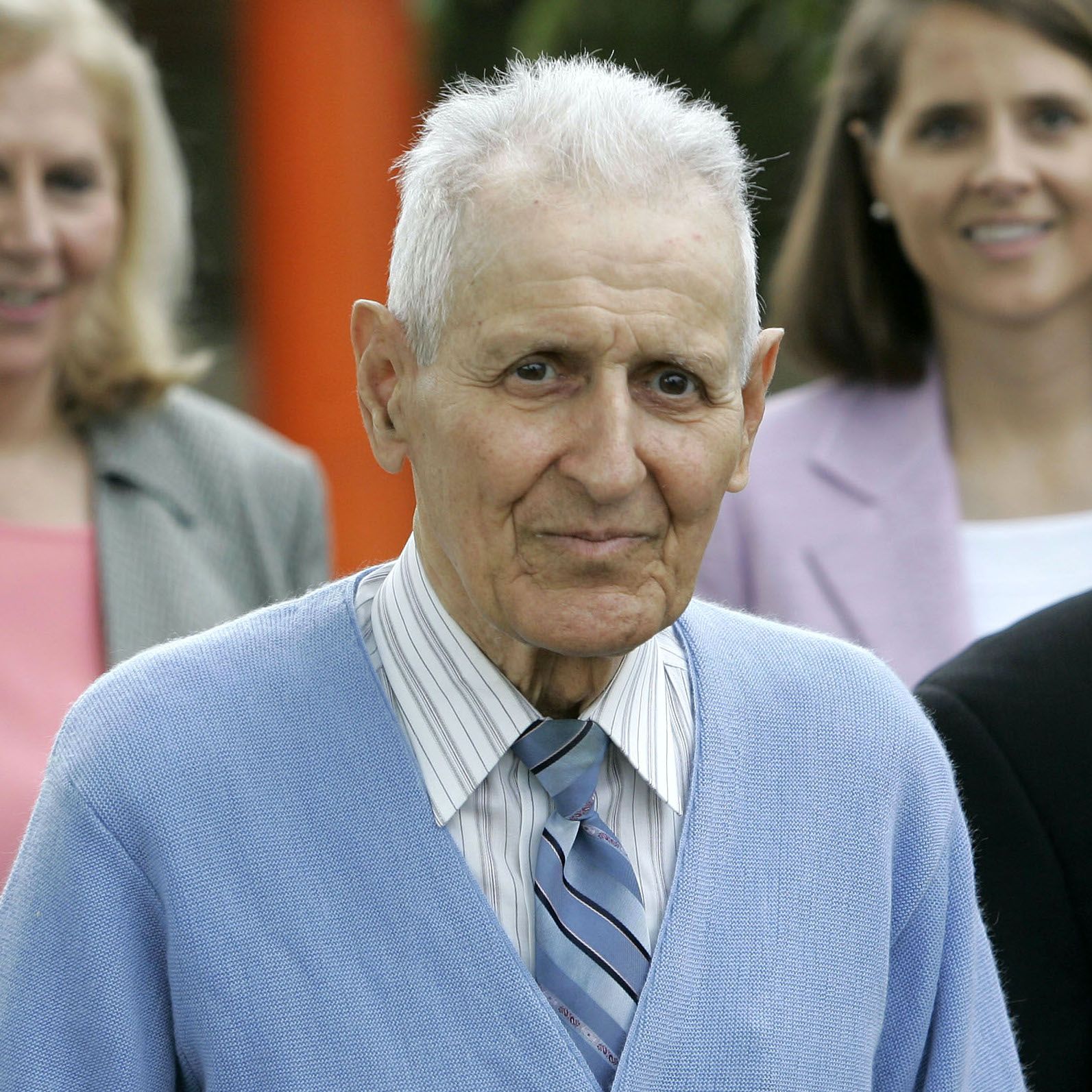
(1928-2011)
Who Was Jack Kevorkian?
Jack Kevorkian was a pathologist who assisted people suffering from acute medical conditions in ending their lives. After years of conflict with the court system over the legality of his actions, he spent eight years in prison after a 1999 conviction. Kevorkian's actions spurred national debate on the ethics of euthanasia and hospice care.
Early Life
Jack Kevorkian was born Murad Kevorkian on May 26, 1928, in Pontiac, Michigan, the second of three children born to Armenian immigrants Levon and Satenig Kevorkian. Kevorkian's parents were refugees who escaped the Armenian Massacres that occurred shortly after World War I. Levon was smuggled out of Turkey by missionaries in 1912 and made his way to Pontiac, Michigan, where he found work at an automobile foundry.
Satenig fled the Armenian death march, finding refuge with relatives in Paris, and eventually reuniting with her brother in Pontiac. Levon and Satenig met through the Armenian community in their city, where they married and began their family. The couple welcomed a daughter, Margaret, in 1926, followed by son Murad -- who later earned the nickname "Jack" by American friends and teachers -- and, finally, third child Flora.
After Levon lost his job at the foundry in the early 1930s, he began making a sizeable living as the owner of his own excavating company -- a difficult feat in Depression-era America. While other families suffered financially, the Kevorkians began living a more comfortable life in a bucolic, multi-cultural suburb in Pontiac. "My parents sacrificed a great deal so that we children would be spared undue privation and misery," Kevorkian later wrote. "There was always enough to eat."
Strict Upbringing
Levon and Satenig were strict and religious parents, who worked hard to make sure their children were obedient Christians. Jack, however, had trouble reconciling what he believed were conflicting religious ideas. His family regularly attended church, and Jack often railed against the idea of miracles and an all-knowing God in his weekly Sunday school class. If there were a God who could make his son walk on water, Kevorkian insisted, he would also have been able to prevent the Turkish slaughter of his entire extended family. Jack debated the idea of God's existence every week until he realized he would not find an acceptable explanation to his questions, and stopped attending church entirely by the age of 12.
The children were also encouraged to perform well in school, and all three demonstrated high academic intelligence -- as the only boy, however, Jack became the focus of Levon and Satenig's high expectations. Jack rose to the occasion easily; even as a young boy, Kevorkian was a voracious reader and academic who loved the arts, including drawing, painting and piano. But along with Jack's academic prowess came a highly critical mind, and he rarely accepted ideas at face value. He engaged in frequent arguments with his teachers at school, sometimes humiliating them when they couldn't keep up with his sharp debate skills.
While his jabs at teachers earned admiration from his classmates, learning came so effortlessly to Jack that it often alienated him from his peers. Kevorkian was promoted to Eastern Junior High School when he was in the sixth grade, and by the time he was in high school he had taught himself German and Japanese. Classmates soon labeled him as an eccentric bookworm, and Kevorkian had trouble making friends as a result. He also gave up the idea of romantic relationships, believing them to be an unnecessary diversion from his studies. In 1945, when Kevorkian was only 17, he graduated with honors from Pontiac High School.
Accepted into the University of Michigan College of Engineering, Kevorkian had aims to become a civil engineer. Halfway through his freshman year, however, he became bored with his studies and began focusing on botany and biology. By midyear, he had set his sights on medical school, often taking 20 credit hours in a semester in order to meet the 90-hour medical school requirement. He graduated in medicine at the University of Michigan in 1952 and began a specialty in pathology soon after. In 1953, however, the Korean War abruptly halted Kevorkian's career. He served 15 months as an Army medical officer in Korea, then finished his service in Colorado.
Early Career
While serving his residency at the University of Michigan hospital in the 1950s, Kevorkian became fascinated by death and the act of dying. He made regular visits to terminally ill patients, photographing their eyes in an attempt to pinpoint the exact moment of death. Kevorkian believed that doctors could use the information to distinguish death from fainting, shock or coma in order to learn when resuscitation was useless. "But really, my number one reason was because it was interesting," Kevorkian told reporters later. "And my second reason was because it was a taboo subject."
Not one to avoid distasteful ideas, Kevorkian again caused a stir with colleagues by proposing that death-row prison inmates be used as the subjects of medical experiments while they were still alive. Inspired by research that described medical experiments the ancient Greeks conducted on Egyptian criminals, Kevorkian formulated the idea that similar modern experiments could not only save valuable research dollars, but also provide a glimpse into the anatomy of the criminal mind. In 1958, he advocated his view in a paper presented to the American Association for the Advancement of Science.
In a method he called "terminal human experimentation", he argued that condemned convicts could provide a service to humanity before their execution by volunteering for "painless" medical experiments that would begin while they were conscious, but would end in fatality. For his unorthodox experiments and strange proposals, Jack Kevorkian's peers gave him the nickname "Dr. Death."
Kevorkian's controversial views earned him minor media attention which ultimately resulted in his ejection from the University of Michigan Medical Center. He continued his internship at Pontiac General Hospital instead, where he began another set of controversial experiments. After hearing about a Russian medical team who was transfusing blood from corpses into living patients, Kevorkian enlisted the help of medical technologist Neal Nicol to simulate these same experiments.
The results were highly successful, and Kevorkian believed the procedure could help save lives on the battlefield -- if blood from a bank was unavailable, doctors might use Kevorkian's research to transfuse the blood of a corpse into an injured soldier. Kevorkian pitched his idea to the Pentagon, figuring it could be used in Vietnam, but the doctor was denied a federal grant to continue his research. Instead, the research fueled his reputation as an outsider, scared his colleagues and eventually infected Kevorkian with Hepatitis C.
Crusade for Assisted Suicide
After qualifying as a specialist in 1960, Kevorkian bounced around the country from hospital to hospital, publishing more than 30 professional journal articles and booklets about his philosophy on death, before setting up his own clinic near Detroit, Michigan. The business ultimately failed, and Kevorkian headed to California to commute between two part-time pathology jobs in Long Beach. These jobs also ended quickly when Kevorkian quit in another dispute with a chief pathologist; Jack claimed that his career was doomed by physicians who feared his radical ideas.
Kevorkian "retired" to devote his time to a film project about Handel's Messiah as well as research for his reinvigorated death-row campaign. By 1970, however, Kevorkian was still jobless and had also lost his fiancee; he broke off the relationship after finding his bride-to-be lacking in self-discipline. By 1982, Kevorkian was living alone, occasionally sleeping in his car, living off of canned food and social security.
In 1985, he returned to Michigan to write a comprehensive history of experiments on executed humans which was published in the obscure Journal of the National Medical Association after more prestigious journals rejected it. In 1986, Kevorkian discovered a way to expand his death row proposal when he learned that doctors in the Netherlands were helping people die by lethal injection. His new crusade for assisted suicide, or euthanasia, became an extension of his campaign for medical experiments on the dying. Kevorkian began writing new articles, this time about the benefits of euthanasia.
He followed up his papers with the creation of a suicide machine he called the "Thanatron" (Greek for "Instrument of Death") which he assembled out of $45 worth of materials. The Thanatron consisted of three bottles that delivered successive doses of fluids: first a saline solution, followed by a painkiller and, finally, a fatal dose of the poison potassium chloride. Using Kevorkian's design, patients who were ill could even administer the lethal dose of poison themselves. After years of rejection from national medical journals and media outlets, Kevorkian would finally become the focus of national attention for his machine and his proposal to set up a franchise of "obitoriums," where doctors could help the terminally ill end their lives.
Making Headlines
But Kevorkian would become infamous in 1990, when he assisted in the suicide of Janet Adkins, a 54-year-old Alzheimer's patient from Michigan. Adkins was a member of the Hemlock Society -- an organization that advocates voluntary euthanasia for terminally ill patients -- before she became ill. After she was diagnosed with Alzheimer's, Adkins began searching for someone to end her life before the degenerative disease took full effect. She had heard through the media about Kevorkian's invention of a "suicide machine," and contacted Kevorkian about using the invention on her.
Kevorkian agreed to assist her in a public park, inside his Volkswagen van. Kevorkian attached the IV, and Adkins administered her own painkiller and then the poison. Within five minutes, Adkins died of heart failure. When the news hit media outlets, Kevorkian became a national celebrity -- and criminal. The State of Michigan immediately charged Kevorkian with Adkins' murder. The case was later dismissed, however, due to Michigan's indecisive stance on assisted suicide.
In early 1991, a Michigan judge issued an injunction barring Kevorkian's use of the suicide machine. That same year, Michigan suspended Jack Kevorkian's medical license, but this didn't stop the doctor from continuing to assist with suicides. Unable to gather the medications needed to use the Thanatron, Kevorkian assembled a new machine, called the Mercitron, which delivered carbon monoxide through a gas mask.
The following year, the Michigan Legislature passed a bill outlawing assisted suicide, designed specifically to stop Kevorkian's assisted suicide campaign. As a result, Kevorkian was jailed twice that year. He was bailed out by lawyer Geoffrey Fieger, who helped Kevorkian escape conviction by successfully arguing that a person may not be found guilty of criminally assisting a suicide if they administered medication with the "intent to relieve pain and suffering," even it if did increase the risk of death.
Kevorkian was prosecuted a total of four times in Michigan for assisted suicides -- he was acquitted in three of the cases, and a mistrial was declared in the fourth. Kevorkian was disappointed, telling reporters that he wanted to be imprisoned in order to shed light on the hypocrisy and corruption of society.
Conviction and Imprisonment
In 1998, the Michigan legislature enacted a law making assisted suicide a felony punishable by a maximum five-year prison sentence or a $10,000 fine. They also closed the loophole that allowed for Kevorkian's previous acquittals. Yet Kevorkian continued to assist patients. Meanwhile, the courts continued to pursue Kevorkian on criminal charges.
Not one to stand down from a challenge, Kevorkian pursued his crusade with even greater passion in 1998. That year, he allowed the CBS television news program 60 Minutes to air a tape he'd made of the lethal injection of Thomas Youk. Youk suffered from Lou Gehrig's disease and had requested Kevorkian's help. On the recording, Kevorkian helped administer the drugs for his patient. Following the broadcast footage, Kevorkian spoke to 60 Minutes reporters and dared the courts to pursue him legally. Prosecutors took notice, this time bringing a second-degree murder charge against Kevorkian. Kevorkian also decided to serve as his own legal counsel.
On March 26, 1999, a jury in Oakland County convicted Jack Kevorkian of second-degree murder and the illegal delivery of a controlled substance. That April, he was sentenced to 25 years in prison with the possibility of parole. During the next three years, Kevorkian attempted to pursue the conviction in appeals court. His request was refused. Lawyers representing Kevorkian sought to bring the case to the U.S. Supreme Court, but that request was also declined.
Illness and Death
On June 1, 2007, after serving a little more than eight years of his sentence, Kevorkian was released from prison on good behavior. The former doctor also promised not to assist in any more suicides. Suffering from liver damage due to the advanced stages of Hepatitis C, doctors suspected Kevorkian had little time left to live. But Kevorkian soon mended, and he began touring the lecture circuit, speaking out about assisted suicide.
On March 12, 2008, Kevorkian announced plans to run as an independent candidate for a seat in U.S. Congress representing Michigan. Though he didn't win the election, he did earn 2.6 percent of the vote.
In 2010, HBO announced that a film about Kevorkian's life, called You Don't Know Jack would premiere in April. The movie starred film legend Al Pacino as Kevorkian, and also featured Susan Sarandon and John Goodman.
On June 3, 2011, at the age of 83, Kevorkian died at Beaumont Hospital in Royal Oak, Michigan. He had been hospitalized for about two weeks with kidney and heart problems before his death. He was survived by his sister, Flora Holzheimer.
QUICK FACTS
- Name: Jack Kevorkian
- Birth Year: 1928
- Birth date: May 26, 1928
- Birth State: Michigan
- Birth City: Pontiac
- Birth Country: United States
- Gender: Male
- Best Known For: Jack Kevorkian was a U.S.-based physician who assisted in patient suicides, sparking increased talk on hospice care and "right to die" legislative action.
- Industries
- Science and Medicine
- Music
- Astrological Sign: Gemini
- Nacionalities
- American
- Death Year: 2011
- Death date: June 3, 2011
- Death State: Michigan
- Death City: Royal Oak
- Death Country: United States
Fact Check
We strive for accuracy and fairness.If you see something that doesn't look right,contact us!
CITATION INFORMATION
- Article Title: Jack Kevorkian Biography
- Author: Biography.com Editors
- Website Name: The Biography.com website
- Url: https://www.biography.com/scientists/jack-kevorkian
- Access Date:
- Publisher: A&E; Television Networks
- Last Updated: May 20, 2021
- Original Published Date: April 2, 2014
QUOTES
- My parents sacrificed a great deal so that we children would be spared undue privation and misery. There was always enough to eat.
- Dying is not a crime.