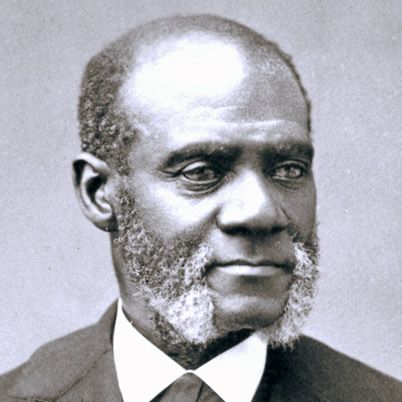
(1815-1882)
Synopsis
Henry Highland Garnet was an African American abolitionist born circa December 23, 1815, in Kent County, Maryland. Born as a slave, Garnet and his family escaped to New York when he was about 9 years old. In the 1840s, he became an abolitionist. His "Call to Rebellion" speech in 1843 encouraged slaves to free themselves by rising up against owners. Seen as a radical, he became a controversial figure within the abolitionist movement. In 1865, Garnet became the first Black speaker to preach a sermon in the House of Representatives. In 1881, he was appointed United States Minister and Counsel General (a position equivalent to ambassador today) in Liberia, and died there a few months later, on February 13, 1882.
Early Life and Slavery
Abolitionist, activist and minister Henry Highland Garnet was born a slave in 1815 in Kent County, Maryland. Garnet became a leading and sometimes controversial figure in the abolitionist movement of the 1800s. He was about 9 years old when he and his family escaped from their owner in 1824. They had permission to attend a funeral in another part of Maryland, but they eventually made their way to New York City instead.
Education
In New York City, Henry Highland Garnet attended the African Free School. There he studied science and English, among other subjects. Garnet also learned about navigation, and later spent some time working aboard ships. Returning after a voyage in 1829, he discovered that his family had been pursued by slave hunters. His parents got away, but his sister was captured. Angered by this attack on his family, Garnet is said to have bought a knife and walked the city streets looking to confront the slave hunter who stole his sister. His friends convinced him to stop seeking vengeance and to hide out on Long Island.
In the 1830s, Garnet continued his education at several institutions. He eventually attended the Oneida Institute in Whitesboro, New York. Finishing his studies in 1840, Garnet pursued a spiritual path. He became a Presbyterian minister and served as the first pastor of the Liberty Street Negro Presbyterian Church in Troy, New York, beginning in 1842.
'Call to Rebellion' Movement
A tireless activist in the fight to end slavery, Garnet worked with the likes of William Lloyd Garrison and Frederick Douglass. He became well-known for his skills as an orator. In 1843, Garnet gave one of his most famous speeches, usually referred to as the "Call to Rebellion," at the National Negro Convention. Rather than try to sway whites to end slavery, he encouraged the slaves to obtain their freedom themselves by rising up against their owners. This was a radical idea at the time, and both Douglass and Garrison opposed it. The convention refused to endorse Garnet's speech after taking a vote on the matter.
In 1850, Garnet traveled to England and Scotland where he spoke widely against the practice of slavery. He also supported allowing Black people to immigrate to other lands, such as Liberia in Africa, a country made up mostly of freed slaves. In 1852, Garnet traveled to Jamaica to serve as a missionary.
After returning to the United States, Garnet became a pastor at the Shiloh Church in New York City. He continued to work to end slavery, but his influence within the abolitionist movement had been somewhat diminished because his more radical views.
Final Years
During the Civil War, he found himself the target of public anger over the issue of slavery. A mob of people sought to attack Garnet during the 1863 draft riots in New York City. They crowded in his street, but they were unable to locate him and his family.
The following year, Garnet moved to Washington, D.C., to serve as pastor of the Fifteenth Street Presbyterian Church. On February 12, 1865, while in Washington, Garnet made history when he was chosen by President Abraham Lincoln to give a sermon before the House of Representatives—making him the first Black speaker to do so.
In 1881, President James A. Garfield appointed Garnet to serve as United States Minister and Counsel General (a position equivalent to ambassador today) in Liberia, fulfilling his lifelong dream to travel to Africa. Unfortunately, his time in Africa was short. Garnet died on February 13, 1882, only a few months after his arrival.
His words may be Garnet's lasting legacy. It is believed that Garnet's "Call to Rebellion" helped inspire others in the abolitionist movement to take action, including John Brown who led the 1859 attack on the arsenal in Harpers Ferry, Virginia (now West Virginia).
QUICK FACTS
- Birth Year: 1815
- Birth date: December 23, 1815
- Birth State: Maryland
- Birth City: Kent County
- Birth Country: United States
- Gender: Male
- Best Known For: Henry Highland Garnet was an African-American best known as an abolitionist whose "Call to Rebellion" speech in 1843 encouraged slaves to rebel against their owners.
- Industries
- World Politics
- Christianity
- Civil Rights
- U.S. Politics
- Astrological Sign: Capricorn
- Schools
- African Free School
- Oneida Institute
- Interesting Facts
- Henry Highland Garnet became the first black speaker to address Congress in 1865.
- Occupations
- Minister
- Death Year: 1882
- Death date: February 13, 1882
- Death Country: Liberia
Fact Check
We strive for accuracy and fairness.If you see something that doesn't look right,contact us!
CITATION INFORMATION
- Article Title: Henry Highland Garnet Biography
- Author: Biography.com Editors
- Website Name: The Biography.com website
- Url: https://www.biography.com/activists/henry-highland-garnet
- Access Date:
- Publisher: A&E; Television Networks
- Last Updated: September 17, 2020
- Original Published Date: April 2, 2014


