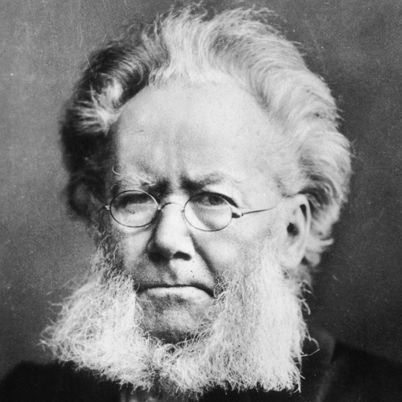
(1828-1906)
Who Was Henrik Ibsen?
Henrik Ibsen was born on March 20, 1828, in Skien, Norway. In 1862, he was exiled to Italy, where he wrote the tragedy Brand. In 1868, Ibsen moved to Germany, where he wrote one of his most famous works: the play A Doll's House. In 1890, he wrote Hedda Gabler, creating one of theater's most notorious characters. By 1891, Ibsen had returned to Norway a literary hero. He died on May 23, 1906, in Oslo, Norway.
Childhood
As a child, Ibsen showed little sign of the theatrical genius he would become. He grew up in the small Norwegian coastal town of Skien as the oldest of five children born to Knud and Marichen Ibsen. His father was a successful merchant and his mother painted, played the piano and loved to go to the theater. Ibsen himself expressed an interest in becoming an artist as well.
The family was thrown into poverty when Ibsen was 8 because of problems with his father's business. Nearly all traces of their previous affluence had to be sold off to cover debts, and the family moved to a rundown farm near town. There, Ibsen spent much of his time reading, painting and performing magic tricks.
At 15, Ibsen stopped school and went to work. He landed a position as an apprentice in an apothecary in Grimstad. Ibsen worked there for six years, using his limited free time to write poetry and paint. In 1849, he wrote his first play Catilina, a drama written in verse modeled after one of his great influences, William Shakespeare.
Early Works
Ibsen moved to Christiania (later known as Oslo) in 1850 to prepare for university examinations to study at the University of Christiania. Living in the capital, he made friends with other writers and artistic types. One of these friends, Ole Schulerud, paid for the publication of Ibsen's first play Catilina, which failed to get much notice.
The following year, Ibsen had a fateful encounter with violinist and theater manager Ole Bull. Bull liked Ibsen and offered him a job as a writer and manager for the Norwegian Theatre in Bergen. The position proved to be an intense tutorial in all things theatrical and even included traveling abroad to learn more about his craft. In 1857, Ibsen returned to Christiania to run another theater there. This proved to be a frustrating venture for him, with others claiming that he mismanaged the theater and calling for his ouster. Despite his difficulties, Ibsen found time to write Love's Comedy, a satirical look at marriage, in 1862.
Writing in Exile
Ibsen left Norway in 1862, eventually settling in Italy for a time. There he wrote Brand, a five-act tragedy about a clergyman whose feverish devotion to his faith costs him his family and ultimately his life in 1865. The play made him famous in Scandinavia. Two years later, Ibsen created one of his masterworks, Peer Gynt. A modern take on Greek epics of the past, the verse play follows the title character on a quest.
In 1868, Ibsen moved to Germany. During his time there, he saw his social drama The Pillars of Society first performed in Munich. The play helped launch his career and was soon followed up by one of his most famous works, A Doll's House. This 1879 play set tongues a-wagging throughout Europe for exploration of Nora's struggle with the traditional roles of wife and mother and her own need for self-exploration. Once again, Ibsen had questioned the accepted social practices of the times, surprising his audiences and stirring up debate. Around this time, he returned to Rome.
His next work, 1881's Ghosts, stirred up even more controversy by tackling such topics as incest and venereal disease. The outcry was so strong that the play wasn't performed widely until two years later. His next work, An Enemy of the People, showed one man in conflict with his community. Some critics say it was Ibsen's response to the backlash he received for Ghosts. Ibsen wrote The Lady From the Sea (1888) and then soon headed back to Norway, where he would spend the remainder of his years. One of his most famous works was to follow, in Hedda Gabler. With Hedda Gabler (1890), Ibsen created one of the theater's most notorious characters. Hedda, a general's daughter, is a newlywed who has come to loathe her scholarly husband, yet she destroys a former love who stands in her husband's way academically. The character has sometimes been called the female Hamlet, after Shakespeare's famous tragic figure.
Back to Norway
In 1891, Ibsen returned to Norway as a literary hero. He may have left as a frustrated artist, but he came back as internationally known playwright. For much of his life, Ibsen had lived an almost reclusive existence. But he seemed to thrive in the spotlight in his later years, becoming a tourist attraction of sorts in Christiania. He also enjoyed the events held in his honor in 1898 to mark his seventieth birthday.
His later works seem to have a more self-reflective quality with mature lead characters looking back and living with the consequences of their earlier life choices. And each drama seems to end on a dark note. The first play written after his return to Norway was The Master Builder. The title character encounters a woman from his past who encourages him to make good on a promise. In When We Dead Awaken, written in 1899, an old sculptor runs into one of his former models and tries to recapture his lost creative spark. It proved to be his final play.
Final Years
In 1900, Ibsen had a series of strokes that left him unable to write. He managed to live for several more years, but he was not fully present during much of this time. Ibsen died on May 23, 1906. His last words were "To the contrary!" in Norwegian. Considered a literary titan at the time of his passing, he received a state funeral from the Norwegian government.
While Ibsen may be gone, his work continues to be performed around the world. Peer Gynt, A Doll's House and Hedda Gabler are the most widely produced plays today. Actresses, such as Gillian Anderson and Cate Blanchett, have taken on Ibsen's Nora and Hedda Gabler characters, which are considered to be two of the most demanding theatrical roles ever. In addition to his plays, Ibsen also wrote around 300 poems.
Ibsen's works have held up over the years because he tapped into universal themes and explored the human condition in a way unlike any of those before him. Author James Joyce once wrote that Ibsen "has provoked more discussion and criticism that of any other living man." To this day, his plays continue to challenge audiences.
Personal Life
Unlike many other writers and poets, Ibsen had a long and seemingly happy marriage to Suzannah Daae Thoresen. The couple wed in 1858 and welcomed their only child, son Sigurd, the following year. Ibsen also had a son from an earlier relationship. He had fathered a child with a maid in 1846 while working as an apprentice. While he provided some financial support, Ibsen never met the boy.
QUICK FACTS
- Name: Henrik Ibsen
- Birth Year: 1828
- Birth date: March 20, 1828
- Birth City: Skien
- Birth Country: Norway
- Gender: Male
- Best Known For: Exiled Norwegian playwright Henrik Ibsen wrote 'A Doll's House' and 'Hedda Gabler', the latter of which featured one of theater's most notorious characters.
- Industries
- Writing and Publishing
- Theater and Dance
- Fiction and Poetry
- Astrological Sign: Pisces
- Nacionalities
- Norwegian
- Death Year: 1906
- Death date: May 23, 1906
- Death City: Kristiania [now Oslo)
- Death Country: Norway
Fact Check
We strive for accuracy and fairness.If you see something that doesn't look right,contact us!
CITATION INFORMATION
- Article Title: Henrik Ibsen Biography
- Author: Biography.com Editors
- Website Name: The Biography.com website
- Url: https://www.biography.com/authors-writers/henrik-ibsen
- Access Date:
- Publisher: A&E; Television Networks
- Last Updated: November 6, 2019
- Original Published Date: April 2, 2014


