(1869-1954)
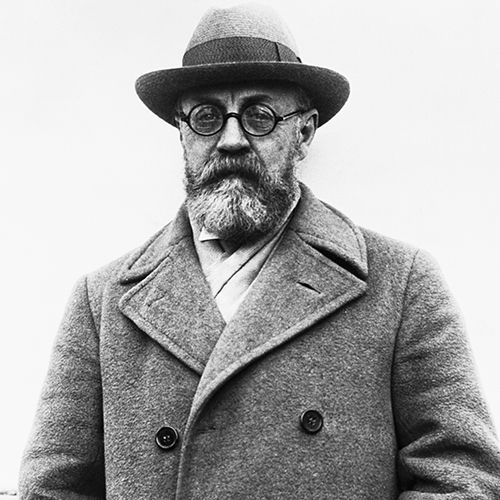
Who Was Henri Matisse?
Over a six-decade career, artist Henri Matisse worked in all media, from painting to sculpture to printmaking. Although his subjects were traditional—nudes, figures in landscapes, portraits, interior views—his revolutionary use of brilliant color and exaggerated form to express emotion made him one of the most influential artists of the 20th century.
Early Life and Training
Henri Matisse was born on December 31, 1869, and was raised in the small industrial town of Bohain-en-Vermandois in northern France. His family worked in the grain business. As a young man, Matisse worked as a legal clerk and then studied for a law degree in Paris from 1887 to 1889. Returning to a position in a law office in the town of Saint-Quentin, he began taking a drawing class in the mornings before he went to work. When he was 21, Matisse began painting while recuperating from an illness, and his vocation as an artist was confirmed.
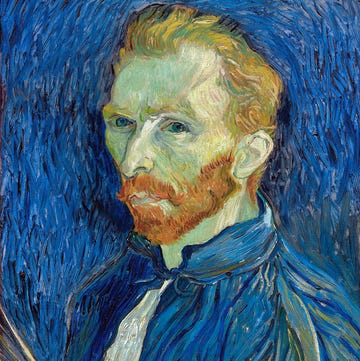
In 1891, Matisse moved to Paris for artistic training. He took instruction from famous, older artists at well-known schools such as the Académie Julian and the École des Beaux-Arts. These schools taught according to the “academic method,” which required working from live models and copying the works of Old Masters, but Matisse was also exposed to the recent Post-Impressionist work of Paul Cézanne and Vincent van Gogh while living in Paris.
Matisse began to show his work in large group exhibitions in Paris in the mid-1890s, including the traditional Salon de la Société Nationale des Beaux-Arts, and his work received some favorable attention. He traveled to London and Corsica, and in 1898, he married Amélie Parayre, with whom he would have three children.
Breakthrough Period
By the turn of the 20th century, Matisse had come under the more progressive influence of Georges Seurat and Paul Signac, who painted in a “Pointillist” style with small dots of color rather than full brushstrokes. He stopped exhibiting at the official Salon and began submitting his art to the more progressive Salon des Indépendants in 1901. In 1904, he had his first one-man exhibition at the gallery of dealer Ambroise Vollard.
Matisse had a major creative breakthrough in 1904 and 1905. A visit to Saint-Tropez in southern France inspired him to paint bright, light-dappled canvases such as Luxe, calme et volupté (1904-05), and a summer in the Mediterranean village of Collioure produced his major works Open Window and Woman with a Hat in 1905. He exhibited both paintings in the 1905 Salon d’Automne exhibition in Paris. In a review of the show, a contemporary art critic mentioned the bold, distorted images painted by certain artists he nicknamed “fauves,” or “wild beasts.”
Painting in the style that came to be known as Fauvism, Matisse continued to emphasize the emotional power of sinuous lines, strong brushwork and acid-bright colors in works such as The Joy of Life, a large composition of female nudes in a landscape. Like much of Matisse’s mature work, this scene captured a mood rather than merely trying to depict the world realistically.
In the first decade of the century, Matisse also made sculptures and drawings that were sometimes related to his paintings, always repeating and simplifying his forms to their essence.
Success and Fame
After finding his own style, Matisse enjoyed a greater degree of success. He was able to travel to Italy, Germany, Spain and North Africa for inspiration. He bought a large studio in a suburb of Paris and signed a contract with the prestigious art dealers of Galerie Bernheim-Jeune in Paris. His art was purchased by prominent collectors such as Gertrude Stein in Paris and the Russian businessman Sergei I. Shchukin, who commissioned Matisse’s important pair of paintings Dance I and Music.
In his works of the 1910s and 1920s, Matisse continued to delight and surprise his viewers with his signature elements of saturated colors, flattened pictorial space, limited detail and strong outlines. Some works, like Piano Lesson (1916), explored the structures and geometry of Cubism, the movement pioneered by Matisse’s lifelong rival Pablo Picasso. Yet despite his radical approach to color and form, Matisse’s subjects were often traditional: scenes of his own studio (including The Red Studio of 1911), portraits of friends and family, arrangements of figures in rooms or landscapes.
In 1917, Matisse began spending winters on the Mediterranean, and in 1921, he moved to the city of Nice on the French Riviera. From 1918 to 1930, he most frequently painted female nudes in carefully staged settings within his studio, making use of warm lighting and patterned backgrounds. He also worked extensively in printmaking during these years.
The first scholarly book about Matisse was published in 1920, marking his importance in the history of modern art as it was still taking place.
Later Years and Death
In his later career, Matisse received several major commissions, such as a mural for the art gallery of collector Dr. Albert Barnes of Pennsylvania, titled Dance II, in 1931-33. He also drew book illustrations for a series of limited-edition poetry collections.
After surgery in 1941, Matisse was often bedridden; however, he continued to work from a bed in his studio. When necessary, he would draw with a pencil or charcoal attached to the end of a long pole that enabled him to reach the paper or canvas. His late work was just as experimental and vibrant as his earlier artistic breakthroughs had been. It included his 1947 book Jazz, which placed his own thoughts on life and art side by side with lively images of colored paper cutouts. This project led him to devise works that were cutouts on their own, most notably several series of expressively shaped human figures cut from bright blue paper and pasted to wall-size background sheets (such as Swimming Pool, 1952).
In one of his final projects, Matisse created an entire program of decorations for the Chapel of the Rosary in Vence (1948-51), a town near Nice, designing stained-glass windows, murals, furnishings and even sacred vestments for the church’s priests.
Matisse died on November 3, 1954, at the age of 84, in Nice. He was buried in nearby Cimiez. He is still regarded as one of the most innovative and influential artists of the 20th century.
QUICK FACTS
- Name: Henri Matisse
- Birth Year: 1869
- Birth date: December 31, 1869
- Birth City: Le Cateau, Picardy
- Birth Country: France
- Gender: Male
- Best Known For: Henri Matisse was a revolutionary and influential artist of the early 20th century, best known for the expressive color and form of his Fauvist style.
- Industries
- Art
- Astrological Sign: Capricorn
- Schools
- École des Beaux-Arts, Paris
- Académie Julian, Paris
- École des Arts Décoratifs, Paris
- Nacionalities
- French
- Death Year: 1954
- Death date: November 3, 1954
- Death City: Nice
- Death Country: France
Fact Check
We strive for accuracy and fairness.If you see something that doesn't look right,contact us!
CITATION INFORMATION
- Article Title: Henri Matisse Biography
- Author: Biography.com Editors
- Website Name: The Biography.com website
- Url: https://www.biography.com/artists/henri-matisse
- Access Date:
- Publisher: A&E; Television Networks
- Last Updated: March 26, 2021
- Original Published Date: April 2, 2014
QUOTES
- My choice of colors does not rest on any scientific theory; it is based on observation, on sensitivity, on felt experience.
- What I dream of is an art of balance, of purity and serenity, devoid of troubling or disturbing subject matter...a soothing, calming influence on the mind, something like a good armchair which provides relaxation from physical fatigue.
- The simplest means are those which best enable an artist to express himself.